











A Self-Excluded Player Hit a Jackpot, Then Lost Every Penny


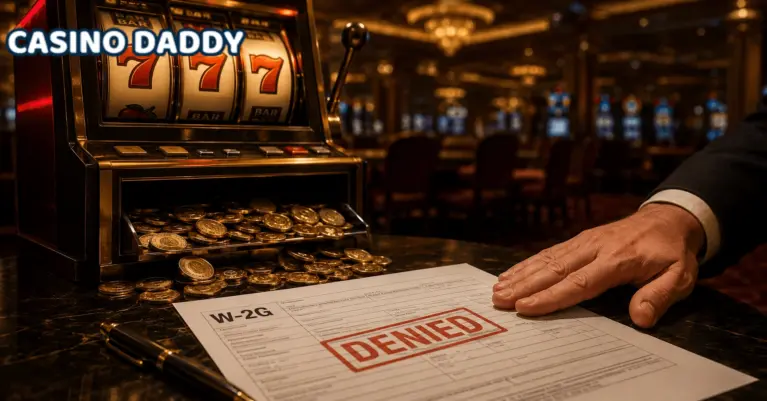
Hitting a jackpot is supposed to be a good day. For one woman at Hollywood Casino at Penn National Race Course in Pennsylvania, it turned into something else entirely. A self-excluded player who crossed state lines from New Jersey to gamble managed to get through the doors, land a slot win, and then lose every dollar of it the moment she sat down to fill out her tax paperwork.
How a Self-Excluded Player Managed to Win a Jackpot
Pennsylvania’s self-exclusion program is a voluntary system that lets problem gamblers formally ban themselves from the state’s casinos. Once enrolled, a person cannot gamble at any licensed venue in the state. This woman remained on the list when she walked into Hollywood Casino at Penn National Race Course.
Nobody caught her at the door. She played, she won, and the W-2G tax form requirement unravelled everything. In Pennsylvania, any slot win of $2,000 or more requires a W-2G form. Filling one out means providing identification, and that ID check revealed her self-exclusion status to casino staff.
Casino staff confiscated the jackpot on the spot. Under Pennsylvania Gaming Control Board (PGCB) rules, the PGCB automatically forfeits winnings that a self-excluded player collects. The money does not go back to the casino. Instead, it goes toward the state’s Compulsive and Problem Gambling programs, which fund treatment and support services.
What Went Wrong at the Door
The more uncomfortable question is how she got in at all. The source does not confirm whether the woman entered on a fake ID or simply walked through without being checked. Both scenarios point to a breakdown in the casino’s admissions process.
Security teams at large venues face real operational pressure. Checking every ID at the door is a substantial demand, and some staff rely on visual assessments rather than hard checks. If staff waved her through without her ID being scanned or verified, Hollywood Casino has a compliance gap it will need to address.
The PGCB is expected to review the incident at its next meeting. Enforcement action against the casino remains unconfirmed. Regardless of the outcome, the venue will likely face pressure to tighten its entry procedures considerably.
Self-Exclusion Programs and Their Limits
Pennsylvania’s self-exclusion program has run since 2006. In the two decades since its launch, the program recorded 4,684 violations. Most involve the excluded individuals themselves, not the casinos.
That pattern points to a structural problem. State-level self-exclusion only works if the excluded player stays in that state. This woman lived in New Jersey and traveled specifically to Pennsylvania to gamble, knowing she could not do so at home. Nothing stopped her from making that journey, and nothing flagged her at the state border.
It is a gap that regulators and advocates have raised for years. A national self-exclusion program would close that loophole by sharing exclusion lists across state lines. Without one, a determined self-excluded player can simply drive to the next state and keep playing.
A Win That Was Never Really a Win
The outcome here is a reminder that self-exclusion is not foolproof. The program relies on cooperation from both venues and the individuals enrolled in it. When either side fails, wins like this one get confiscated and the player walks away with nothing.
The forfeited money will go toward problem gambling support services, which is exactly the kind of resource the woman may benefit from. The PGCB’s next steps regarding the casino remain to be seen, but the case has already made a strong argument for tighter admissions controls. For many observers, it also reopens the wider conversation about what self-exclusion should look like at the national level.

The Author
The Author
Slots and News Reviewer