










Industry News
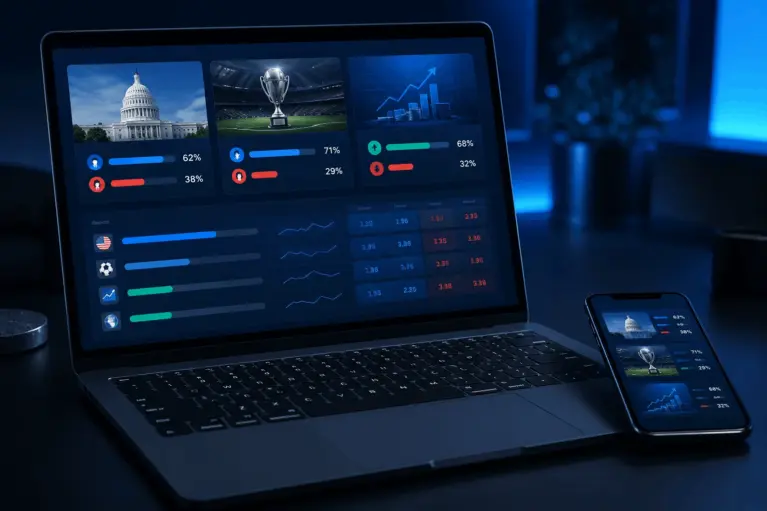
Somewhere between a stock exchange and a sportsbook, there’s a market where people put real money on who wins the next election, whether the Fed cuts rates, or if a tech company hits a trillion-dollar valuation. No bookmaker sets the odds. No analyst picks the number. The crowd does and the crowd, it turns out, is often frighteningly accurate.
Prediction markets have existed in various forms for decades, but 2024 and 2025 changed everything. A landmark court ruling, explosive trading volumes, and mainstream platforms pulling in billions of dollars per month pushed them from a niche forecasting tool into a genuine financial phenomenon. If you’ve been hearing the names “Polymarket” or “Kalshi” and wondering what on earth is going on, you’re in exactly the right place.
CasinoDaddy’s guide covers everything: what prediction markets are, how they work under the hood, where to use them, how to build an edge, and the messy legal landscape still being fought out in courtrooms across the United States. No prior experience needed. Bring curiosity and a healthy scepticism of your own gut instincts.
 Reviewed byNadia Winchester
Every market on a prediction platform is built around a specific, resolvable question. Good questions have clear, verifiable answers. “Will the Federal Reserve cut interest rates at its September 2025 meeting?” is a clean market. “Will the economy improve?” is not — too vague to ever definitively resolve, and the platform organisers would spend more time arguing about it than trading.
When a market opens, it offers contracts for each possible outcome. Most markets are binary: YES or NO. Some offer multiple outcomes, such as which candidate wins an election, with each outcome priced independently.
Each contract is priced between $0.01 and $0.99, representing a 1% to 99% probability. At resolution, the correct outcome’s contracts pay $1 each, and the wrong outcomes pay $0.
If you bought YES contracts at $0.40 and the event resolves YES, you’ve made $0.60 per contract. If it resolves NO, you’ve lost your $0.40. Simple arithmetic, genuinely difficult execution.
This is where prediction markets get genuinely interesting. Prices aren’t set by an algorithm or an expert panel. They emerge from trading activity.
When more people believe YES is likely and buy YES contracts, the price rises. When doubt creeps in and traders sell, it falls. Every trade is a vote weighted by money, and the aggregate result is a real-time probability estimate that incorporates everything the market collectively knows.
This is called the wisdom of crowds effect, and it works surprisingly well. Academic research consistently finds that prediction markets outperform expert forecasts and opinion polls, particularly for political and economic events. The 2024 US presidential election is the most high-profile recent example: prediction markets had Trump as the heavy favourite well before most major media outlets reflected that. They were right.
The mechanism keeping prices honest is arbitrage. If a contract is mispriced relative to what a well-informed trader believes, that trader profits by correcting it. This constant pressure keeps markets sharp, at least when there’s enough liquidity for it to function properly.
There are two ways to profit in a prediction market:
You can also short an outcome on platforms that support it, effectively selling YES contracts you don’t own and betting the price will fall. Think of it as telling the market it’s being too optimistic, and backing that opinion with cash.
The downside is equally clear: if you’re wrong, you lose your stake. Unlike sports betting, though, you can often cut losses by selling before resolution rather than watching a bad position go all the way to $0.
The range of prediction markets has expanded dramatically. Here’s a breakdown of the main categories:
The breadth is part of what makes prediction markets compelling. Any event with a clear, verifiable outcome can, in theory, become a market. Which means almost anything can become a market.
People often try to squeeze prediction markets into a category they already understand. “It’s basically gambling” and “it’s basically investing” both miss the mark. The table below shows where they actually sit.
| Feature | Sports Betting | Prediction Markets | Financial Trading |
|---|---|---|---|
| What you’re trading | Fixed-odds bet vs. a bookmaker | Event probability contract vs. other traders | Shares, assets, derivatives |
| Who sets the price | Bookmaker (with built-in margin) | The market (all traders collectively) | The market |
| House edge | Yes, always baked into odds | No, platform takes a small fee per trade | No, broker charges commission |
| Can you exit early? | Rarely (some cash-out features) | Yes, sell contracts before resolution | Yes |
| Settlement | On event result | On event result ($1 or $0) | Whenever you sell, or via dividends |
| Skill vs luck | Mixed, heavy luck component | Mixed, more skill on information-heavy events | Mixed, varies by strategy |
| Regulation | Gambling authorities | CFTC (US) or gambling regulators (varies by country) | Financial regulators (SEC, FCA, etc.) |
The core distinction is that prediction markets are peer-to-peer. You’re competing against other traders, not fighting against a house with an edge baked in. If you’re better informed than the average participant in a specific market, you have a genuine edge. That’s closer to investing than gambling, but the binary settlement and event-based structure keeps prediction markets in their own lane.
Industry News

Industry News
Industry News
Two platforms dominate, controlling around 97.5% of global trading volume between them. A few others are worth knowing.
Kalshi is a federally regulated derivatives exchange based in the US, licensed by the Commodity Futures Trading Commission (CFTC) since 2020. It offers event contracts on politics, economics, sports, crypto, weather, and more, and it accepts deposits in US dollars.
What makes Kalshi historically significant is the fight it picked in 2023. The CFTC tried to block it from offering election-based contracts, classifying them as illegal gaming. Kalshi sued. A federal court sided with Kalshi in September 2024, ruling that election contracts didn’t constitute gambling under the Commodity Exchange Act. The CFTC dropped its appeal in May 2025. That ruling cracked the door open for the entire US prediction market industry.
The numbers that followed were staggering. Monthly trading volume grew from $1.2 billion in early 2025 to $20 billion by January 2026. Kalshi remains the most regulated and most institutionally credible platform available to US users.
Best for: US users who want a fully regulated, dollar-denominated platform with broad event coverage.
Polymarket is a decentralised prediction market built on blockchain infrastructure. Users trade using USDC (a dollar-pegged stablecoin), and settlement is handled by a decentralised oracle system, meaning Polymarket never holds or controls user funds directly. For anyone who’s ever worried about a platform disappearing with their money, that architectural choice matters.
Originally inaccessible to US users after a CFTC cease-and-desist in 2022, Polymarket relaunched in the US in late 2025 after acquiring a CFTC-registered exchange. Its international platform remains far larger. In April 2026, Polymarket US saw $1.3 billion in trading volume compared with $9 billion on Polymarket International.
The platform is known for its clean interface, fast onboarding, and massive political and sports markets. It abstracts blockchain complexity through wallet-less signup via fiat on-ramps and social login, which eliminates the friction that killed earlier crypto-based prediction projects.
Best for: Crypto-comfortable users who want the largest and most liquid global prediction markets.
Manifold operates on an entirely different model. There’s no real money involved. Users trade using a play-money currency called Mana, and anyone can create a market on virtually any question, from US elections to “will my cat learn to open the door handle?”
That sounds like it wouldn’t produce useful probabilities. Surprisingly, it often does. During the 2024 US Presidential election, Manifold’s market showed Trump at 58% probability, close to Kalshi’s 59% and Polymarket’s 62.5%. Real financial incentives sharpen forecasting, but their absence doesn’t destroy accuracy entirely.
Manifold briefly experimented with real-money betting through a feature called Sweepcash, launched in September 2024, but that was shut down on March 28, 2025. The platform returned to its play-money roots.
Think of Manifold as a forecasting sandbox. No risk of losing real money, no KYC required, and no restrictions on market creation. For anyone who wants to understand how prediction markets work before putting real cash in, it’s an excellent starting point.
Best for: Beginners learning the mechanics, researchers, and forecasting enthusiasts who want breadth without financial risk.
The rest of the market is small. Smaller platforms collectively accounted for just $12.5 billion in total trading volume in 2025, compared to hundreds of billions for Kalshi and Polymarket combined. Some names worth knowing:
Getting started is genuinely straightforward. Here's the process from zero to first trade.
For real-money trading, Kalshi (US, regulated, dollar-denominated) and Polymarket (global, crypto-based) are the two realistic options for most users. If you’d rather learn the mechanics risk-free first, start with Manifold. No shame in that at all.
Both Kalshi and Polymarket require identity verification (KYC) for real-money accounts. Have your ID ready. The process takes a few minutes. Manifold requires no KYC whatsoever.
Kalshi accepts bank transfers and card deposits in USD. Polymarket requires USDC, either from a crypto wallet or via their Stripe or MoonPay fiat on-ramp. Start small. This is still the learning phase.
Don’t pick at random. Find an area where you have genuine information or expertise: sports, economics, technology, whatever you follow closely. The more you know relative to the average trader in that market, the better positioned you are.
Every market has specific terms for how it resolves. “Will the Fed cut rates in September?” might resolve solely based on the official FOMC announcement. Make sure you know exactly what constitutes a YES outcome before buying anything. Misreading resolution criteria is one of the most common and most avoidable beginner mistakes.
If the market shows a 40% probability and you believe the true probability is 60%, you have a positive expected value trade. Buy YES. If you think the true probability is 20%, buy NO. The gap between the market price and your estimate is your edge. If you have no view, you have no edge.
Every contract can go to zero. Spread across multiple markets, size according to your actual conviction, and never risk more than you can afford to lose completely.
If a contract has moved significantly in your favour before resolution, selling to lock in profit is a legitimate strategy. Active position management is what separates prediction market traders from passive bettors.
Trading prediction markets well is a skill. It can be built, and the core of it is thinking clearly and honestly about probability.
The single biggest improvement most new traders can make is shifting from “I think X will happen” to “I think X has a 70% chance of happening.” These sound similar but require completely different mental machinery. Probability thinking forces you to account for uncertainty rather than defaulting to confident declarations.
A useful exercise: after taking a position, ask yourself what would have to be true for you to be wrong. If you can’t answer that question clearly, you’re not actually thinking probabilistically. You’ve convinced yourself of a conclusion and are now looking for reasons to feel good about it.
Calibration means your stated probabilities match reality over time. A well-calibrated trader who calls something a 70% probability is right about 70% of the time across many such calls.
Most people are badly miscalibrated. They’re overconfident on uncertain events and sometimes underconfident on near-certainties. The good news is calibration improves with practice and feedback. Platforms like Metaculus and Manifold publish calibration data so you can see exactly how your forecasts have performed over time. Few things are more humbling, or more useful.
The traders who consistently profit aren’t necessarily smarter than average. They’re better informed in specific domains. A doctor has an edge in healthcare markets. A financial analyst has an edge in economic data releases. A political scientist has an edge in electoral markets.
Focus on areas where you genuinely know more than the typical trader. In markets where you have no information edge, you’re not trading with skill. You’re gambling with extra steps.
Prediction markets are vulnerable to the same cognitive biases as every other form of human judgment. The most common ones:
The best traders treat their predictions like scientists treat hypotheses: held provisionally, updated when new evidence arrives, and abandoned without ego when proven wrong. The ego part is harder than it sounds.
Not every market is worth holding to resolution. If a contract has moved from 30% to 70% in your favour with a month still to go, the risk-reward of holding for the remaining $0.30 upside may not justify the risk of a reversal. Selling at a profit before resolution is a legitimate and often smart strategy. Active management separates serious traders from people who buy and hope.
The honest answer is: it depends entirely on where you are and which platform you’re using. The legal status of prediction markets is one of the most actively contested regulatory questions in finance right now, and the landscape is moving fast.
The US has the most developed and most contested prediction market legal framework. The story begins with Kalshi.
After obtaining Designated Contract Market status, Kalshi started offering political event contracts, such as whether the Democrats would control the House after the 2024 election. The Democrat-controlled CFTC used its authority to prevent these, classifying them as gaming contrary to public interest. Kalshi challenged the restriction. In a surprising result, the federal district court in Washington DC sided with Kalshi, holding that political event contracts were allowed under the Commodity Exchange Act because the underlying event involved politics, not gaming.
The CFTC initially appealed the ruling but dropped the appeal in May 2025 after the change in administration. The current CFTC has taken a strongly pro-prediction-markets position, asserting exclusive federal jurisdiction over CFTC-registered platforms.
The states disagree, loudly. Nevada, New Jersey, and Maryland sent cease-and-desist letters to Kalshi, claiming it was violating state gaming laws. Kalshi sued back. The most significant judicial development as of early 2026 is the Third Circuit’s April 6, 2026 decision affirming a preliminary injunction barring New Jersey from enforcing its gambling laws against Kalshi’s sports-related contracts. Maryland went the other way in August 2025, denying Kalshi’s injunction request. Massachusetts issued a preliminary injunction against Kalshi in January 2026. On April 2, 2026, the CFTC itself sued Arizona, Connecticut, and Illinois, arguing that the Commodity Exchange Act preempts their gambling laws as applied to event contracts.
For US users: federally regulated platforms like Kalshi and Polymarket US operate legally at the federal level. Whether they’re legal in your specific state is actively being litigated and may vary.
The EU has no unified prediction market framework, which means each country applies its own gambling or financial rules. As of early 2026, France, Belgium, Poland, Portugal, Hungary, Romania, and Ukraine had banned or restricted Polymarket, while Germany, Spain, Denmark, and Greece remained accessible.
The EU’s approach stands in sharp contrast to the US direction. The European Commission has shown no interest in creating a tailored regime for prediction markets, which means European users face a patchwork of national frameworks with no clear resolution in sight.
The UK classifies prediction markets on politics, sports, and entertainment as gambling, regulated by the Gambling Commission.
Outside the US and EU, no jurisdiction has created a dedicated prediction market regime. Singapore banned Polymarket in 2025. Australia prohibits access. Taiwan investigated users for political betting. Polymarket operates without restriction in approximately 180 countries, but that number is shrinking as regulators catch up.
Check your local laws before depositing real money. The regulatory picture changes regularly, and what’s accessible today may not be tomorrow.
Prediction markets are exciting to trade, and that excitement can cloud judgment faster than you’d expect. Here are the real risks, stated plainly.
If you need support, the National Problem Gambling Helpline (1-800-522-4700) in the US and GamCare (0808 8020 133) in the UK are available. Treat any sign of problem behaviour with the same seriousness you’d bring to any other gambling concern.
Prediction markets are not a passing trend. The infrastructure is maturing, the volumes are real, and institutional money is paying attention.
The clearest signal of where this is going is who’s entering the space. CME Group and FanDuel announced a partnership to develop an event contracts platform, two of the most established names in financial derivatives and sports betting, joining forces on a prediction market product. That’s not a speculative startup play. That’s institutional validation.
Interactive Brokers now offers access to CFTC-regulated event contracts through its standard brokerage interface. The wall between prediction markets and mainstream finance is getting thinner every quarter.
The US federal-vs-state battle will resolve eventually, most likely through Supreme Court precedent or Congressional legislation. Proposed legislation like the Public Integrity in Financial Prediction Markets Act has been introduced, but nothing has passed as of mid-2026. The direction at the federal level is clearly permissive. Whether that survives state-level resistance is the open question.
In Europe, the picture is harder to read. With no indication the European Commission intends to create a tailored framework, European users will likely continue navigating a patchwork of national rules for the foreseeable future.
Prediction markets are becoming increasingly attractive to algorithmic traders and AI-powered forecasting systems. When a market can be updated in real time based on news feeds, polling data, or economic releases, there’s a natural fit with automated systems that process information faster than humans. This will likely increase overall market accuracy over time, and make obvious mispricings harder to find.
Perhaps the most interesting long-term shift is how prediction market prices are being used as data, not just as trading vehicles. Newsrooms, hedge funds, policy analysts, and research institutions now cite Polymarket and Kalshi probabilities the way they once cited polling averages. When a major political event breaks, journalists check the prediction market price first.
That shift, from niche forecasting tool to genuine information infrastructure, suggests prediction markets are here to stay regardless of how the regulatory battles resolve. The market for knowing what’s likely to happen next is, as it turns out, enormous.
Prediction markets sit in a genuinely fascinating place: part exchange, part forecasting competition, part intellectual sport. They reward people who think carefully about uncertainty, update their views honestly, and resist the emotional traps that catch most traders out. The mechanics are approachable, the range of markets is enormous, and getting started has never been easier.
The legal situation is messy and evolving, particularly in the US and Europe. But the core activity — putting money behind a well-reasoned probability estimate and trading against the collective wisdom of the crowd — is going nowhere. If anything, it’s just getting warmed up.
Prediction markets are exciting, but they’re not the only game in town. If you fancy something with a bit less data analysis involved, online casinos offer a different kind of fun with a much gentler learning curve.
Not at all. Kalshi is fully dollar-based and works like any standard regulated platform. Polymarket’s US version also supports fiat deposits via Stripe and MoonPay. Crypto knowledge only becomes relevant if you want to use Polymarket’s larger international platform directly.
Yes. If you hold a YES contract and the event resolves NO, the contract settles at $0 and you lose your stake. There is no residual value and no partial payout. This is why position sizing and exit management matter far more than in most other markets.
On large, liquid markets, manipulation is genuinely difficult. Moving the price requires enormous capital, and any artificial move quickly attracts arbitrage traders who correct it. On small, niche markets with low trading volume, the risk is higher. Stick to high-liquidity markets, especially while learning.
On Kalshi (CFTC-regulated), user funds are held separately from company funds, which provides structural protection. On Polymarket, the blockchain architecture means your USDC is controlled by your own wallet, not the platform directly. On unregulated platforms, protections are weaker and less defined. Regulation exists for a reason.
In the US, winnings from CFTC-regulated prediction markets are treated as section 1256 contract gains, with a favourable 60/40 split between long-term and short-term capital gains rates. Outside the US, tax treatment varies by jurisdiction. Keep records of all trades and consult a tax professional in your country. This is genuinely not the place to wing it.
A small number of traders do. The top performers on platforms like Polymarket demonstrate consistent returns across thousands of trades, but they operate with systematic, disciplined strategies and significant starting capital. For most people, prediction markets are best approached as a high-skill activity that can be profitable with the right edge and the right discipline, not as a primary income replacement.
The Author
The Author
Slots and News Reviewer