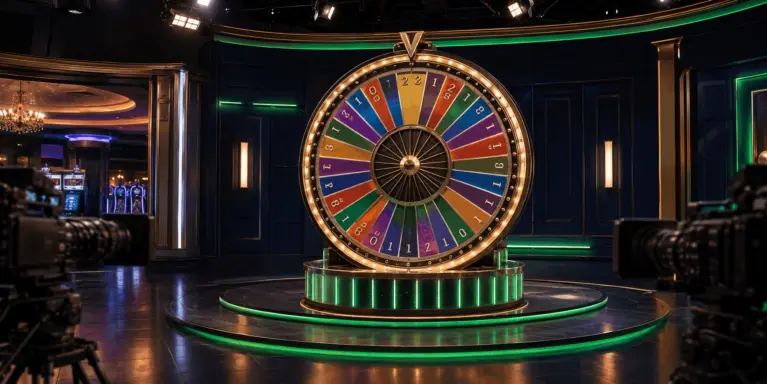
Live casino game shows changed the rules on what a live dealer game could be. Instead of a quiet table with a slow shuffle, you get a giant spinning wheel and a host in full costume. Multipliers can turn a modest bet into a genuine windfall in seconds. These games aren’t roulette or blackjack dressed up for TV. They’re built from the ground up as standalone entertainment formats, and that changes how you should approach betting on them.
This page breaks down what separates a game show from a table game, how the multiplier engine works behind the curtain, and what each major title actually brings to the screen. You’ll meet Crazy Time’s four bonus rounds, Monopoly Live’s board game energy, and four more shows that each play by their own rules. Every game gets a full breakdown on its own dedicated page, linked further down.
Because these games run on RNG multipliers layered over live mechanics, volatility here looks nothing like a blackjack table. We’ll cover what that means for your bankroll later on, so you walk in with real expectations instead of guesswork.
 Reviewed byNadia Winchester

New Casino
 Rated 84 of 100%
welcome bonus
100% up to €100

New Casino
Rated 82 of 100%
welcome bonus
550% up to €3540 + 400 FS


Exclusive Bonus
Rated 88 of 100%
welcome bonus
400% up to €4,000 + 400 FS

New Casino
Rated 83 of 100%
welcome bonus
250% up to €4,000 + 250 FS

New Casino
Rated 81 of 100%
welcome bonus
100% up to €5,000 + 175 FS


Crypto Casino
Rated 85 of 100%
welcome bonus
500% up to $10,000

Crypto Casino
Rated 89 of 100%
welcome bonus
100% up to €100,000

Crypto Casino
Rated 90 of 100%
welcome bonus
200% up to €100 + 150 FS

Crypto Casino
Rated 55 of 100%
welcome bonus
150% up to €1,300 + 100 FS

Crypto Casino
Rated 87 of 100%
welcome bonus
100% up to $1,500 + 150 FS

Crypto Casino
Rated 94 of 100%
welcome bonus
150% up to €4,000 + 400 FS

Rated 91 of 100%
welcome bonus
305% up to €1,200

Rated 89 of 100%
welcome bonus
305% up to €1,200

Crypto Casino
Rated 91 of 100%
welcome bonus
100% Deposit Bonus

Rated 91 of 100%
welcome bonus
200% Bonus up to €350

Rated 90 of 100%
welcome bonus
NO KYC REQUIRED

Rated 74 of 100%
welcome bonus
100% up to €500


Hot Casino
Rated 95 of 100%
welcome bonus
243% up to €5,555 + 243 FS
A blackjack table follows fixed rules. Cards get dealt, you hit or stand, the house pays out on a known math model. Game shows scrap that structure entirely. There’s no card count to track and no wheel segment tied to a fixed payout table like European Roulette. Instead, you’re betting on outcomes that funnel into a second layer: a multiplier system that can turn a 2x segment into a 200x win depending on what happens in the bonus round.
Take Crazy Time as the clearest example. The base wheel has 54 segments split between number bets (1, 2, 5, and 10) and four bonus games: Cash Hunt, Pachinko, Coin Flip, and the Crazy Time bonus itself. Land on a number and you get paid that number’s odds, plain and simple. Land on a bonus segment, though, and the game pulls you into a separate mini-game with its own multiplier engine, and that’s where the real volatility lives.
This bonus-round layer is the defining trait across every major game show. Monopoly Live has its 3D bonus board. Funky Time runs four Bonus Boards behind its main wheel. Deal or No Deal Live borrows an entire briefcase-opening format from the TV show it’s named after. None of these mechanics exist in classic table games, because table games were never designed to hand out five-figure multipliers on a single spin.
The human element shifts too. A blackjack dealer manages cards and enforces house rules with minimal personality on screen. A game show host runs a full broadcast: energy, commentary, crowd-style excitement building as the wheel slows down. Evolution built entire studio sets for these shows, complete with lighting rigs and camera work that owes more to television production than to a casino floor.
That difference matters for how you should treat these games. A table game rewards patience and bankroll discipline built around a known house edge. A game show rewards patience of a different kind: waiting for the bonus segments to land, since that’s where the outsized multipliers sit. Betting purely on the base numbers in Crazy Time, for instance, keeps your variance low but also caps your realistic upside well below what drew you to the game in the first place.
Every live game show runs on two systems working at once. The physical side is real: an actual wheel, spun by an actual host, filmed on an actual set. The digital side sits behind it, an RNG (random number generator) that assigns multiplier values to segments before each spin even starts. Neither system fakes the other. The wheel result is genuine, and the multiplier attached to it is generated independently and verified through the same auditing bodies that certify slot RNGs.
Here’s where it gets interesting. In games like Crazy Time, certain top slot segments carry a “Top Slot” feature. Before the main wheel spins, a smaller wheel above it lands on a multiplier value, then that value gets applied to one or two segments on the main wheel for that round only. Land on one of those boosted segments, and your payout multiplies accordingly.
That two-layer system breaks down into three moving parts:
Say you bet $10 on the number 2 segment in Crazy Time. The Top Slot feature has just boosted that segment to a 3x multiplier for this round. The wheel spins, lands on 2, and instead of the standard 2x payout for that number, you collect 2x the multiplier. Your $10 bet returns $60 instead of $20. That’s the entire mechanic in one spin: base odds, then a multiplier layer that can dramatically change the outcome without touching the underlying game rules.
Bonus rounds carry so much weight in a game show’s overall RTP because of that third layer. They land far less often than the number segments, but when they hit, the payout scale is nowhere close to a standard number bet.
Six titles dominate the live game show space right now, and each one plays by a different set of rules. Full breakdowns, strategy notes, and complete rule sets live on each game’s dedicated page, linked below. Here’s the quick version of what makes each one worth your time.
 Crazy Time is the most played live game show in the world, and it earns that spot through sheer variety. The base wheel has 54 segments, split between number bets (1, 2, 5, 10) and four bonus games: Cash Hunt, Pachinko, Coin Flip, and the Crazy Time bonus round itself. That bonus round alone carries a top multiplier potential of 20,000x, though hitting it takes patience and a fair bit of luck.
Evolution built this one to run at 96.08% RTP, with high volatility concentrated around the bonus segments rather than the plain number bets. Players chasing big multipliers gravitate toward this game specifically because of how often the bonus wheel gets triggered relative to other shows.
 Monopoly Live takes the wheel format and bolts on a fully rendered 3D bonus board straight out of the board game. The base wheel has 54 segments too, but instead of four separate bonus games, everything funnels into one big bonus round when you land on the 2 Rolls segment. That’s when the wheel disappears and a virtual Rich Uncle Pennybags takes over, rolling dice across a Monopoly board while you collect cash, multipliers, and 2x Rolls along the way.
The bonus round isn’t fixed length either. Landing on more 2x Rolls segments during the board sequence can extend how long you stay in the bonus, stacking multipliers as you go. Evolution built this one with a 96.23% RTP, and the appeal here leans more toward atmosphere and nostalgia than raw multiplier chasing, though the ceiling still reaches up to 10,000x on a strong run.

Sweet Bonanza CandyLand keeps the wheel format intact and pours the Sweet Bonanza slot’s candy DNA on top of it. Same 54-segment setup as the other wheel-based shows here, but Pragmatic Play trades number-only bonus triggers for two dedicated bonus games, Candy Drop and Sweet Spins, plus a Bubble Surprise segment that can hand out an instant multiplier or launch you straight into one of those bonuses.
Pragmatic Play runs this one at up to 96.48% RTP, and the Sugar Bomb feature is what separates it from a standard money wheel. Land on one of its three segments and every active bet gets a 2x to 10x multiplier applied to a free respin, bonus rounds included. That’s how a modest bet chains into a five-figure multiplier.
Find the best casinos to play Sweet Bonanza CandyLand and learn how to play.
Funky Time trades Crazy Time’s wheel for a bigger one. The 64-segment DigiWheel packs four separate bonus rounds (BAR, Stayin’ Alive, Disco, and VIP Disco) into just 12 of its slots, so most spins still land on the Number 1 or one of 12 letters spelling PLAY, FUNK, and TIME.
VIP Disco is the one to chase. It’s the rarest trigger on the wheel, but it also carries the highest ceiling of the four, up to 10,000x. Evolution built this one at 95.99% RTP, and every payout, no matter how the multipliers stack, gets capped at $500,000 per spin.
We gathered the best casinos to play Funky time right here!
 Deal or No Deal Live adapts the TV format almost beat for beat. Instead of betting on wheel segments, you’re betting on briefcases, each hiding a value that gets revealed as the round progresses. A virtual banker occasionally interrupts to offer a deal, and depending on the game variant, players can vote on whether to accept it.
This format runs closer to a game of chance and suspense than a multiplier-chasing exercise. Evolution built it with an RTP that varies by variant, generally landing between 95% and 96.5%, and the appeal here comes from the slow reveal rather than any single explosive multiplier moment. It plays best for players who want the tension of the show format without the volatility spikes of Crazy Time or Funky Time.
Find the best casinos to play Deal or No Deal Live right here!
 Dream Catcher started this entire category back in 2017, and it remains the simplest entry on this list. There’s no bonus board, no 3D animation, no dice roll. Just a large money wheel with 54 segments split between numbers (1, 2, 5, 10, 20, 40) and two multiplier segments (2x and 7x) that double or multiply your entire bet if the wheel lands there after a number spin.
That simplicity is the whole appeal. Evolution built this one at 96.58% RTP, among the highest in the category, and its low-complexity format makes it the easiest starting point for players new to game shows overall.
| Game | Provider | RTP | Volatility | Top Multiplier | Bonus Round Style |
|---|---|---|---|---|---|
| Crazy Time | Evolution | 96.08% | High | 20,000x | 4 separate bonus games (Cash Hunt, Pachinko, Coin Flip, Crazy Time) |
| Monopoly Live | Evolution | 96.23% | Medium-High | 10,000x | 3D board bonus, variable length via 2x Rolls |
| Sweet Bonanza CandyLand | Pragmatic Play | 96.51% | High | 20,000x | Two bonus games (Candy Drop, Sweet Spins) plus Sugar Bomb multiplier respin |
| Funky Time | Evolution | 95.99% | High | 10,000x | 4 bonus rounds (BAR, Stayin’ Alive, Disco, VIP Disco) |
| Deal or No Deal Live | Evolution | 95%-96.5% (varies by variant) | Medium | Varies by variant | Briefcase reveal, banker deal offers |
| Dream Catcher | Evolution | 96.58% | Low-Medium | 40x (base), higher with 2x/7x multiplier segments | N/A |
Not every game show fits every kind of player. Some reward patience, others reward risk tolerance, and knowing the difference upfront saves you from picking a game that fights your natural style.
Game show volatility behaves differently than table game volatility. A blackjack session might see your bankroll drift up and down in small, predictable steps. A game show session can sit flat for twenty spins, then spike hard when a bonus round lands. That gap between quiet stretches and sudden swings is what catches new players off guard.
The math behind this comes down to how rarely bonus segments appear on the wheel. Crazy Time’s four bonus segments make up only 8 of the wheel’s 54 slots, so most spins land on standard number bets that pay modestly. The big multipliers exist, but they’re backloaded into a small slice of outcomes, which means your bankroll needs to survive the dry stretches to reach them.
A flat loss limit works better here than a spin count, because game shows don’t move at a fixed pace the way slots do. Bonus rounds can stretch a single spin into several minutes of gameplay, so counting spins gives you a distorted sense of how long you’ve actually been playing.
Set a dollar amount you’re comfortable losing before you sit down, and treat that as a hard stop regardless of how the session feels in the moment. If a Crazy Time bonus round is running and you’ve already hit your limit, let it play out as a spectator rather than chasing it with a fresh bet.
Spreading smaller bets across multiple segments changes your risk profile compared to piling everything onto one number. A five-way split across 1, 2, 5, 10, and a bonus segment smooths out the swings, since you’re more likely to catch something on every spin even if the individual payouts run smaller.
Concentrating your whole bet on a single bonus segment raises your ceiling but also raises how often you walk away with nothing. Neither approach is wrong, but knowing which one matches your bankroll size and risk tolerance matters more than chasing whichever worked last session.
Live game shows translate to mobile better than most table games, mainly because the visual spectacle was built with a screen in mind from the start. Evolution and Pragmatic Play both designed these formats knowing plenty of players would tune in from a phone during a commute or a quick break, so the interfaces scale down without losing the core experience.
The wheel spin, the host commentary, and the bonus round animations all run smoothly on modern devices through HTML5, no app download required. You’ll get the same RTP, the same multiplier mechanics, and the same bonus triggers as the desktop version. The only real difference comes down to screen real estate during bonus rounds like Monopoly Live’s 3D board, where some detail gets compressed to fit a smaller display.
A stable connection matters more here than on a slot game, since these shows stream live video continuously rather than loading static assets. A dropped connection mid-bonus-round can be frustrating, though most platforms preserve your bet and resolve the outcome once you reconnect.
Battery drain is worth keeping in mind too. Live video streaming for an extended session pulls more power than a standard slot session, so plan around that if you’re playing somewhere without easy access to a charger.
Live game shows carry a different kind of risk than a slot spin or a hand of blackjack. The spectacle, the host energy, and the possibility of a five-figure multiplier can pull you into longer sessions than you planned. That excitement is part of the design, so it helps to go in with clear boundaries already set.
A few practical habits make a real difference:
If gambling stops feeling like entertainment and starts feeling like something you can’t control, support is available. Organizations like GamCare and the National Council on Problem Gambling offer confidential help, and most licensed casinos provide self-exclusion tools directly through your account settings.
Live game shows earned their spot in the casino world by breaking every rule table games followed for decades. No fixed odds, no quiet dealer, no predictable pacing. Instead, you get a spinning wheel, a host in full swing, and a multiplier engine that can turn a small bet into something worth talking about.
Each of the six games covered here plays that formula differently. Crazy Time leans on variety, Monopoly Live on nostalgia, Dream Catcher on simplicity, and the rest carve out their own identity somewhere in between. None of them work like a table game, and none of them should be approached with a table game mindset.
Pick the one that matches how you actually want to play, set your bankroll limit before you start, and treat the big multipliers as a bonus rather than an expectation. Head to the dedicated page for whichever game caught your attention and get the full breakdown before you place a single bet.
Results run on licensed RNG systems audited by independent testing labs like GLI and eCOGRA. The physical wheel spin is genuine, and the multiplier values layered on top come from the same certified RNG technology used across regulated online casinos. Casinos don’t have a lever to pull that changes your outcome.
Bonus segments make up a small fraction of the wheel. Crazy Time’s four bonus segments cover only 8 of 54 slots, so most spins land on standard number bets instead. That rarity is exactly what makes the bonus rounds worth the wait when they do land.
Most licensed casinos offer demo versions of these game shows, though a few require a real account to access even the free-play mode. Check the specific casino’s game library, since demo availability varies more here than it does for slots.
Yes, though it works differently. The RTP figures for each game (Crazy Time at 96.08%, Dream Catcher at 96.58%, and so on) already factor in the house edge across every possible outcome, including the rare bonus round multipliers.
Dream Catcher is the simplest starting point. Its single bonus mechanic and lower volatility make the rules easy to grasp on your first session, without the layered bonus boards you’ll find in Crazy Time or Funky Time.
No. The RNG mechanics behind these games run independently of how many players are at the table, unlike a poker room where player count affects game pace. Peak hours might mean a livelier chat and host energy, but the math stays the same.
The Author
The Author
Slots and News Reviewer