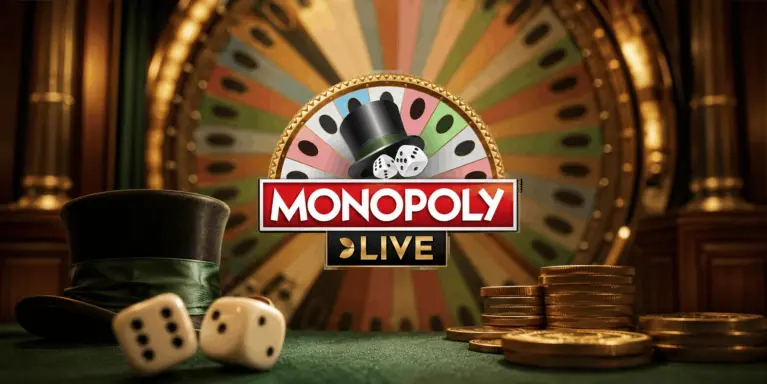
Monopoly Live built its reputation on a name every player already knows. Evolution took a giant spinning money wheel, licensed one of the most recognizable board games on the planet, and added a virtual host who actually walks around a 3D city collecting your winnings. That mix of familiar and flashy explains why this game show has stuck around since 2019, long enough to become one of the most requested live titles at nearly every major casino.
You don’t need to know how to trade Boardwalk for a hotel to enjoy this one. The wheel spin decides your fate the same way it does on any Evolution money-wheel game, but the moment Mr. Monopoly steps in, the whole screen changes. Cameras cut to a fully rendered augmented reality board, dice roll, and multipliers stack while the live host narrates from the sidelines.
This guide covers everything worth knowing before you place a bet: how the wheel actually works, what each segment pays, where Mr. Monopoly’s bonus round can take your stake, and whether any betting approach genuinely helps. We’ll also get into the studios behind the broadcast and how to keep the whole thing fun rather than costly.
 Reviewed byNadia Winchester
Quick Answer
Monopoly Live is Evolution's board-game-themed money wheel, running on a 54-segment wheel with a 96.23% RTP and an augmented reality bonus round starring Mr. Monopoly.


New Casino
 Rated 84 of 100%
welcome bonus
100% up to €100

New Casino
Rated 82 of 100%
welcome bonus
550% up to €3540 + 400 FS


Exclusive Bonus
Rated 88 of 100%
welcome bonus
400% up to €4,000 + 400 FS

New Casino
Rated 83 of 100%
welcome bonus
250% up to €4,000 + 250 FS

New Casino
Rated 81 of 100%
welcome bonus
100% up to €5,000 + 175 FS


Crypto Casino
Rated 85 of 100%
welcome bonus
500% up to $10,000

Crypto Casino
Rated 89 of 100%
welcome bonus
100% up to €100,000

Crypto Casino
Rated 90 of 100%
welcome bonus
200% up to €100 + 150 FS

Crypto Casino
Rated 55 of 100%
welcome bonus
150% up to €1,300 + 100 FS

Crypto Casino
Rated 87 of 100%
welcome bonus
100% up to $1,500 + 150 FS

Crypto Casino
Rated 94 of 100%
welcome bonus
150% up to €4,000 + 400 FS

Rated 91 of 100%
welcome bonus
305% up to €1,200

Rated 89 of 100%
welcome bonus
305% up to €1,200

Crypto Casino
Rated 91 of 100%
welcome bonus
100% Deposit Bonus

Rated 91 of 100%
welcome bonus
200% Bonus up to €350

Rated 90 of 100%
welcome bonus
NO KYC REQUIRED

Rated 74 of 100%
welcome bonus
100% up to €500


Hot Casino
Rated 95 of 100%
welcome bonus
243% up to €5,555 + 243 FS
Peel back the AR graphics, and Monopoly Live runs on the same wheel format Evolution built for Dream Catcher back in 2017. A live host spins a large vertical wheel divided into 54 segments, and you bet on where it lands before the spin starts.
Most of those segments carry a number: 1, 2, 5, or 10. Land on one you backed, and you get paid at that number’s odds, plain and simple. Two other segment types change the game entirely. Chance segments hand out an instant cash prize or a multiplier that carries into your next spin, while the 2 Rolls and 4 Rolls segments send you straight into the bonus round, where Mr. Monopoly takes over the screen.
That bonus round is the whole reason people come back. Instead of a second flat payout, you get dice rolls across a 3D Monopoly board, with cash prizes and multipliers waiting at different squares. Landing doubles during the bonus buys you an extra roll, so a single trip through the board can stretch on far longer than the thirty seconds a normal spin takes.
| Feature | Detail |
|---|---|
| Provider | Evolution |
| Launched | 2019, in partnership with Hasbro |
| Wheel segments | 54 |
| Bet spots | 6 (numbers 1, 2, 5, 10, plus 2 Rolls and 4 Rolls) |
| Bonus triggers | 2 Rolls and 4 Rolls |
| Max multiplier | Up to 10,000x, with a per-bet cap around €500,000 |
| RTP | Up to 96.23%, varies by segment |
| Studio | Multiple locations across Europe and the US |
Monopoly Live got its first public look at ICE 2019, the industry’s biggest trade show, in February of that year. Evolution had already built a reputation with Dream Catcher, the money wheel that launched back in 2017. That wheel quietly became one of the most played live casino games in Europe. Slapping a Hasbro license onto that same format was a bold move, but the board game’s near-universal recognition made the pairing feel obvious in hindsight.
The official launch followed in April 2019. Evolution reached the deal through a sublicense from Scientific Games, the company holding broader rights to Hasbro’s gaming properties at the time. Evolution’s product team leaned hard into the augmented reality angle. They built a full 3D rendering of the Monopoly board that Mr. Monopoly could walk around in real time. Nothing quite like it existed in live casino before. The game picked up Game of the Year honors from both EGR and Gaming Intelligence within its first year.
US expansion came in phases, tied to state-by-state licensing rather than one single rollout. New Jersey, Delaware, and Connecticut all got dedicated Monopoly Live studios, with Michigan following through a studio built in Grand Rapids. Each state runs the same wheel, the same odds, and the same bonus mechanics as the European version. What changes is the set and the local licensing body signing off on the stream.
The Hasbro relationship didn’t stop growing after launch either. Evolution and Hasbro signed a new multi-year, exclusive licensing agreement in 2025. It covers future titles across the Evolution portfolio, including Monopoly Roulette and other board-game-branded releases still rolling out. Monopoly Live effectively opened that door. It proved a licensed board game could translate into a live casino hit worth building an entire content pipeline around.
A few numbers worth knowing:
Seven years after Dream Catcher first proved the money wheel format worked, Monopoly Live took it further. It showed that a familiar brand could make an already-solid game even bigger.
The wheel spin takes seconds. The bonus round, when it lands, can run several minutes. Here's the full sequence from bet placement to payout.

Choose from six spots: numbers 1, 2, 5, 10, or the bonus triggers 2 Rolls and 4 Rolls. You can stake more than one at once, and most players spread a small amount across at least one bonus spot to stay in the game if it hits.
A live presenter releases the wheel by hand, and it spins for roughly 20 to 30 seconds before slowing down. There’s no digital simulation involved. What you’re watching is a genuine physical spin, filmed continuously from multiple camera angles.
If it stops on a number you backed, your payout lands instantly at that number’s odds. A bet on 10 pays 10 to 1, for example, with your stake returned alongside the winnings.
Mr. Monopoly presents a Chance card to every player at the table, whether or not they bet on it. The card shows either a cash prize, paid immediately, or a multiplier that carries into your very next spin.
Only players who placed a bet on that exact segment get paid from what follows. Everyone else watches the bonus play out without collecting anything.
The screen shifts entirely into a 3D rendering of the Monopoly board. Dice roll live, and Mr. Monopoly moves that many spaces, collecting cash prizes or multipliers at each stop. Rolling doubles earns an extra roll, so a strong sequence of doubles can stretch a 2 Rolls bonus well past its minimum length.
Once every roll is used, your total bonus winnings display on screen and pay out together with your original stake. The wheel resets, and the next round opens for betting.
A quick note worth flagging: if you didn’t bet on 2 Rolls or 4 Rolls before the wheel landed there, you’ll still see Mr. Monopoly’s walk play out, but you won’t collect a cent from it. Betting a small amount on both bonus spots every round is the only way to guarantee you’re in it when the wheel lands there.
Fifty-four segments sound like a lot to track, but Monopoly Live’s wheel breaks down into just seven distinct bet types. Numbers dominate by a wide margin, which keeps the pace quick between the moments that actually change the game.
Here’s exactly what’s hiding behind those 54 slots:
| Segment | Count on Wheel | Probability | Payout | RTP |
|---|---|---|---|---|
| Number 1 | 22 | 40.74% | 1:1 | Within the 91.30%–96.23% published range |
| Number 2 | 15 | 27.78% | 2:1 | 96.23% (highest published) |
| Number 5 | 7 | 12.96% | 5:1 | 91.30% (lowest published) |
| Number 10 | 4 | 7.41% | 10:1 | Within the 91.30%–96.23% published range |
| Chance | 2 | 3.70% | Cash prize or carry-over multiplier | Not fixed — payout varies by card |
| 2 Rolls | 3 | 5.56% | Bonus round entry, 2+ dice rolls | Not fixed — payout varies by round |
| 4 Rolls | 1 | 1.85% | Bonus round entry, 4+ dice rolls | Not fixed — payout varies by round |
A few things worth pulling out of that table. The numbered segments cover 48 of the 54 slots, so close to nine out of every ten spins land on a straightforward payout rather than sending anyone into a bonus. That’s by design. The plain numbers keep the pace moving while you wait for a 2 Rolls, 4 Rolls, or Chance segment to show up.
Combined, 2 Rolls and 4 Rolls occupy just four segments total, which works out to roughly one bonus trigger every 14 spins. The 4 Rolls segment alone sits at 1.85%, the rarest single outcome on the wheel, but it’s also the one that carries the deepest bonus sequence once it lands.
Notice the RTP pattern too. Number 2 pays out modestly but returns the most over time, while Number 5 pays a bigger multiplier and gives back the least. That trade-off is standard across wheel games. It’s the same reason a number that hits often can’t also pay huge, and vice versa.

Two segment types turn Monopoly Live from a straightforward wheel bet into the show everyone’s actually watching. Chance and the two roll-based bonuses work completely differently from each other, so it’s worth separating exactly what each one does.
Land on Chance, and Mr. Monopoly steps forward with a virtual card for the entire table, whether you bet on it or not. Every player at the table gets the same reveal. There’s no betting spot for Chance specifically, which makes it the one outcome nobody can plan around.
The card shows one of two things:
That second outcome is where Chance gets interesting. A multiplier drawn on one spin and confirmed on the next effectively stacks two separate wins into one moment, and it’s part of what keeps players betting through quiet stretches on the numbers.
Landing on either bonus segment sends the whole screen into a fully rendered 3D city, and Mr. Monopoly starts walking. The mechanics stay consistent whether you triggered 2 Rolls or 4 Rolls. Only the starting number of dice throws changes.
Here’s what happens once the board loads:
Once every roll is used, the round ends and your total bonus winnings get added to your balance alongside your original stake. Evolution caps individual bet payouts at roughly €500,000, with reported multipliers on strong runs reaching up into the 15,000x range.
None of this is something you can influence once the bonus starts. Where Mr. Monopoly lands depends entirely on the dice roll and the board’s underlying RNG. What you control is whether you’re covered on 2 Rolls or 4 Rolls before the wheel stops, since that’s the only decision point in the entire sequence.
Monopoly Live has no skill component to speak of. The dice rolls, the wheel spin, and the Chance card reveal all run on RNG or physical randomness that no amount of timing or pattern-reading changes. What you can control is how you spread your bankroll across the six available bet spots, and that choice shapes what your session actually feels like, even though it can’t touch the underlying house edge.
The “10-5-2-1” approach covers all four numbered segments, which together make up 88.88% of the wheel. Wins land often, since you’re catching close to nine out of every ten spins. Payouts stay modest, though, and you’ll frequently watch a bonus round trigger without collecting a cent, because this approach skips 2 Rolls and 4 Rolls entirely.
Most regular players settle somewhere between the two extremes. Stake most of your bankroll on 1 or 2 for steady, frequent returns, then add a smaller side bet on 2 Rolls so you’re not shut out if the wheel lands there. This smooths out the dry stretches between bonus hits without requiring a massive bankroll to sustain.
Betting toward outcomes tied to Chance-triggered multipliers means accepting more variance in exchange for the chance at a stacked payout. Since Chance has no dedicated bet spot, this approach really means staying active on numbers so you’re positioned to benefit whenever a multiplier card lands, then hoping the next spin confirms it.
Betting exclusively on 4 Rolls covers just 7.40% of the wheel’s total value and misses far more spins than it catches. When it lands, though, the extended dice sequence and stacking multipliers give this approach the highest ceiling on the table. It’s the approach built purely around the big swing, not the steady session.
A few numbers worth keeping in mind:
None of these approaches change the math working against you in the long run. What changes is the shape of your session: how often you win small versus how long you wait for something big. Pick the one that matches the kind of night you’re actually looking for, not the one you think might beat the wheel.
Monopoly Live’s home base sits in Riga, Latvia, inside Evolution’s flagship production facility. This is the same city where Dream Catcher first proved the money wheel format could work, and it remains the studio most players outside the US land on by default. Riga runs multilingual presenter rotations, so you’ll find English, German, and Italian dealers all working the same wheel depending on which table you join.
That single-studio setup didn’t stay that way once US regulation caught up with demand. Evolution rolled out dedicated Monopoly Live studios state by state rather than through one blanket launch, a pattern shaped by how gambling licensing actually works across the country.
Here’s where the game currently broadcasts from:
Each state studio runs the identical 54-segment wheel, the same odds, and the same bonus mechanics you’d find in Riga. What changes is the physical set, the presenter roster, and which regulatory body signs off on the stream. The math underneath stays exactly the same no matter which studio you land on.
Evolution’s relationship with Hasbro didn’t stop at this one title either. A broader licensing agreement signed in 2025 opened the door for more board-game-branded releases across Evolution’s portfolio, with Monopoly Roulette among the first titles to follow. Monopoly Live effectively built the template that made the rest of that pipeline possible.
Monopoly Live runs on the same HTML5 framework across every device, so there’s no separate app to download and no stripped-down mobile version waiting for you. What loads on desktop is what loads on your phone, just resized to fit the screen.
The wheel spin, the host commentary, and the 3D bonus board all render identically on mobile browsers. Evolution built this game with cross-device play in mind from the start, since a large share of live casino traffic already comes from phones and tablets rather than desktops.
The betting grid compresses to fit six bet spots into a much smaller area, so double-check your stake lands on the right segment before the timer runs out. Landscape mode gives noticeably more room during this step than holding the phone upright.
The 3D bonus board takes the biggest visual hit on a small screen. Some of the finer detail on Mr. Monopoly’s board gets compressed to fit, though the core mechanics, dice rolls, property values, and multiplier stacking, all play out exactly the same regardless of screen size.
Connection stability matters more here than it does on a slot game, since Monopoly Live streams continuous live video rather than loading static assets. A dropped connection during a 4 Rolls bonus can be frustrating, though most platforms preserve your bet and resolve the outcome once you reconnect.
Battery drain also adds up faster than a typical mobile session. Continuous video streaming pulls more power than a standard slot spin, so keep that in mind if you’re settling in for a longer session away from a charger.
Beyond that, there’s genuinely no compromise. Whether you’re catching a quick spin on a break or watching a full 4 Rolls sequence play out on the train home, the mobile version delivers the same game, just smaller.
Monopoly Live is built around nostalgia and spectacle, and that’s exactly why it’s worth a clear head before you sit down. The familiar board, the friendly host energy, and the anticipation of watching Mr. Monopoly walk toward a big multiplier all pull you into longer sessions than you might have planned. That pull is part of the design, so it helps to set boundaries before the wheel starts spinning, not once you’re a few rounds deep.
Because 2 Rolls and 4 Rolls together occupy just four of the wheel’s 54 segments, it’s tempting to keep betting past your limit while waiting for one to land. Each spin is independent, though. A long gap without a bonus trigger doesn’t make the next one more likely, and increasing your stake to “catch up” only raises what you stand to lose if the dry spell continues.
Decide on a loss limit and a time limit before your session starts, not in the middle of a 4 Rolls sequence when the multipliers are stacking. Most licensed casinos build tools directly into your account to help enforce this automatically:
If gambling stops feeling like entertainment and starts feeling like something you can’t step away from, that’s worth taking seriously. Organizations like GamCare, BeGambleAware, and the National Council on Problem Gambling offer free, confidential support regardless of where you play.
Monopoly Live works best as exactly what it’s designed to be: a bit of nostalgic fun with a shot at a big multiplier along the way. It stays that way when you play it within limits you’ve set for yourself in advance, and stick to them regardless of how a session is going.
Monopoly Live earned its place in live casino the way its board game namesake earned its place on shelves worldwide: through sheer familiarity turned into something genuinely fun to watch. Evolution didn’t just slap a licensed logo onto an existing wheel, though. It built an entire augmented reality board around Mr. Monopoly, and that extra layer of production is exactly what separates this game from a standard money wheel spin.
That production value doesn’t change what’s actually happening under the hood, because this is still a game of chance, with a house edge that swings from roughly 3.77% on the best-paying numbers up to nearly 9% on the riskiest bonus chases. No amount of tracking past spins or waiting for a “due” 4 Rolls segment changes what happens next. What you can control is how you spread your bets, how much you stake, and when you decide the session’s over.
That balance between spectacle and simple math is really the appeal, since Monopoly Live doesn’t pretend to reward a strategy it was never built to have. It gives you a familiar wheel, a genuinely entertaining bonus round, and the kind of nostalgic charm that makes even a quiet session worth sticking around for. Play it for what it is, and Mr. Monopoly usually delivers exactly that.
Stakes typically start around $0.10 to $0.50 per spin, with maximums reaching $2,500 to $5,000 depending on the casino and which segment you’re betting. High-roller tables with higher ceilings exist at some operators.
No. Monopoly Live streams live around the clock with a real presenter and a real wheel, so there’s no traditional demo mode. Some casinos let you watch the live feed without placing a bet, which works as a free way to learn the format before staking real money.
No. The physical wheel spin is genuine and filmed continuously from multiple camera angles, while the bonus board and Chance card outcomes run on RNG systems certified by independent testing labs like GLI and eCOGRA. Casinos don’t have a lever that changes your result.
2 Rolls and 4 Rolls together occupy just four of the wheel’s 54 segments, so most spins land on a plain number instead. That rarity is exactly what makes the bonus worth the wait when it does land, especially if Mr. Monopoly rolls a run of doubles once he’s on the board.
You still get to watch the bonus round play out along with everyone else at the table. You just won’t collect any winnings from it, since only players who staked that exact segment participate in the payout.
That depends on what you’re after. Crazy Time offers more bonus variety across four separate mini-games, Dream Catcher keeps things simple with no bonus board at all, and Monopoly Live sits in between with one longer, more atmospheric bonus round built around board-game nostalgia. Trying more than one is the only real way to know which format clicks for you. Compare all six shows on our live game shows hub.
The Author
The Author
Slots and News Reviewer