Craps has a reputation problem online, and live craps inherited it. Walk up to a physical table and the shouting, the stickman’s chant, and the sheer number of bet types on the felt can make it feel like the most intimidating game in the building. That reputation followed the game online, where for years craps barely existed in live dealer form at all because streaming a physical dice table convincingly is genuinely hard to pull off.
That’s changed. Live craps now streams from real studios with real dice, a real table layout, and a dealer who calls the action exactly like a Vegas pit crew. The learning curve is still there, but so is the payoff, since craps holds some of the best odds in the entire casino, including the only true zero-house-edge bet you’ll find anywhere on the floor.
This page breaks down how live craps actually works, every bet on the table and what it pays, where the house edge really hides, and why the Odds bet deserves a section of its own. Below, you’ll find our current pick of the best live craps casinos.
 Reviewed byNadia Winchester

New Casino
 Rated 84 of 100%
welcome bonus
100% up to €100

New Casino
Rated 82 of 100%
welcome bonus
550% up to €3540 + 400 FS


Exclusive Bonus
Rated 88 of 100%
welcome bonus
400% up to €4,000 + 400 FS

New Casino
Rated 83 of 100%
welcome bonus
250% up to €4,000 + 250 FS

New Casino
Rated 81 of 100%
welcome bonus
100% up to €5,000 + 175 FS


Crypto Casino
Rated 85 of 100%
welcome bonus
500% up to $10,000

Crypto Casino
Rated 89 of 100%
welcome bonus
100% up to €100,000

Crypto Casino
Rated 90 of 100%
welcome bonus
200% up to €100 + 150 FS

Crypto Casino
Rated 55 of 100%
welcome bonus
150% up to €1,300 + 100 FS

Crypto Casino
Rated 87 of 100%
welcome bonus
100% up to $1,500 + 150 FS

Crypto Casino
Rated 94 of 100%
welcome bonus
150% up to €4,000 + 400 FS

Rated 91 of 100%
welcome bonus
305% up to €1,200

Rated 89 of 100%
welcome bonus
305% up to €1,200

Crypto Casino
Rated 91 of 100%
welcome bonus
100% Deposit Bonus

Rated 91 of 100%
welcome bonus
200% Bonus up to €350

Rated 90 of 100%
welcome bonus
NO KYC REQUIRED

Rated 74 of 100%
welcome bonus
100% up to €500


Hot Casino
Rated 95 of 100%
welcome bonus
243% up to €5,555 + 243 FS
Craps is a dice game built around a single shooter rolling two six-sided dice while everyone else at the table bets on the outcome. It’s one of the oldest games in the casino, tracing back to French and English dice games centuries old, but it plays fast and stays social in a way few other table games manage.
The game’s modern form traces back to Hazard, an English dice game that French settlers simplified before it crossed the Atlantic. Bernard de Marigny, a wealthy Creole gambler and politician, brought that simplified version to New Orleans around 1805, establishing the point-and-seven structure still used today. A century later, an American dice maker named John H. Winn refined it further, adding the Don’t Pass bet and the modern table layout around 1907, a change that closed off the cheating problems that had plagued the game and turned it into something casinos could run fairly. That combined framework has barely changed since
The core of the game is the Pass Line bet. A round starts with the come-out roll, and the shooter either wins outright, loses outright, or sets a “point” that has to be rolled again before a seven shows up. Everything else on the table, from Place bets to Hardways, builds on top of that basic structure.
Live craps recreates this exactly, with a real dealer, a real table, and real dice caught on camera from multiple angles so every roll is verifiable. Evolution brought the first serious live craps product to market, and it remains the benchmark other studios build against.
What makes craps different from blackjack or roulette in live format is the physicality of it. A shoe of cards or a spinning wheel translates to video fairly easily. A shooter throwing dice across a felt table, with the dice sometimes bouncing off stacks of chips or the table wall, is harder to stream cleanly, which is part of why live craps arrived later than most other live table games.
A handful of terms come up constantly at the table, and knowing them upfront makes everything else on this page easier to follow:
Every bet type covered later on this page builds directly on these five ideas, so it’s worth keeping them in mind as the table moves through its rhythm of come-out rolls, points, and resolutions.

Before any dice hit the table, players place their Pass Line bets. This is the standard starting bet in craps, and it’s the one nearly every new player begins with. Once bets are down, the shooter picks up the dice and the round begins.
The shooter’s first throw is called the come-out roll, and it can end the round immediately. A 7 or 11 wins every Pass Line bet on the spot. A 2, 3, or 12 loses them outright, a result known as craps, which is where the game gets its name.
Any other number, 4, 5, 6, 8, 9, or 10, becomes the “point” instead of ending the round. The dealer marks it with a puck, and the shooter keeps rolling until one of two things happens. The point number reappears and Pass Line bets win, or a 7 shows up first and those bets lose.
Every roll between the point being set and its resolution matters for other bets on the table, even if it doesn’t affect the Pass Line directly. Once the point hits or a 7 ends the round, the dice pass to the next shooter and a new come-out roll begins.
Sarah places $10 on the Pass Line. The come-out roll lands on 5, so 5 becomes the point. The shooter rolls a 9, then a 3, then a 6, none of which affect Sarah’s bet directly. On the fifth roll, a 5 finally shows up. Sarah’s Pass Line bet wins even money, and she walks away with $20 total.
Had a 7 landed before that second 5, Sarah’s bet would have lost instead, ending the round there and passing the dice to the next shooter.
Craps has more bet types than any other table game in the casino, and that’s what scares off a lot of new players. The good news is you never need to touch most of them. Here’s the full rundown, organized so the bets that actually matter float to the top.
| Bet | Payout | House Edge | Notes |
|---|---|---|---|
| Pass Line | 1:1 | 1.41% | The standard starting bet |
| Don’t Pass | 1:1 | 1.36% | Betting against the shooter, 12 pushes |
| Come | 1:1 | 1.41% | Same math as Pass Line, placed mid-round |
| Don’t Come | 1:1 | 1.36% | Same math as Don’t Pass, placed mid-round |
| Odds (taking) | True odds, varies by point | 0% | Only available after a point is set |
| Place 6 or 8 | 7:6 | 1.52% | Best standalone bet outside the line bets |
| Place 5 or 9 | 7:5 | 4.00% | Solid middle-tier option |
| Place 4 or 10 | 9:5 | 6.67% | Higher payout, higher cost |
| Field | 1:1 (2x or 3x on 2 or 12) | ~2.78% to 5.56% | One-roll bet, edge depends on the table’s 12 payout |
| Big 6 or Big 8 | 1:1 | 9.09% | Same bet as Place 6/8 with a worse payout, always skip it |
| Hardway 6 or 8 | 9:1 | 9.09% | Wins on matching pairs before an easy way or a 7 |
| Hardway 4 or 10 | 7:1 | 11.11% | Same concept, lower odds of hitting |
| Any Craps | 7:1 | 11.11% | One-roll bet on 2, 3, or 12 |
| Any Seven | 4:1 | 16.67% | The worst bet on the entire table |
| Horn | Varies (15:1 to 30:1 by number) | ~12.5% to 13.3% | Splits action across 2, 3, 11, and 12 |
A few things worth flagging before moving on. Place 6 and Place 8 do the exact same job as Big 6 and Big 8, just at a much better payout, so there’s genuinely no reason to ever choose the Big version. Hardways and the proposition bets in the middle of the table look tempting because of their flashy odds, but they carry some of the steepest house edges in the entire casino.
Then there’s the Odds bet, sitting at a flat 0% house edge. That number is correct, and it deserves its own section coming up next, because most players either don’t know it exists or don’t understand why it works the way it does.
Every other bet on this table gives the house an edge. The Odds bet doesn’t. It pays out at exactly true mathematical odds, so the payout ratio matches the real probability of the point number hitting before a 7. No other wager anywhere in a casino, table game or otherwise, does that. There’s a catch, and it’s the reason casinos are happy to offer it. The Odds bet can’t stand on its own. It only becomes available once you’ve already placed a Pass Line, Don’t Pass, Come, or Don’t Come bet and a point has been established. You’re laying it “behind” that original bet, and it rides alongside the base wager until the round resolves. The payout depends entirely on which number becomes the point, since each point number carries its own fixed probability.
| Point Number | Taking Odds (Pass/Come) | Laying Odds (Don’t Pass/Don’t Come) |
|---|---|---|
| 4 or 10 | 2:1 | 1:2 |
| 5 or 9 | 3:2 | 2:3 |
| 6 or 8 | 6:5 | 5:6 |
Taking odds means you’re betting the point rolls before a 7, so a $10 bet on the point of 4 pays $20 if it hits. Laying odds flips the position. You’re now favored to win since a 7 is more likely to appear before a 4, so you have to put up more money to win less. A $20 lay on the 4 only returns $10, but it wins more often to compensate.
Marcus bets $10 on the Pass Line, and the come-out roll sets a point of 6. He backs it with $30 in odds, taking advantage of the casino’s 3-4-5x odds structure. The shooter rolls a 6 three rolls later, so Marcus wins $10 on the Pass Line at 1:1, plus $36 on the odds bet at 6:5. His original $10 bet cost him roughly 1.41% in expected value, but the $30 odds bet cost him nothing extra since it paid at the true probability of the outcome.
That’s why serious players max out their odds every time they can. The Pass Line bet still carries its edge, but stacking odds on top dilutes that edge across a much larger total wager, dropping the combined house edge below 0.5% in most cases. Most live craps tables display the maximum odds multiplier directly on screen, and it usually ranges from 3-4-5x up to 10x depending on the casino. Always check before the point is set, since odds have to go down before the next roll once a point is live.
 House Edge Breakdown: Which Bets Actually Deserve Your Money
The bets and payouts table above tells you what each wager pays. This section tells you what that math actually means once you’re standing at the table trying to decide where your chips go. Craps has one of the widest house edge ranges of any casino game. The gap between the best bet and the worst bet on the same table runs from 0% all the way up to nearly 17%, and both bets sit inches apart on the felt. That range is exactly why craps rewards players who know what they’re doing far more than games like slots, where every bet carries roughly the same built-in cost regardless of which button you press.
Pass Line, Don’t Pass, Come, and Don’t Come sit at the foundation of any sound craps approach, all landing between 1.36% and 1.41%. That already puts them ahead of most bets in the casino before odds even enter the picture. Stack Odds behind any of them and the combined edge on your total action drops below 0.5%, which ranks among the lowest costs you’ll find on any bet anywhere, live or otherwise. Place 6 and Place 8 come in just behind at 1.52%, and they solve a real problem: they let you bet directly on the two most common numbers without waiting for a point to be set first. A shooter who’s on a hot streak rolling 6s and 8s all night rewards players who had money on those numbers the whole time, not just the ones who happened to have the point already established there.
Big 6 and Big 8 exist purely as a beginner trap. They bet on the exact same outcome as Place 6 and Place 8, a 6 or 8 landing before a 7, but pay even money instead of 7:6. On a $12 bet, that’s the difference between $14 back and $12 back for identical risk. There’s no version of this bet worth making once Place bets are on the table. Hardways and the proposition bets clustered in the center of the table look exciting because of their double-digit payouts. A Hardway 4 pays 7:1, and Any Seven pays 4:1, numbers that sound generous next to a Pass Line’s even money. But the house edges tell the real story, running from 9% on Hardway 6 and 8 up to 16.67% on Any Seven, which stands as the single worst bet on the entire table. A $10 bet on Any Seven costs an average of $1.67 every time it’s placed, compared to roughly 14 cents for the same $10 on the Pass Line.
Most casino games keep every bet within a tight band of house edge, so switching bets barely changes your expected loss. Craps breaks that pattern completely. A player who only ever bets Pass Line with max Odds and Place 6/8 is playing one of the fairest games in the building. A player betting the same bankroll on Hardways and prop bets is playing something closer to a lottery, just with better production values.
A simple rule covers most situations at a live craps table. Stick to Pass Line, Come, and Place 6/8, back every point with maximum Odds, and treat everything in the center of the table as entertainment rather than strategy. That approach alone keeps a player’s overall table edge well under 1%, putting craps ahead of roulette, slots, and most other games on the floor when played this way.
Every craps table runs on a rhythm, and understanding that rhythm makes the game far less intimidating. Live craps recreates the full crew and layout you’d find at a physical table, so knowing what each role does and where each bet sits helps players follow the action instead of guessing.
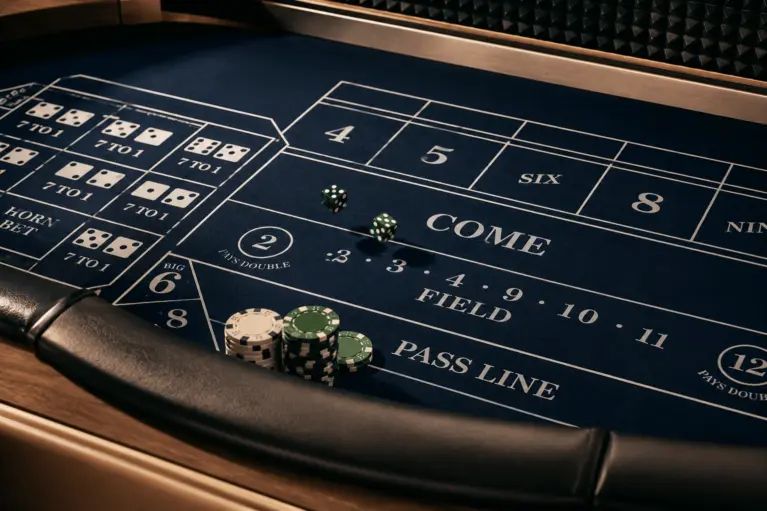
A standard craps table splits into three zones. The two outer sections mirror each other and hold the Pass Line, Don’t Pass, Come, Don’t Come, and Place bet areas. The center strip holds every proposition bet, including Hardways, Any Seven, Any Craps, and the Horn. This layout isn’t random. Bets placed in the outer zones carry the lowest house edges on the table, while everything crammed into the center carries the highest. Physical distance from the shooter roughly tracks with how good the bet actually is, and that pattern holds in live dealer format too, even without a physical stick pushing chips around.
A physical casino runs craps with up to four staff at once: two dealers handling bets on either side, a boxman supervising the table, and a stickman controlling the dice and calling out results. Live craps studios condense this crew, usually down to one dealer who manages betting, calls the roll, and keeps the pace moving, sometimes paired with a second dealer during busier sessions. The dealer’s calls matter more in craps than in almost any other live game. Every roll gets announced by number, not just result, since a 6 completing a point plays out completely differently from a 6 landing during an open Come bet. Watching for these calls is part of learning to follow a live craps table properly.
At a physical table, the dice pass clockwise to the next player after a shooter sevens out, and anyone at the table can take a turn holding the dice. Live craps studios can’t replicate physical rotation with real players, so the dealer serves as a permanent virtual shooter, rolling on behalf of the table for every round. This changes the social dynamic slightly. Physical craps builds excitement around a hot shooter, since the whole table wins together when their numbers hit. Live craps keeps the math identical, but the shooter becomes a fixed presence rather than a rotating player, which shifts the energy from “cheering for a specific person” to “cheering for a specific number.”
Every craps table uses a marker called the puck to show the game’s current phase. A black puck reading OFF means the table sits in come-out roll territory. A white puck reading ON, placed directly on a number, shows the point that’s currently live. Live craps streams display this exact same puck on screen, so players always know at a glance whether Pass Line bets are still open or a point is already in play.
Live craps is one of the harder games to stream well, so far fewer providers offer it compared to blackjack or roulette. The ones who do have invested heavily in getting the physical mechanics right.
Evolution built the first serious live craps product and remains the clear market leader. Their table uses multiple camera angles to track the dice precisely, including an overhead shot that catches every roll regardless of where the dice land on the felt. The interface mirrors a physical Vegas table closely, right down to the puck placement and dealer call patterns.
Live craps hasn’t seen the same wave of competing releases that blackjack and roulette have. Building a live craps table means solving genuinely hard streaming problems, since dice bouncing unpredictably off chip stacks and table walls makes consistent camera tracking far tougher than following a card shoe or a spinning wheel. That difficulty has kept the field narrow, with most other major studios choosing to focus their live catalogues elsewhere instead.
When comparing live craps tables across casinos, camera angle quality matters more here than in almost any other live game. A table that struggles to show a clear view of every roll makes it harder to trust results, even when the underlying math is fair. Dealer pacing also varies more in craps than in blackjack or roulette, since calling out point numbers, tracking multiple bet types, and managing Odds bets all take longer than dealing a card or spinning a wheel.
Craps looked like the least mobile-friendly live game for years, and that reputation had some truth to it. A table with over 20 bet types crammed onto one felt layout doesn’t shrink onto a phone screen without some real design work.
Modern live craps interfaces solve this with a few smart design choices:
The one genuine limitation is screen real estate during a busy round. A table with several active Come bets stacked across different point numbers demands more scrolling on a phone than it would on a desktop or tablet. Players running more complex craps strategies with multiple simultaneous bets tend to find tablets or desktop play more comfortable for that reason, while Pass Line and Place bettors rarely notice a difference.
Craps moves fast, and that speed can make it easy to lose track of how much you’re wagering. A single round often involves several bets at once, from the Pass Line to Odds to a Place bet or two, and that stacking effect means a session’s total spend can climb faster than it feels like it should.
A few practical habits help keep play in check:
If gambling stops feeling fun or starts affecting your finances, relationships, or wellbeing, support is available. Organizations like GamCare, BeGambleAware, and the National Council on Problem Gambling offer confidential help, and most licensed casinos provide built-in tools for deposit limits, time-outs, and self-exclusion directly through your account settings.
Live craps rewards the players willing to learn its layout, and that investment pays off fast. A game that looks chaotic from the outside runs on straightforward math once the Pass Line, the point, and the Odds bet click into place.
The numbers back that up clearly. A Pass Line bet backed with maximum Odds puts the house edge under 0.5%, among the lowest of any bet in a live casino. Stick to the core bets covered here, skip the flashy proposition bets in the center of the table, and craps becomes one of the fairest games you can play online.
Pick a table from our list above, watch a round or two before betting if the format feels new, and let the dice do the rest.
No. Live craps uses real dice, filmed from multiple angles, so every roll happens under camera supervision rather than through a random number generator. Licensed casinos undergo regular audits to confirm results match true probability.
The Odds bet pays at exactly true mathematical odds because it can’t stand alone. Every other bet includes a built-in house edge, since casinos need that margin to operate profitably across every other wager on the table.
Most licensed casinos offer demo versions of live craps tables, though some restrict demo access to RNG-based games only. Check individual casino terms, since live dealer demo availability varies more than it does for slots.
Minimums vary by casino and by time of day, often starting as low as $0.50 to $1 on off-peak tables and climbing higher during busy hours. High-stakes tables with much larger minimums also exist for players who want them.
No. Most experienced players stick to a small handful of bets, mainly Pass Line, Come, and Place 6/8, backed with Odds. Understanding the full table helps you follow the action, but it isn’t required to play well.
Live craps studios use the dealer as a constant virtual shooter rather than rotating the dice among players. The math stays identical, but the social experience of cheering for a specific shooter shifts toward cheering for specific numbers instead.
The Author
The Author
Slots and News Reviewer