










What New Zealand Online Casino Standards Demand From Pokies


New Zealand quietly raised the bar for what an online pokie has to prove about itself. The Online Casino Gambling (Minimum Standards) 2026 took effect on 8 July. New Zealand’s online casino standards now reach into random-number generation, game pacing and the mathematics behind every spin. The Department of Internal Affairs issued the document as the country moves toward a licensed market.
How New Zealand’s Online Casino Standards Treat Randomness
Standard 14 sits at the centre of the document. It requires game results to be acceptably random, and software pseudo-random number generators must be cryptographically secure. Their output has to spread uniformly across the full range, and outcomes must follow their expected theoretical probabilities.
The New Zealand online casino standards also ban adaptive behaviour, sometimes called compensated gaming. A game cannot adjust outcomes because a player just lost six spins in a row. Operators must monitor generator output continuously, and any anomaly or failure forces the affected game offline.
One clause matters more than the rest for anyone building slots. Any scaling or mapping of that output has to preserve uniformity, independence and the certified probability distribution. So the online casino standards New Zealand introduced do not only police the random value itself. They police what happens to it afterwards.
A Fair RNG Does Not Mean Fair Symbols
Here is where most players go wrong. Randomness sounds like it should give every symbol an equal shot at appearing, but pokies do not get designed that way. The generator picks a position on a virtual reel strip, and the game decides which symbol sits there.
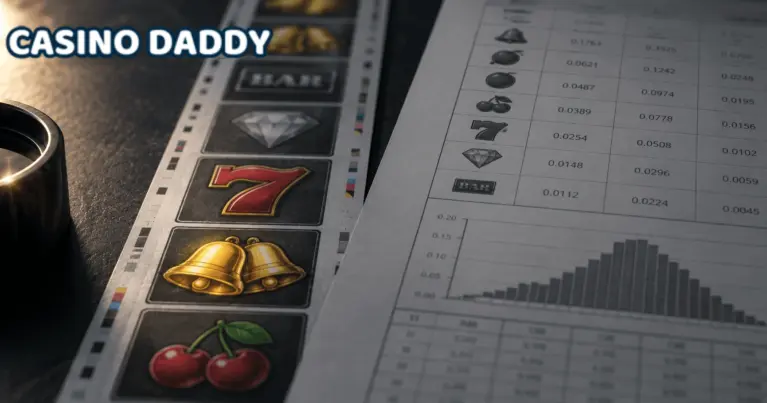
Picture a strip with 100 positions. A low-value card symbol might occupy 20 of them while a premium symbol occupies two. Every position still carries the same one-in-100 chance of selection, so the generator stays unbiased. The cheap symbol simply has ten times as many doors into the result.
A shuffled playlist works the same way. Load it with ten copies of one track and a single copy of another, and the shuffle still treats every slot fairly. Structural research on gaming machines documented 72-stop virtual reels where each stop carried an identical one-in-72 probability. Design decides frequency, and the generator only decides position.
The Five-by-Three Grid Is Only a Window
The grid on screen rarely describes the structure underneath it. Five reels showing three symbols each look simple, but those symbols come from much longer virtual strips. A simplified five-reel game with 32 stops per reel produces 33,554,432 possible combinations. Push that to 40 stops per reel and the figure climbs past 102 million.
Commercial titles use their own reel lengths and mathematical models, so those numbers work as illustration rather than benchmarks. What matters is the scale gap between what players see and what the game holds. New Zealand’s online casino standards do not force developers to publish that structure. They force the selection process to reproduce it faithfully.
Hit Frequency and RTP Answer Different Questions
Virtual reel design also explains why two familiar figures get confused so often. Hit frequency counts how often a spin produces something the game classes as a win. Return to player describes the theoretical share of stakes a game gives back across a very large number of rounds.
Analysis of manufacturer design documents found per-line hit frequencies ranging from roughly 4.9% on one commercial title to about 16.7% on another. The same research found different RTP configurations of a single game holding broadly similar hit frequencies. So a slot can pay small wins constantly and still return less over time. A higher theoretical return promises nothing about a short session.
Volatility adds a third axis. It describes how widely results scatter around the expected return, and higher-volatility designs push more of that return into rare outcomes. Paytables, bonus mechanics and multipliers all feed into it, so reel strips alone never tell the full story.
Pacing Rules Reach Past the Mathematics
Standard 10 handles a different problem, because the New Zealand online casino standards also govern speed. Games must leave at least 2.5 seconds between the start of one round and the moment the next can begin. Opening or reviewing a game cannot trigger play by itself.
The same standard covers disclosure. Where a paid version of a game carries different odds or a different theoretical return from its free-to-play equivalent, players have to learn that first. A 2025 study found participants shown a 90% RTP statement rated their winning chances more favourably than participants given no figure. Context changes how a number lands, and New Zealand’s online casino standards respond by pairing technical rules with disclosure duties.
Compliance Arrives Before the Licences Do
The technical rules work alongside the Online Casino Gambling Regulations 2026, and together they define what licensed operators must meet. The framework allows a maximum of 15 licences. Suppliers can no longer treat a game’s mathematics as a private commercial detail. Under the online casino standards New Zealand now enforces, the generator, its mapping and the certified distribution all face defined requirements.
None of this changes how a virtual reel pokie works. The generator still selects an eligible position, and the design still decides what sits there. That gap explains how an unbiased process produces wildly uneven symbol frequencies.
For players, the practical takeaway sits in the game information panel. RTP, volatility, hit frequency and maximum win each describe a different slice of the model, and none predicts the next spin. New Zealand’s online casino standards make sure that model behaves exactly as certified. Reading it properly is still the player’s job.

The Author
The Author
Slots and News Reviewer