










New York Sues Polymarket, Lawsuit Answered Within Hours


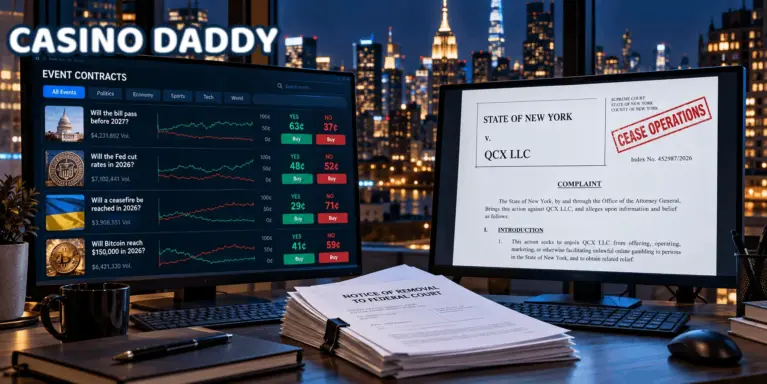
Two filings landed within hours of each other on Thursday, and both circle one question: who gets to regulate a wager that calls itself a contract. New York brought its lawsuit against Polymarket that morning, with Attorney General Letitia James and Governor Kathy Hochul accusing the operator of running an unlicensed gambling business inside the state. The company did not wait to reply. Before the day closed, it filed its own case in federal court and moved to pull the state complaint out of Manhattan.
The speed of that answer says plenty about the stakes. Prediction markets have spent the past year drawing sports action away from bettors who would once have opened a sportsbook app, and they have done it without holding a gaming licence anywhere in the country. So when New York aims a lawsuit at Polymarket, the ruling that follows could decide if that arrangement survives.
What New York’s Lawsuit Against Polymarket Claims
The complaint targets QCX LLC, which trades as Polymarket US. State attorneys argue that the platform’s event contracts fit New York’s definition of gambling, because customers stake money on results they cannot control. Strip away the trading vocabulary, the filing says, and what remains is sports wagering offered without approval from the New York State Gaming Commission.
Tax revenue sits near the centre of the lawsuit, because New York wants Polymarket held to the same obligations licensed operators carry. Sportsbooks and casinos in the state pay into funds supporting education, youth sports programmes and problem gambling services. The complaint describes a competing product built to skip that bill.
Age rules give the filing a second edge. Polymarket accepts customers from 18, while New York sets the floor for mobile sports betting at 21. Officials pointed to research tying early gambling exposure to mental health strain and financial damage among younger users.
What the State Wants From the Court
The remedies list reaches well past a simple order telling the company to stop. New York seeks an injunction halting operations in the state without a licence, forfeiture of money earned through the alleged illegal activity, and restitution for affected customers. It also asks for penalties worth three times the revenue generated, plus a separate $100,000 charge for every offer or attempted offer of sports wagering inside state lines.
Those figures scale with volume, which is why they carry real weight. The company has advertised heavily through the current sports calendar, so the per-offer penalty alone could reach an uncomfortable number if a court ever applies it. That exposure explains the counterpunch.
Polymarket Answers on Federal Ground
Polymarket rejected the framing outright, moved to shift New York’s lawsuit into federal court, then opened a second case against James and the state Gaming Commission. Its argument rests on jurisdiction rather than conduct. Event contracts traded on federally regulated exchanges answer to the Commodity Futures Trading Commission, the filing says, and Congress has already barred states from enforcing gambling law against those venues.
Polymarket US operates under CFTC oversight. The business relaunched in the American market in December 2025 after leaving in 2022 over regulatory pressure, and it runs a separate offshore operation founded in 2020. Its complaint calls the state’s description of federally regulated trading as unregulated gambling an erroneous theory.
Chief Legal Officer Neal Kumar took a sharper line in public. He noted the company started in a small New York apartment and now employs more than 350 people locally, dismissed the attorney general’s filing as recycled work, and said the team intends to stay and “fight for our users”.
A Fight That Started Before This Week
New York filed a near-identical lawsuit against Kalshi in July, so the theory now aimed at Polymarket arrives well tested. The CFTC then sued New York and Massachusetts earlier this year over state attempts to apply gambling law to federally regulated operators. Two arms of government are suing each other over the same product.
Other states have joined in. Missouri ordered six prediction market operators to stop taking sports wagers on 21 September. Days earlier, the Ninth Circuit blocked Kalshi from offering sports contracts on tribal lands, handing tribal operators a win that regulators elsewhere noticed.
Why Sportsbooks Are Watching Closely
Licensed operators hold a direct stake here, because they carry costs their rivals avoid. A DraftKings or FanDuel customer in the state bets under a heavy tax rate, age verification at 21, and a full responsible gambling framework sitting behind the product. A prediction market customer gets something similar without any of that infrastructure.
Meanwhile the company keeps expanding. It signed a marketing partnership with the New York Yankees, struck an MLB deal, launched a large advertising campaign, and picked up an endorsement from LeBron James. None of that behaviour suggests a business preparing to retreat.
Where New York’s Lawsuit Against Polymarket Goes Next
The immediate question is procedural. If the case moves to federal court, the company fights on ground where its preemption argument carries the most force. If it stays in state court, New York gets to test its gambling definition in front of a jury that lives with the consequences of unlicensed operators.
Either way, the ruling travels. Courts across the country are weighing the same conflict, and the first clear appellate answer will set the template for every state that wants to pull prediction markets under gaming law. Until then, both sides keep filing, and the market keeps taking bets.

The Author
The Author
Slots and News Reviewer