







- Play’n Go
- High
- Released October 2026
Tower Run Treasure Steps

Good
Play'n GO's monster-tower climb where every win charges a nine-stage meter toward wilds, multipliers and a 30,000x Hold & Spin.
Where to play for real
 RetroBet Casino
Rated 94 of 100
RetroBet Casino
Rated 94 of 100
350% up to €15,000 + 350 FS
- x50 wagering
- €20 min deposit
- US players welcome
- RTP
- 96.2%
- Volatility
- High
- Max win
- €30,000 x600 at max bet
- Bet range
- €0.10 up to €50
Tower Run Treasure Steps Review
Overview
- Provider
- Play’n Go
- Released
- 15 October 2026
- Grid
- 5x5
- Devices
- Android, IOS, Windows
- Progressive
- No
- Jackpot
- No
Pros and cons
Good sides
- Maximum win of 30,000x the bet
- Win-O-Meter of Destiny charges inside a single spin, so one long cascade run can open the Treasure Room
- Bob's Ascent pays an instant prize every 18 steps even when the grid produces nothing
- Treasure Room mimics hide cash prizes worth up to x5,000 the base bet
- GO ULTRA upgrades three separate mechanics for 50% extra stake
Weaknesses
- High volatility leaves long stretches between features
- Every bonus route funnels into the Treasure Room, with no free spins round
- Royal symbols need seven or more matches and start at 0.3x the bet
- Switching bet level loads a separate Bob's Ascent path and parks the current climb
- GO ULTRA leaves Bob's Ascent instant prizes untouched
Maths and paytable
- RTP
- 96.2%
- Volatility
- High
- Max win
- €30,000
- Max win as multiple
- x600
- Minimum bet
- €0.10
- Maximum bet
- €50
Features and theme
- Features
- Theme
- Special symbols
Where to play
- Casinos featuring this slot below
- 6
- Best offer
- 350% up to €15,000 + 350 FS
Play Tower Run Treasure Steps for Real money
 Rated 94 of 100%
welcome bonus
350% up to €15,000 + 350 FS

Rated 93 of 100%
welcome bonus
100% up to €100 + 100 FS

Rated 93 of 100%
welcome bonus
350% up to €15,000 + 350 FS

Rated 93 of 100%
welcome bonus
350% up to €15,000 + 350 FS

Rated 91 of 100%
welcome bonus
305% up to €1,200


Exclusive Bonus
Rated 91 of 100%
welcome bonus
150% up to 50,000 USDT + 300 FS
 Bob wants to be a knight, and the qualification he has chosen for himself is the Treasure Tower, a building that stopped taking structural engineering seriously several centuries ago. Tower Run Treasure Steps sets him on a walkway above a 5×5 grid and moves him upward a few steps at a time, past monsters considerably better equipped than he is, through portals opening onto rooms no architect ever signed off, and beneath a floating eye that watches the whole climb without comment. Play’n GO released it on 15 October 2026.
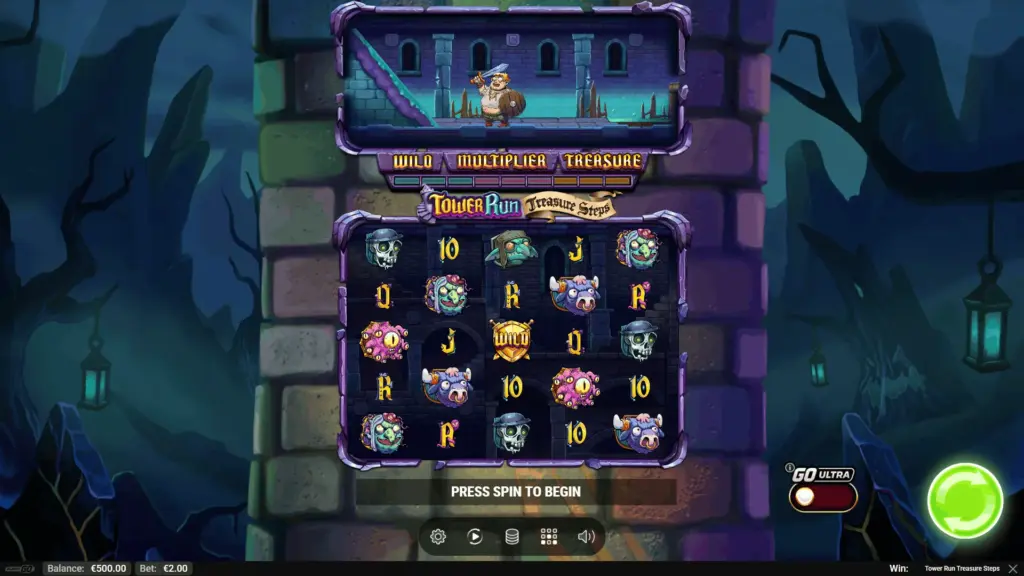
The grid below him pays anywhere rather than along lines, with monster symbols needing six matches and royals needing seven, and every win that forms adds a charge to the nine-segment meter mounted between Bob and the reels. Three charges scatter wilds through the empty positions, six attach a global multiplier to everything that follows, and nine swing open the door to the Treasure Room, where sticky coins and locked chests settle how the round ends. The meter empties at the start of every spin, so all nine charges have to arrive inside one cascading sequence.
Hanging a 30,000x ceiling on that structure leaves the base game thin across long stretches, with a small number of spins carrying the weight of everything around them.
Tower Run Treasure Steps Features: Nine Charges and a Door at the Top
Two counters drive the base round, and they run on completely different clocks. The meter above the grid lives and dies inside a single spin, while Bob’s climb accumulates across every spin played at that stake and pays on a schedule the reels have no influence over whatsoever.
The Win-O-Meter of Destiny Starts Over Every Spin
The meter sits directly above the grid as three labelled blocks, WILD, MULTIPLIER and TREASURE, each holding three segments. Every winning combination anywhere on the grid adds one charge, so a spin that cascades repeatedly can walk through all three stages, while a spin paying once collects the win and nothing else. The thresholds are evenly spaced and fixed:
- Three charges trigger Wild Rift
- Six charges trigger the Dimensional Multiplier
- Nine charges open the Treasure Room
None of that progress survives into the following spin, which means a sequence stalling at eight charges leaves nothing behind except the wins it already paid.
Wild Rift Fills the Gaps at Three
Reaching three charges drops one to four wilds onto empty positions once the current win has resolved and before the grid checks for its next cascade, giving the sequence fresh material to work with at exactly the point it might otherwise have died. The wild is a gold shield that substitutes for every paying symbol, lands only during the base game, and can feed several winning combinations at once in a grid this crowded. Each new spin clears the wilds along with the meter.
The Dimensional Multiplier Takes Over at Six
Three more wins arm the second stage, which drops another one to four wilds and attaches a global multiplier of x2, x3, x4 or x5 to every win in the next cascading sequence, including the cascades that sequence goes on to produce. Only one multiplier value applies per trigger, and the active figure appears as a glowing badge beside the game logo so the size of the run is visible while it is still happening. A spin generous enough to skip past the first stage entirely, by producing two initial wins and four cascade wins in a row, compensates by dropping two to eight wilds instead of the usual one to four.
Bob’s Ascent Pays on a Timer the Grid Cannot Touch
 Every spin advances Bob one to six steps along the walkway, with a monster waiting every eighteen steps, and reaching one triggers an encounter that pays an instant prize of x0.2, x0.5, x1, x2, x3, x4, x5 or x10 the base bet before the symbols below are even evaluated. The counter in the corner of the walkway tracks the distance, so the next payout is always visible in advance, and a losing grid costs nothing in progress because the climb advances on spins rather than on wins. Bob’s position is stored separately for every bet level, which makes a change of stake load a different climb entirely and park the one already underway until that stake comes back.
Inside the Treasure Room: Coins, Mimics and Three Lives
The ninth charge does not open the door straight away, because the Treasure Room waits for the grid to fall idle, which means every cascade has to finish and no further wins can still be forming. What follows is a self-contained Hold & Spin on an empty 5×5 grid where the monsters and royals disappear completely, leaving every position to resolve as a coin, a mimic, a key or nothing at all.
| Symbol | Prize | Sticky | Behaviour |
|---|---|---|---|
| Coin | x1 to x5 the base bet | Yes | Pays the moment it lands |
| Mimic | x10 to x5,000 the base bet | Yes | Opens once its countdown of 4, 6, 8, 10 or 12 reaches zero |
| Key | No prize of its own | No | Opens one random closed mimic, then disappears |
Coins Pay on Landing, Mimics Make You Wait
A coin arrives with its cash prize already showing and locks into position the moment it touches the grid, banking x1 to x5 the base bet with no further conditions attached to it. Mimics operate on a delay instead, landing as closed chests with a countdown of 4, 6, 8, 10 or 12 printed underneath, and that number falls by one at the start of every subsequent spin until it reaches zero and the lid finally comes off. The prize waiting inside runs from x10 as far as x5,000 the base bet, which is where the headline figures in Tower Run Treasure Steps actually come from, and the countdown is the price of admission.
Keys Open One Chest and Disappear
Keys carry no value whatsoever and exist purely to cut a countdown short, selecting one closed mimic at random and springing it on the spot. A key landing at a moment when every chest on the grid has already opened accomplishes nothing and still vanishes on the following spin, since keys are the one symbol in the room that refuses to stick.
Every Landing Buys the Lives Back
 The round opens with three lives, and the arithmetic governing them is unusually forgiving: a coin landing refills them, a mimic landing refills them, a key landing refills them, and a mimic opening refills them as well. Lives only tick down on a spin where the board produces absolutely nothing, which turns the feature into a question of how long the grid can keep finding something rather than a fixed allowance of respins. The room closes when the lives run out or when all 25 positions sit occupied by sticky symbols, at which point every prize collected along the way is summed into a single payout, and running GO ULTRA raises both the starting count and every refill to four.
Tower Run Treasure Steps Paytable: Monsters at Six, Royals at Seven
Ten paying symbols split into two tiers with different entry requirements, and the gap between those requirements does more work than it first appears. Five monsters pay from six matching symbols anywhere on the grid, five royals need seven before they register at all, and a 25-position grid produces clusters large enough that the difference between six and seven decides how often each tier contributes anything.
The Eyeball Blob Tops a Deliberately Steep Ladder
 The pink many-eyed blob sits at the top and demonstrates how aggressively the ladders are back-loaded, paying a limp 1.5x at six matches, climbing to 25x at nine, then leaping to 250x at ten and 5,000x once eleven or more land together. A run from the bottom of that ladder to the top multiplies the return by more than three thousand, and the helmeted skull at the bottom of the monster tier manages a comparatively modest two hundred across the same span. Royals behave far more politely, with the ace topping out at 30x and the ten reaching 2.5x, which keeps the low tier functioning as meter fuel rather than as a source of income.
Each symbol combination pays only its highest applicable band, though several different symbols landing in the same evaluation all pay together and add into one total.
Full Paytable
| Symbol | 6 | 7 | 8 | 9 | 10 | 11+ |
|---|---|---|---|---|---|---|
| Eyeball blob | 1.5 | 3 | 7.5 | 25 | 250 | 5000 |
| Bull demon | 1.2 | 2.5 | 6 | 12 | 50 | 500 |
| Brained zombie | 0.8 | 2 | 5 | 7.5 | 25 | 250 |
| Hooded goblin | 0.6 | 1.5 | 4 | 6 | 18 | 180 |
| Helmeted skull | 0.5 | 1 | 3 | 4.5 | 10 | 100 |
| A | No pay | 0.5 | 1.5 | 2.5 | 6 | 30 |
| K | No pay | 0.4 | 0.8 | 1.5 | 3.5 | 15 |
| Q | No pay | 0.4 | 0.6 | 1 | 2.5 | 7.5 |
| J | No pay | 0.3 | 0.5 | 0.8 | 1.5 | 5 |
| 10 | No pay | 0.3 | 0.4 | 0.6 | 1 | 2.5 |
All values are multiples of the total bet.
No Lines, No Scatter, Pays Anywhere
Position carries no meaning here, so six eyeball blobs scattered into six separate corners of the grid pay precisely what six adjacent ones would, and the only thing being counted is how many of a kind came to rest after the symbols stopped falling. The gold shield wild substitutes for every paying symbol and appears during the base game alone, which makes the wilds arriving through the meter the main route to those eleven-symbol bands.
More unusual is what the paytable leaves out, because Tower Run Treasure Steps carries no scatter symbol of any description. Nothing needs to land three times to buy entry to the bonus, and the Treasure Room arrives purely through nine wins charging the meter, which removes the familiar near-miss of watching two scatters sit on the grid and leaves the tension entirely with how long a cascade can keep going.
How to Play Tower Run Treasure Steps

Pick a stake before Bob starts climbing
Stakes run from 0.10 to 50.00, and the choice carries more weight here than the usual question of bankroll pacing, because Bob’s position on the walkway is saved separately against every individual bet level. Settling on a figure and staying with it lets the steps accumulate toward the next monster encounter without interruption, while hopping between levels loads whichever climb belongs to the new stake and parks the previous one exactly where it stood. Every cash prize in the game is calculated from the base bet as well, so the number chosen at the start governs the size of everything the tower hands back later.
Watch the meter rather than the grid
The nine-segment meter above the reels is the only thing on screen tracking progress toward the features, and it counts winning combinations rather than symbols, which makes a scrappy spin producing four small wins far more valuable than a tidy one producing a single large one. Segments light up in sequence across the WILD, MULTIPLIER and TREASURE blocks, keeping the distance left to run visible throughout. Nothing carries forward once the next spin begins, which is worth remembering during a sequence that stalls on seven or eight charges.
Let the cascade finish before counting
Cascades make the final value of a spin impossible to judge while symbols are still falling, since every removal refills the grid and may create the win that tips the meter over its next threshold. Wild Rift drops its wilds after the current win resolves but before the grid checks for another cascade, and the Dimensional Multiplier applies to the whole sequence that follows rather than to the win that triggered it. The Treasure Room insists on complete stillness too, opening only once the cascades have run out and no further wins can form.
Read the mimic countdowns
Each closed mimic inside the Treasure Room carries a number between 4 and 12 that drops by one at the start of every spin, and those figures give a reasonable sense of how long the round needs to survive for the chest to pay anything at all. A mimic landing on 12 wants twelve further spins before it opens under its own steam, which is precisely where keys earn their keep, springing one closed chest at random the moment they arrive. Lives refill completely whenever any coin, mimic or key touches the grid, and whenever a mimic opens, so the round continues for as long as the board keeps finding something.
Decide on GO ULTRA while the reels are idle
GO ULTRA costs an extra 50% of the base bet and can only be switched while the base game sits still, because the toggle locks the moment a feature starts running. Turning it on applies a permanent x2 multiplier to every base game win, pins the Dimensional Multiplier at x5 instead of leaving it to land anywhere between x2 and x5, and lifts the Treasure Room to four lives with every refill matching. Bob’s instant prizes stay exactly as they were, since the x2 covers grid wins alone.
Hand the climb over to autoplay
Autoplay offers runs of 10, 20, 50, 75 or 100 spins, alongside a fast play option in the settings menu for anyone who would rather not watch every cascade resolve at full speed. Bob advances on every spin regardless of who presses the button, so a long autoplay run collects monster encounters at the same rate manual play does. The sequence halts by itself when the Treasure Room triggers, leaving the Hold & Spin to be played out properly.
Stakes From 0.10 to 50.00 and the 50% GO ULTRA Asks For
Stakes climb from 0.10 to 50.00 along a ladder of fixed steps, though the figure worth checking before any of them is the RTP the operator has chosen to run, because Play’n GO ships Tower Run Treasure Steps in five separate configurations. The default returns 96.2%, with alternatives sitting at 94.2%, 91.2%, 87.2% and 84.2%, and the distance between the top and bottom of that range matters considerably more than any decision made at the betting panel.
What GO ULTRA Changes and What It Leaves Alone
Adding 50% to the stake upgrades three mechanics at once:
- A permanent x2 global multiplier doubles every base game win, applying to each spin, each cascade and each symbol win
- The Dimensional Multiplier arrives fixed at x5 instead of landing somewhere between x2 and x5
- The Treasure Room opens with four lives rather than three, and every refill restores four
The toggle sits beside the spin button and responds only while the base game is idle, locking itself for the duration of any feature. Switching it on puts a glowing X2 badge next to the game logo and washes the grid frame pink, making the state impossible to mistake at a glance. Bob’s Ascent stays outside the arrangement completely, since the doubled multiplier covers grid wins and leaves the instant prizes from monster encounters exactly as they were. Those upgrades also apply only to features triggered during a round where GO ULTRA was already active, so flipping the switch partway through a promising sequence does nothing for that sequence.
Bob’s Path Belongs to the Stake That Built It
 Every bet level keeps a private copy of Bob’s walkway, and the game swaps between them the instant the stake changes. A climb sitting two steps short of a monster at 1.00 disappears from view the moment the bet moves to 2.00, replaced by whatever progress that level had banked previously, then returns in precisely the same condition when the stake comes back down. Progress behaves as an asset attached to a number rather than to the session, which rewards choosing a stake and committing to it, and penalises the habit of nudging the bet upward after a dry run.
GO ULTRA sits outside this behaviour entirely, because the surcharge rides on top of the base bet without changing which level is being played, leaving the climb exactly where it stood.
Every Prize Is Calculated From the Base Bet
Coins, mimics and monster encounters all pay multiples of the base bet rather than the inflated figure GO ULTRA produces. A 1.00 stake with GO ULTRA running costs 1.50 a spin, and a mimic opening on x100 still pays 100.00, which makes the surcharge a purchase of better multipliers and deeper feature margins rather than a straight scaling of everything on screen. That distinction grows teeth at higher stakes, where the extra half of every bet accumulates faster than a cold run gives the x2 any chance to recover it.
Tower Run Treasure Steps Visuals: A Tower That Stopped Obeying Physics
Play’n GO have built the entire screen as a cross-section of the tower, setting the reels into a slab of purple-grey masonry and staging the action above them on an actual floor of the building rather than in a decorative header. Outside the stonework, Tower Run Treasure Steps lets the forest handle the atmosphere, hanging teal lanterns among bare branches, running veins of blue and magenta light through the roots, and sending a small green bat drifting across the right-hand edge at intervals for reasons nobody has ever explained.
Bob Walks, the Floors Scroll Past Him
The panel above the grid shows a lantern-lit corridor in cold teal and stone, complete with arched windows, blue torches, scattered floor spikes and a ramp climbing out of frame, and Bob trudges through it from left to right across the course of a session. He is a short, round, moustached knight in a pointed helmet with a blue plume, carrying a sword considerably more confident than its owner, and on reaching the right-hand edge of a floor the whole corridor slides away to deliver a fresh one with its own monster already in position. A purple plaque in the corner counts down the steps to that meeting, and the encounter plays out as a brief scuffle with the sword raised and coins spilling down into the reels afterward.
The Treasure Room Changes the Lighting
Reaching nine charges swaps the cold forest palette for something far warmer, dropping the grid into a vault lit by wall torches, with gothic arched windows standing behind the reels and heaps of gold spilling across the floor on either side. The frame turns gold, the hearts tracking the lives sit along the top beside the respin counter, and the chests burn with small flames while they wait out their countdowns. Opened mimics flip from gold to a cold teal and display their value, which keeps a crowded board readable even at speed, and the round closes with a tower doorway bursting open and a pile of monsters tumbling out across the total.
Five Monsters Worth Looking At
The symbol set earns its keep on a grid this dense. A pink many-eyed blob with one enormous yellow iris tops the ladder, trailed by a purple bull-demon with its tongue out, a green zombie sporting both an exposed brain and a blade through the skull, a hooded goblin, and a helmeted skeleton rounding off the monster tier. Royals arrive as heavy gold letterforms that stay legible while half the grid is clearing at once, and the gold shield wild remains the brightest object on the board by a comfortable margin. Winning clusters light individually with their values floating above them as the running total climbs underneath.
The Tip Bar Tells Jokes
A strip beneath the reels rotates through messages, and roughly half of them are doing genuine work, explaining that every win charges the meter, that three wins drop one to four wilds, that nine wins open the Treasure Room. The other half is Bob. “Hero rule #1: press spin before panic” surfaces regularly, as does the flatly ominous “You feel watched”, which pairs neatly with the giant eye the game keeps gesturing at, and now and then the bar simply reports that BOB says “Hya!” while he swings at something.
Sound Design: Sword Swings, Coin Drops and the Door at Nine
A single spin in Tower Run Treasure Steps can be running three things at once, with symbols clearing and refilling across the grid, segments filling on the meter above it, and Bob advancing along his walkway, and the audio carries most of the load in keeping those threads apart. Each event gets its own cue rather than sharing one generic win sound, which matters on a game where the biggest animation and the most important event are frequently different things.
Telling a Cascade From a Charge
The base game layers its cues by event rather than by size, so a player watching the grid still knows what the meter is doing behind the action:
- Symbols clearing, and the refill dropping in behind them
- The meter taking a charge and stepping up through the WILD, MULTIPLIER and TREASURE blocks
- Wilds arriving through the rift at three
- The global multiplier locking in at six
- Bob reaching a monster, and the encounter resolving
Win tiers escalate on top of all that, and because encounter prizes resolve before the grid is evaluated at all, their cue lands early in the spin and stays distinct from whatever the symbols are about to do. The result is crisp and easy to follow at speed, which a cascading game needs rather more than most.
The Treasure Room Gets Its Own Bed
Crossing nine charges swaps the music out completely, retiring the base game track in favour of something heavier that runs for the duration of the Hold & Spin. Inside it the cues divide cleanly between the three symbols, with coins landing and banking in one motion, chests thudding into place and counting down a step at a time, and keys arriving on a sharper note that resolves the instant a lid comes off. Those countdowns give the round a pulse the base game has no equivalent for, and the big win presentation sits over the top of everything with a rising count that keeps climbing well past the point where the number stopped looking modest.
Playing Tower Run Treasure Steps: What the Tower Actually Did
 A session of roughly 180 spins at 1.00 and 1.50, split between manual play and four autoplay runs, finished marginally ahead of where it started, which flatters the base game considerably more than the base game deserves. Three Treasure Rooms carried the entire result, and the stretches between them ran long enough to make the shape of the game obvious.
The Base Game Runs on Small Change
Spins that paid anything at all mostly returned between a fifth of the stake and one and a half times it, with 0.20, 0.40 and 0.90 turning up far more often than anything worth a second glance. Cascades long enough to light the WILD block and drop fresh wilds across the grid arrived occasionally rather than regularly, and the Dimensional Multiplier was rarer still, appearing once at x2 with both the WILD and MULTIPLIER blocks lit and a pair of wilds falling into the gaps. Reaching all nine charges happened three times across the whole session, which accounts for essentially every unit of profit on the board.
Three Treasure Rooms, Three Different Shapes
| Round | Trigger spin | Final total | How it played |
|---|---|---|---|
| First | 6.00 | 88.00 (88x) | Longest of the three, dropping to one life before recovering |
| Second | 32.90 | 92.90 (92.9x) | A key landed early and cracked a chest ahead of its countdown |
| Third | 6.30 | 44.30 (44.3x) | Briefest run, ending with numbers still on several chests |
All three triggered at a 1.00 stake, and none produced a mimic above x20, which left the x50, x100, x500, x1000 and x5000 bands entirely theoretical for the duration. The second arrived off the back of the biggest base game spin of the session, a 32.90 cascade that charged the meter to nine entirely under its own power, making it the only round where the trigger spin itself was worth watching.
Bob Paid More Reliably Than the Grid
Monster encounters landed at x2, x1 and x0.2, figures that sound negligible beside a 30,000x ceiling and turned out to be the most dependable thing on the screen. They arrive on a step count rather than on wins, so dry spells producing nothing whatsoever from the grid still delivered an encounter every eighteen steps, and watching that counter in the corner is a materially different kind of waiting from watching the meter.
The per-stake storage behaves exactly as documented. A climb sitting on 16 of 18 steps at 1.00 disappeared the instant the bet moved to 2.00, which loaded a fresh path at zero, and dropping back to 1.00 restored the original climb at 16 with nothing lost.
Where It Lands
Around a hundred of those spins ran with GO ULTRA active and none of them produced a Treasure Room, leaving both the four-life version and the guaranteed x5 multiplier unseen despite the surcharge riding on every one. That is a small sample and evidence of nothing beyond variance, though it does sharpen the trade on offer, since the extra 50% buys better features without buying more of them. The ceiling stayed a very long way off throughout, which is the expected outcome at this volatility and worth saying plainly.
Who Are Play’n GO?
Play’n GO supply more than 400 titles to regulated operators across upwards of 35 jurisdictions, built over two decades under co-founder and chief executive Johan Törnqvist, with licences held in Great Britain, Malta and Gibraltar alongside approvals covering Romania, Greece and Ontario. Most players meet them through Rich Wilde and the Book of Dead long before encountering anything else in the range, though the studio has spent recent years building distinct families of games rather than leaning on that one.
A Release Almost Every Week
Output runs relentlessly, with the autumn 2026 schedule placing new titles roughly seven days apart and occasionally two on a single date, which gives the catalogue its characteristic mix of tightly themed series and standalone mechanical experiments. Reactoonz, Rise of Olympus, Sweet Alchemy, the Wilde series, Legion Gold and the Joker range all run as ongoing lines, while Grid Slots gathers the cascading pay-anywhere designs together, and Tower Run Treasure Steps sits squarely in that group. Beyond the online catalogue the company also runs land-based and social casino divisions, a music label and a partnership with the TGR Haas F1 team, which is a broader spread of interests than most suppliers trouble themselves with.

Our Take on Tower Run Treasure Steps
The Ceiling Is Real and a Very Long Way Off
A 30,000x maximum sits printed on the game’s own splash screen and again in the paytable header, and the arithmetic reaching it needs a Treasure Room filling up with mimics landing in the upper prize bands, an outcome the documentation permits and ordinary play does almost nothing to suggest. Across roughly 180 spins the best chests opened on x20, leaving five higher bands untouched, while the three completed Hold & Spin rounds returned between 44x and 93x. Those are respectable figures for a feature that triggered three times, and they sit several orders of magnitude beneath the headline, which is the honest position on any slot carrying a ceiling this tall.
One Spin Can Do Everything
The decision giving Tower Run Treasure Steps its character is the meter emptying at the start of every spin. Nothing accumulates, nothing carries forward, and a spin reaching eight charges leaves behind precisely as much as a spin reaching none, which strips out the slow build most feature-meter games depend on and substitutes a run of independent attempts. On a good spin the effect is considerable, because the same cascade sequence dropping wilds at three and a multiplier at six can still be running when it opens the door at nine, stacking all three stages into one unbroken chain. On every other spin the meter is scenery.
The Trade It Asks For
Bob’s Ascent acts as the counterweight to all of that, grinding out an instant prize every eighteen steps regardless of what the grid manages, and across a long session it proves the most reliable thing on the screen despite paying between x0.2 and x10. GO ULTRA asks 50% more for better features rather than more frequent ones, which suits a player already at peace with the waiting and does very little for anyone hoping to reach the Treasure Room sooner.
The game fits:
- Players who enjoy cascading pay-anywhere grids and can sit out dry stretches without reaching for the bet adjuster
- Anyone who likes a persistent progression hook running underneath the spins
- Players content to judge a slot on its best spins rather than its average ones
It fits less well:
- Anyone expecting a free spins round, since the game carries none at all
- Players who want a bonus buy, which GO ULTRA deliberately stops short of being
- Anyone who finds a meter resetting every spin more frustrating than exciting
What Players Ask About Tower Run Treasure Steps
Can you play Tower Run Treasure Steps for free?
Yes. A free demo runs on this page using play credits, covering the complete game including the Win-O-Meter of Destiny, Bob’s Ascent and the Treasure Room. GO ULTRA can be toggled in the demo as well, so the upgraded features are testable without putting anything at stake.
What is the RTP of Tower Run Treasure Steps?
The default configuration returns 96.2%. Play’n GO also supply versions at 94.2%, 91.2%, 87.2% and 84.2%, and the figure actually running depends on the operator, which makes the in-game information screen worth a look before starting.
What is the maximum win in Tower Run Treasure Steps?
30,000x the bet, stated on the game’s own splash screen and repeated in the paytable header. The route there runs through the Treasure Room, where a single mimic can conceal as much as x5,000 the base bet.
How do you trigger the Treasure Room?
Nine wins inside a single spin. Every winning combination anywhere on the grid adds one charge to the Win-O-Meter of Destiny, and the room opens once the grid falls idle with all nine segments lit. Because the meter empties at the start of each spin, all nine charges have to arrive within one cascading sequence.
What happens to Bob’s Ascent if you change your bet?
Every bet level stores its own climb. Moving the stake loads whatever position that level had saved, and returning to the original stake restores the earlier climb exactly where it stopped. Switching GO ULTRA on or off leaves the climb alone, since the surcharge rides on top of the base bet without changing which level is in play.
Is GO ULTRA worth turning on?
It costs 50% more per spin and upgrades three things: a permanent x2 multiplier on base game wins, the Dimensional Multiplier fixed at x5, and four Treasure Room lives in place of three. Features do not arrive any more often, and Bob’s instant prizes stay untouched, so the answer depends on valuing a stronger feature above a longer bankroll.
Can you buy the bonus in Tower Run Treasure Steps?
No. The game carries no feature buy of any kind. GO ULTRA improves the features once they arrive rather than purchasing access to them, and nine wins on the meter remain the only way into the Treasure Room.
How volatile is Tower Run Treasure Steps?
High, with the provider’s own rating sitting at the top of its scale. The base game pays in fractions of the stake across long stretches, and the Treasure Room carries essentially the whole result, which is the pattern a session tends to follow.

The Author
The Author
Slots and News Reviewer
Play Similar slots

Infernal Trinity GO Guaranteed
Rated 85 of 100%

Redtail Robber Cash Vault Heist
Rated 84 of 100%

Ghost Booster Go Guaranteed
Rated 82 of 100%

Lawn n’ Complete Disorder
Rated 81 of 100%