






Hacksaw Moves Into Prediction Markets With B2B Launch


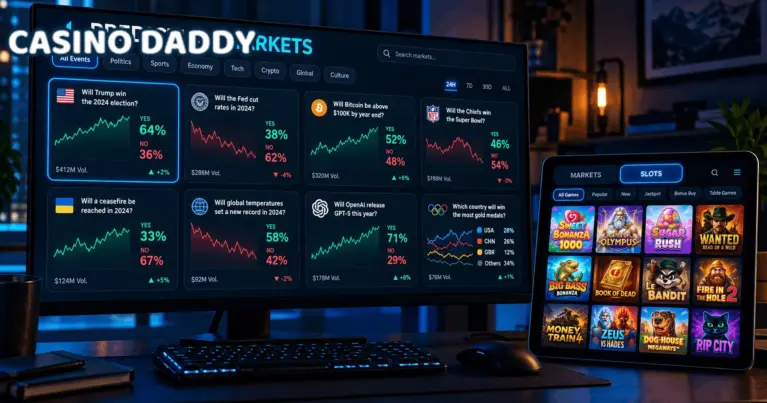
Hacksaw spent years building slots that ended up in almost every major online casino lobby, and the group is now pointing that same distribution at something completely different. Hacksaw has launched a business-to-business platform that lets operators run prediction markets without building any of the underlying technology themselves. The company supplies the plumbing, and its partners keep the players, the brand and the front end.
The timing follows a busy year. In March the group set up Hacksaw Ventures, an investment and acceleration arm backing early-stage iGaming companies, and this launch extends the same appetite for ground outside slot development. Event trading has pulled in serious money and serious scrutiny over the past two years, so Hacksaw wants a position in prediction markets before the category hardens.
What Operators Actually Get
The pitch is straightforward. Hacksaw is offering any operator that wants prediction markets a route into its infrastructure, distribution network and existing integrations, instead of commissioning a build that would swallow months and a dedicated engineering team. Brand, customer relationships and user experience all stay on the operator’s side.
Hacksaw is selling prediction markets as infrastructure rather than as a consumer product of its own. Market creation, settlement rules and technical risk all sit with the supplier. The operator decides how the product looks, where it lands in the lobby and which players see it first.
Malta Signs Off on Type 3
The Malta Gaming Authority has extended Hacksaw’s B2B Critical Gaming Supply Licence to include Type 3 Gaming Services, which now runs alongside the Type 1 authorisation the company already held. Type 3 covers peer-to-peer activity, and event trading falls squarely inside it. That extension is the piece that makes the whole thing workable under Maltese rules.
The regulatory position also separates this launch from much of what is happening elsewhere. Courts, state regulators and the CFTC are still fighting in the United States over the basic question of what event contracts legally are. Hacksaw gets to build prediction markets inside a framework that has already answered it.
Shared Liquidity Is the Real Selling Point
The most interesting piece of the platform is a connected volume framework that pools peer-to-peer participation across every operator on Hacksaw’s network. Thin liquidity kills these products quickly. A market with a handful of participants prices badly, settles slowly and gives nobody a reason to come back, and most operators launching alone walk straight into that problem.
Hacksaw intends to pool prediction markets participation across its entire partner base, so a small brand opens with the same depth as a large one. That approach rewrites the usual economics of entering a new vertical. How well it works depends on how many operators sign up, which is the part nobody can measure yet.
Why Hacksaw Wants a Piece of Prediction Markets
Money explains most of it. Research and brokerage firm Bernstein estimates annual trading volumes across the sector could reach roughly $1 trillion by 2030. A number that size pulls in companies with no history whatsoever in event contracts, and Hacksaw is hardly the only established supplier eyeing prediction markets from outside the vertical.
Group chief executive Ana Vrabic Verdir described the category as a compelling opportunity sitting where technology, entertainment and market participation meet. She pointed to the company’s platform, distribution capability and operator relationships as the obvious route in. Marcus Cordes, operational chief executive of Hacksaw Gaming, put it in blunter commercial terms, saying operators reach the category far more efficiently by leaning on infrastructure the company has spent years building. The group will fund the expansion inside its existing cost base.
The Part That Stays Unproven
Operator adoption remains the open question. Selling infrastructure works when customers actually want the product, and plenty of operators are still watching the American legal fights before touching event trading in any form. Hacksaw holds the relationships and the licence, yet it has named no partner operator and no date for the first live markets.
The move does put a slots studio inside a category dominated by exchanges and fintech startups, and it arrives there from a position most of those rivals cannot match. Hacksaw games already sit in hundreds of casino lobbies, and the operators running those lobbies take sales calls from the company every week. That matters more than any technical advantage in a category this young.
Hacksaw is betting that prediction markets turn into a standard tab next to slots and live dealer, rather than a cycle that burns out once the novelty fades. If that bet lands, supplying the technology to everyone pays better than running a single consumer platform. The next year of operator sign-ups will say which way it went.

The Author
The Author
Slots and News Reviewer