









Michigan Casinos
Online casinos in Michigan: the biggest US market by revenue
Online casinos in Michigan launched on 22 January 2021, and in the five years since the state has grown into the largest regulated iGaming market in the country by monthly revenue. March 2026 set a record with $322.1 million in internet gaming gross receipts, ahead of every other US state.
The structure here is different from most places. Michigan has both commercial and tribal operators: each licensed online casino must partner with one of Detroit’s three commercial casinos or one of the state’s 12 federally recognised tribes. That gives fifteen licensed brands, the maximum the law currently allows.
This page covers how the law works, which operators are licensed and who they partner with, what the market looks like in numbers, the protections that come with a licence, and why sweepstakes casinos are not an option in Michigan. If you have been searching for MI online casinos, everything below applies to the same regulated market.
Are online casinos in Michigan legal?
Yes. Online casinos in Michigan have been legal since the Lawful Internet Gaming Act was signed in December 2019, with the first sites going live in January 2021. Every legal site is licensed by the Michigan Gaming Control Board and must partner with one of Detroit’s three commercial casinos or one of the state’s 12 tribes. Players must be 21 or over and physically inside Michigan. Sweepstakes casinos are a separate matter and have been pushed out of the state by MGCB enforcement since 2024.
How the law works for online casinos in Michigan
Michigan regulates internet gaming under the Lawful Internet Gaming Act, signed by Governor Gretchen Whitmer on 20 December 2019. Regulators spent the following year writing the rules, and eight online casinos went live on the same day in January 2021.
One regulator, not two
Unlike New Jersey, where licensing and enforcement sit with separate bodies, Michigan runs both through the Michigan Gaming Control Board. The MGCB licenses operators, platform providers and suppliers, audits games and finances, sets cybersecurity standards, and enforces responsible gambling rules.
The partnership requirement
No brand operates on its own licence. Each online casino must partner with either one of Detroit’s three commercial casinos or one of Michigan’s 12 federally recognised tribes. That is why the market is capped at fifteen brands, and why several nationally known names run under a tribal partner in the Upper Peninsula.
What a licence costs
- Application fee: $50,000
- Initial licence fee: $100,000
- Annual fee thereafter: $50,000
- Licence term: five years, renewable
Age and location rules
Players must be 21 or over. Operators run identity checks at sign-up and geolocation during play, so accounts only work inside state lines. Residency is not the test: a visitor physically in Michigan can play, a resident travelling elsewhere cannot.
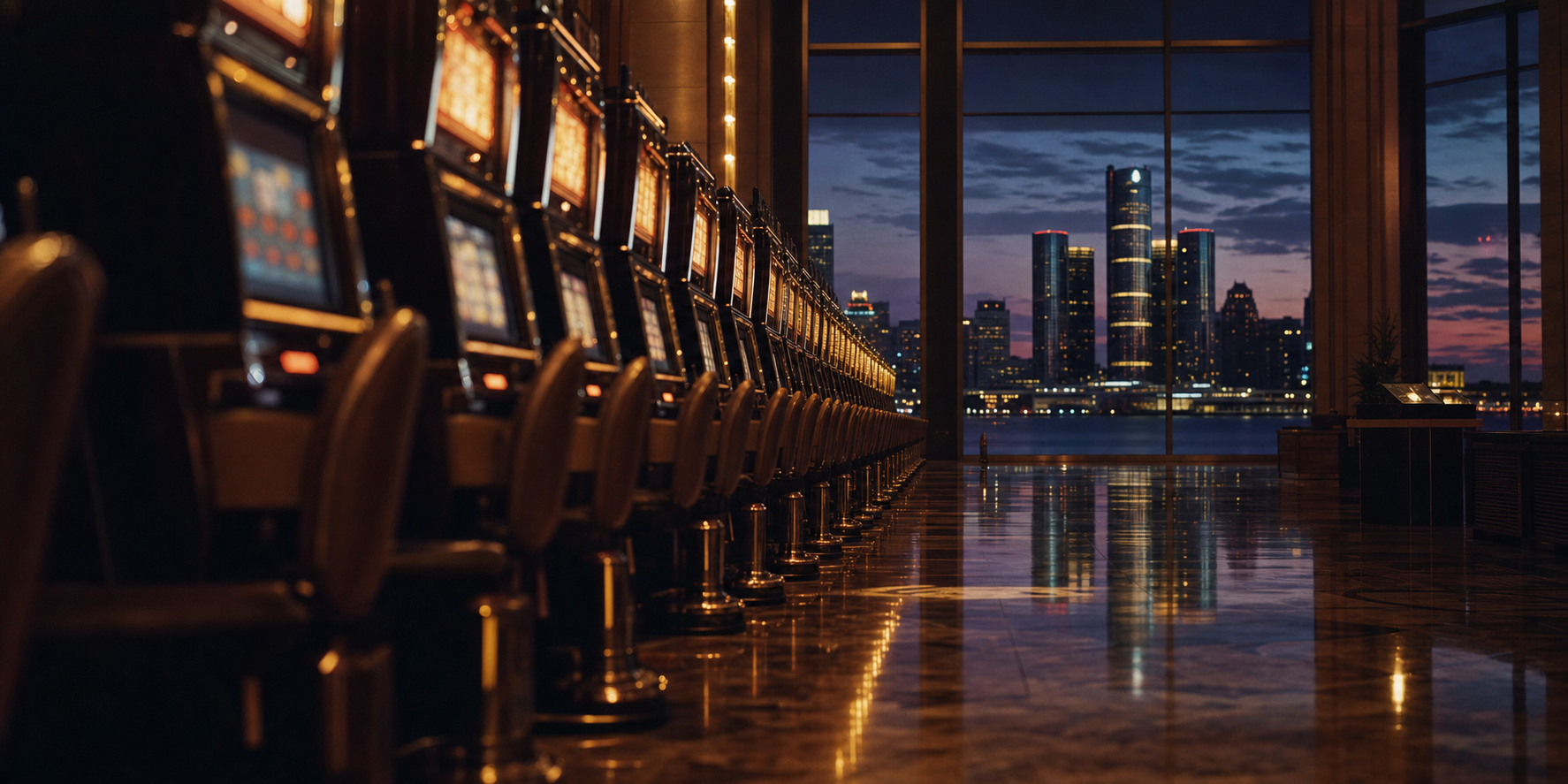
Licensed online casinos in Michigan and their land-based partners
Because every brand runs under a commercial or tribal licence, the quickest way to check whether a site is legitimate is to look at which Michigan property it partners with. The list below follows the operators authorised by the Michigan Gaming Control Board.
| Online brand | Land-based partner |
|---|---|
| BetMGM Casino | MGM Grand Detroit (commercial) |
| FanDuel Casino | MotorCity Casino (commercial) |
| Hollywood Casino | Greektown Casino-Hotel (commercial) |
| DraftKings Casino | Bay Mills Resort Casino (Bay Mills Indian Community) |
| Caesars Palace Online Casino | Turtle Creek Casino & Hotel (Grand Traverse Band) |
| Hard Rock Bet Casino | Island Resort & Casino (Hannahville Indian Community) |
| BetRivers Casino | Little River Casino Resort (Little River Band of Ottawa Indians) |
| Golden Nugget Casino | Ojibwa Casino (Keweenaw Bay Indian Community) |
| Fanatics Casino | Northern Waters Casino Resort (Lac Vieux Desert Band) |
| bet365 Casino | Odawa Casino (Little Traverse Bay Bands of Odawa Indians) |
| Horseshoe Online Casino | Sault Ste. Marie Tribe of Chippewa Indians |
| Eagle Casino & Sports | Soaring Eagle Casino & Resort (Saginaw Chippewa Tribe) |
| Play Gun Lake | Gun Lake Casino (Match-E-Be-Nash-She-Wish Band) |
| FireKeepers Casino | FireKeepers Casino (Nottawaseppi Huron Band) |
| Four Winds Casino | Four Winds Casino (Pokagon Band of Potawatomi Indians) |
How to verify a site yourself
If a casino is not tied to one of these properties, it does not hold a Michigan licence. The MGCB publishes the current list of authorised operators, and checking there is more reliable than trusting a badge on the operator’s own homepage.
For more on what the licence itself requires, see our guide to casino licences by jurisdiction.
For a closer look at the licence itself, including what it requires of an operator and how to verify one, see our guide to Michigan licensed casinos.
The Michigan online casino market in numbers
The Michigan Gaming Control Board publishes monthly figures for every licensed operator, which makes the market unusually transparent. The numbers below come from those reports.
| Metric | Figure |
|---|---|
| iGaming gross receipts, March 2026 | $322.1 million, an all-time state record |
| iGaming gross receipts, May 2026 | $305.8 million, up 22% year on year |
| iGaming adjusted gross receipts, May 2026 | $293.5 million, up 24.2% year on year |
| iGaming gross receipts, August 2026 | $303.0 million, with adjusted gross receipts of $290.8 million, up 17.6% year on year |
| Combined online total, May 2026 | $382.5 million including sports betting |
| Full year 2025 | $3.8 billion across iGaming and online sports betting |
| Licensed online casinos | 15, the statutory maximum |
| Market launched | 22 January 2021 |
Online dwarfs the casino floor
In March 2026 Detroit’s three commercial casinos took $112.3 million between them, while online gaming produced $322.1 million. Online accounted for roughly two thirds of all reported gambling revenue in the state that month.
How the tax works
Michigan taxes online casino revenue on a sliding scale based on each operator’s adjusted gross receipts, starting at 20% for the smallest tier and rising to 28% for operators above $12 million. The money funds the Internet Gaming Fund, a compulsive gambling prevention fund, the First Responder Presumed Coverage Fund and the State School Aid Fund.
Sweepstakes casinos are closed off in Michigan
Sweepstakes casinos, the dual-currency sites built around free Gold Coins and redeemable Sweeps Coins, are not available to Michigan players. The route the state took to get there is different from most others, and worth understanding.
Enforcement rather than a dedicated ban
Michigan never passed a statute naming sweepstakes casinos. Instead the MGCB treated them as gaming under the state’s existing gambling provisions, which put them outside the promotional sweepstakes framework they rely on elsewhere. Cease-and-desist letters began going out in late 2023, and the major platforms had withdrawn by 2024.
Why the state took that line
Michigan already had a licensed, taxed online casino market paying application fees, annual fees and up to 28% on revenue. Allowing an unlicensed alternative to compete for the same players was never likely, and the MGCB has said as much.
What it means in practice
- No major sweepstakes platform currently accepts Michigan players.
- Sites use geolocation to block the state at registration and at redemption.
- Enforcement has been aimed at operators, not at players.
- Balances have been lost before: Chumba and LuckyLand both closed to Michigan users in 2024.
The wider pattern
Michigan is one of a growing group of states where sweepstakes gaming is off the table. New Jersey, Connecticut, Montana, Nevada and New York all acted in 2025, mostly through explicit legislation, while Michigan, Idaho and Washington rely on existing gambling law instead.
Player protection and responsible gambling
The protections attached to an MGCB licence are enforceable, and there is a regulator with the power to act when an operator falls short. That is the practical difference between the licensed market and anything outside it.
What licensed operators must provide
- Identity and age verification at sign-up, with a hard 21+ minimum.
- Geolocation checks that block play from outside state lines.
- Games and random number generators audited by the MGCB.
- Deposit, wager, loss and time limits that players set themselves.
- Cooling-off periods and account self-exclusion.
- Cybersecurity standards set and reviewed by the regulator.
Two separate exclusion programmes
Michigan runs more than one route out. The Disassociated Persons List covers the Detroit commercial casinos, while the Internet Gaming and Sports Betting Responsible Gaming Database covers online play across licensed operators. Both are administered through the MGCB.
Enforcement against unlicensed sites
The MGCB has been unusually active here. Between December 2025 and April 2026 it issued cease-and-desist orders to 45 offshore operators taking Michigan wagers without a licence, and on 8 October 2026 it sent letters to 33 more, covering offshore casinos, sweepstakes-style sites and unlicensed sportsbooks. That is close to 80 sites ordered out in under a year, which tells you how seriously the board treats the gap between licensed and unlicensed play.
Where to get help
- Michigan Problem Gambling Helpline: 1-800-270-7117, staffed around the clock.
- 1-800-GAMBLER: national helpline, also available at 800gambler.org.
- Michigan Association on Problem Gambling: state-level support and treatment information.
- BeGambleAware: guidance and self-assessment tools at begambleaware.org.
Signs worth taking seriously
Chasing losses, gambling with money meant for something else, hiding how much you play, or finding it crowds out work and relationships are all reasons to pause and use the limit tools. The state also runs DontRegretTheBet.org with further resources.

Games and payments at online casinos in Michigan
Michigan lobbies are among the deepest in the regulated US market, partly because fifteen operators compete for the same players and partly because the state has been running long enough for libraries to build up.
What you will find
- Slots: the bulk of every lobby, from around 400 titles at the smaller tribal-only sites to well over 3,000 at the largest. Progressive jackpots run into seven figures.
- Table games: blackjack, roulette, baccarat and craps, typically 40 to 80 variants depending on the operator.
- Live dealer: streamed tables with real dealers, including studio setups exclusive to individual brands.
- Online poker: legal in Michigan, and since July 2026 DraftKings has run multi-state poker shared with Pennsylvania and New Jersey.
- Video poker, bingo and Slingo: smaller categories but present at most licensed sites.
Payment methods
Licensed sites offer debit cards, ACH and online banking, PayPal and Venmo, Apple Pay, prepaid Play+ cards, PayNearMe, wire transfer, and cash at the partner casino cage. Minimum deposits are usually $10, though some operators go as low as $5.
Payout speeds
Cash at the cage and prepaid cards are effectively instant. PayPal and Venmo usually land within 24 to 48 hours. ACH and online banking take two to five business days, and a posted cheque can take one to three weeks.
A note on crypto
No licensed Michigan online casino accepts cryptocurrency. If a site offers crypto deposits to Michigan players, it is operating offshore and outside the MGCB system.
How to choose between online casinos in Michigan
With fifteen licensed MI online casinos to pick from, the licence itself stops being a differentiator. Everything on the MGCB list has cleared the same bar, so the choice comes down to fit.
What actually varies
- Library size: the range is wide, from around 400 titles to over 3,600. If you play one category, check that category rather than the headline number.
- Commercial or tribal partner: sites tied to Detroit casinos tend to offer cash at the cage in the city, while tribal partners put that option in the Upper Peninsula or northern Michigan.
- Loyalty schemes: the national groups let you spend points offline as well, which matters if you visit their properties elsewhere.
- Bonus terms: wagering requirements matter more than headline amounts. A smaller offer at 1x beats a larger one at 30x.
- App quality: ratings vary sharply between operators, from near-perfect to under 3 out of 5.
- Withdrawal speed: a real difference between brands and a common source of complaints.
Checks worth doing first
- Confirm the site appears on the MGCB list of authorised operators.
- Read the wagering requirement and game weighting before depositing.
- Set deposit and loss limits at sign-up rather than later.
- Check which methods are supported for withdrawals, not just deposits.
For the wider picture across the country, see our guide to online casinos in the United States, which covers how each state treats real money play.
Latest Michigan gambling news


Industry News
Michigan Cracks Down on 45 Illegal Gambling Sites

Industry News
Gambling Tax Hikes Proposed in Michigan Budget
Are online casinos in Michigan legal?
Yes. Real money online casinos have been legal in Michigan since January 2021 under the Lawful Internet Gaming Act. Every legal site is licensed by the Michigan Gaming Control Board and must partner with one of Detroit’s three commercial casinos or one of the state’s 12 federally recognised tribes. You must be 21 or over and physically inside Michigan to play.
How many online casinos are licensed in Michigan?
Fifteen, which is the maximum state law currently allows. Licences are held by Detroit’s three commercial casinos and Michigan’s 12 federally recognised tribes, and each licence holder partners with one online brand. The Michigan Gaming Control Board publishes the current list of authorised operators.
Can I play sweepstakes casinos in Michigan?
No. The Michigan Gaming Control Board treats dual-currency sweepstakes platforms as gaming under existing state gambling law, which put them outside the promotional sweepstakes framework. Cease-and-desist letters went out from late 2023 and the major platforms had withdrawn by 2024. Enforcement has targeted operators rather than players, but balances have been lost when sites closed to Michigan users.
Do I have to live in Michigan to play?
No, residency is not the requirement. What matters is where you are when you play. Licensed operators run geolocation checks and will block access from outside state lines, so a visitor inside Michigan can play while a resident travelling elsewhere cannot. You must also be 21 or over.
Is online poker legal in Michigan?
Yes. Online poker was authorised alongside casino games under the Lawful Internet Gaming Act and launched in January 2021. Michigan also shares player pools with other states: in July 2026 DraftKings launched multi-state internet poker linking Michigan, Pennsylvania and New Jersey, which deepens the games available.
How do I self-exclude from online casinos in Michigan?
Michigan runs the Internet Gaming and Sports Betting Responsible Gaming Database for online play, alongside the Disassociated Persons List which covers the Detroit commercial casinos. Both are administered through the Michigan Gaming Control Board and forms are available on its website. Support is also available around the clock on the Michigan Problem Gambling Helpline, 1-800-270-7117.

The Author
The Author
Site Admin