











New Jersey Makes Responsible Gambling Checks Mandatory


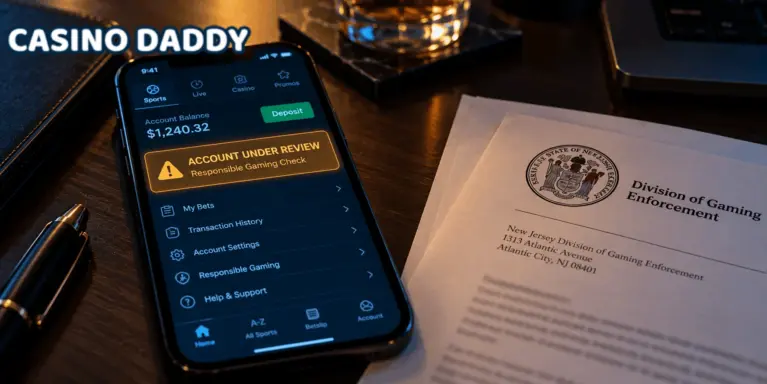
Picking the moment to step in used to be a judgement call for online operators. It no longer is. New Jersey has written its player protection expectations into enforceable rules, so responsible gambling duties now sit in regulation instead of guidance documents. Attorney General Jennifer Davenport unveiled the framework on Tuesday with Governor Mikie Sherrill behind it, and the state claims nobody else in the country has made behavioural data checks compulsory in this way.
How New Jersey Tightened Responsible Gambling Duties
Each licensed site in New Jersey has to name a responsible gambling lead, and that person carries the can for compliance. Thresholds and behavioural triggers handle the detection work, flagging accounts automatically once play crosses lines the regulator has drawn, which removes the guesswork that used to sit behind every escalation decision. Detection no longer waits on a support agent noticing something odd mid-chat.
Plenty of the bigger brands ran systems like this already, with staff trained to watch for warning signs. Technology was never the missing piece. Operators simply had no shared rule telling them when a customer deserved a second look, so each licence holder set its own tolerance and lived with it. Identical play on two sites could trigger an intervention at one brand and nothing at all at the other.
The groundwork goes back to 2023. New Jersey began steering responsible gambling policy toward player data that year, though operators signed up voluntarily at the time. Proposed regulations followed in September 2025, with reported triggers including single-day deposits above $10,000, and the version adopted this week finally gives the regulator something it can enforce.
A Flagged Account Does Not Make Someone a Problem Player
Hitting a trigger opens a file. Nothing else happens until the operator examines that activity next to the rest of the customer’s behaviour. Jamie McKelvey, who coordinates responsible gambling work at the DGE, framed the triggers as a reason to look harder at an account instead of a verdict on the person behind it. Only after that review can a company formally designate someone at risk.
Both sides gain something from the extra step. New Jersey keeps its responsible gambling regime from collapsing into a crude numbers game, operators retain room for judgement, and one unusually large deposit from a comfortable recreational player stays exactly that. Customers who do get flagged after the review land on an internal at-risk register, which starts the clock on the contact requirements.
Three Phases, Ending in a Live Conversation
Contact escalates through three defined stages. The opening rounds lean on information, nudging the customer toward deposit caps, time limits and the other tools already built into the account. New Jersey reserves its sharpest responsible gambling requirement for the final stage, where the operator’s designated lead has to hold a real conversation with the player about what the data has turned up.
A refusal to engage does not end the operator’s obligations. Companies that still consider the customer at risk once phase three concludes have to shut the account, the hardest edge anywhere in the New Jersey rulebook on responsible gambling. Very few regulators anywhere have put compulsory closure in writing.
Free Therapy Access Arrives With the Rules
RecoverMe came out of the same announcement. The state has made the app free for residents and for anyone gambling in New Jersey who wants help getting a grip on their play, under an arrangement with the company behind it. Cognitive behavioural therapy sits at its core, alongside screening questionnaires, guided sessions and a log that shows users their own patterns over time. A separate local layer routes people in acute distress toward emergency help.
Davenport presented the app and the rules as one piece of work. “Ads are everywhere. You can gamble anywhere,” she told reporters, arguing that state law should cover anyone betting within its borders. Officials also nodded to allegations circulating about operators aiming promotional pushes at customers who already showed disorder symptoms, which puts the New Jersey move on responsible gambling in sharper context.
The Kalshi Fight Runs Alongside
The same press conference doubled as a progress report on the state’s war with prediction markets. Sports event contracts remain the sticking point, and New Jersey wants the Supreme Court to revisit a Third Circuit ruling that handed oversight of them to the Commodity Futures Trading Commission. Two of the three judges found that federal commodities law leaves no room for state gambling rules to reach the products.
Support behind the petition runs wide. Thirty-nine states, the District of Columbia, 146 tribal nations and organisations representing them, and the NFL have all filed in the state’s corner. Mary Jo Flaherty, acting head of the DGE, told reporters she wants the justices to take it up, and she pointed out that neither DraftKings nor FanDuel was running prediction market products in the state at that stage.
Where New Jersey Takes Responsible Gambling From Here
Documentation becomes the battleground now. Operators in New Jersey need a named responsible gambling lead, written thresholds, a review process that holds up under inspection and a paper trail covering every phase of every intervention. Good intentions count for nothing once an inspector asks for the file on a specific player.
Other states will read this closely. New Jersey legalised online casinos in 2013 and sports betting in 2018, and its responsible gambling rulebook carries the same gravitational pull those earlier frameworks did. Multi-state operators should build to this standard now rather than retrofit a dozen markets later.

The Author
The Author
Slots and News Reviewer