











Ohio Targets Prediction Markets With New Legal Action


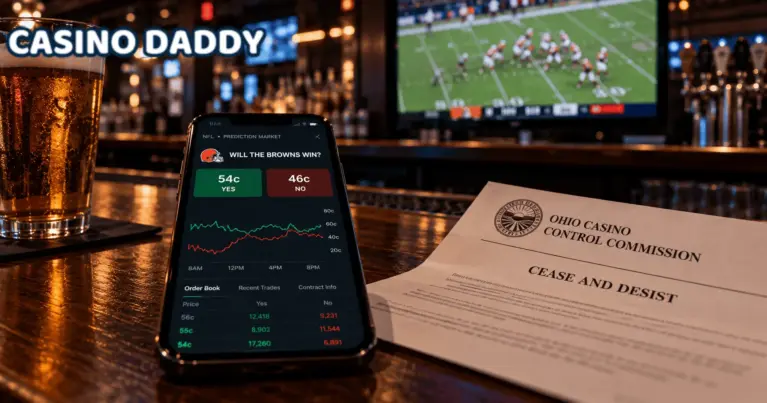
Ohio has spent more than a year arguing with prediction markets in court, and the state now wants to widen the fight. Governor Mike DeWine confirmed that more legal action is coming against operators selling sports event contracts, products he treats as gambling under existing state law. The Ohio Casino Control Commission has already served cease-and-desist notices on Kalshi, Polymarket and Robinhood.
His position leaves little room for negotiation. Ohio lets licensed sportsbooks take sports bets under strict conditions, and he sees no reason prediction markets should sell the same exposure without carrying the same licence, tax rate and age checks. Calling a wager an event contract does not change what the customer is doing with it.
DeWine Pushes Past Warning Letters
Notices went out, and the sports contracts stayed live. That result pushed the governor toward enforcement, and he has signalled that Ohio will now argue its case against prediction markets in court rather than send another round of correspondence. The commission has a list of companies already on record, which makes the next step a question of timing rather than target selection.
The advertising has irritated him as well. Ohio viewers see prediction markets promoted during live sporting broadcasts, running alongside the ads of licensed operators who pay a 20% tax and verify every customer’s age. He reads that as an attempt to compete inside the regulated market while sitting outside the rules that govern it.
The Jurisdiction Question Nobody Has Settled
Kalshi’s defence has not shifted. The company argues that its event contracts fall under the Commodity Futures Trading Commission, the federal regulator responsible for derivatives, and that state gaming authorities have no standing to interfere with a federally registered exchange. Ohio is not the only state to run into that argument, but it has pushed harder against prediction markets than most of its peers.
A federal court has already ruled that Kalshi must comply with Ohio law. The company challenged the decision and continues to maintain that federal oversight should override state gambling statutes. Where the appeals land will decide how much reach a state regulator actually has over a platform that answers to Washington.
Two Ohio Bills Would Pull Prediction Markets Into State Law
Lawmakers have opened a second front. Senate Bill 479, introduced on 13 October, would define betting on elections as prohibited gambling and stop platforms from listing election contracts in the state. Senate Bill 430 takes the sports side, classifying sporting event contracts as sports wagers and forcing operators to hold a state licence and pay tax on what they earn.
Senator Bill DeMora, who sponsors SB 430, puts the cost of doing nothing at $200 million to $300 million in lost revenue. His bill would also extend Ohio’s minimum age of 21 to prediction markets, closing the gap that currently lets younger users trade. So far neither proposal has built much momentum, and SB 430 has yet to be assigned to a committee.
The Age Gap Worrying Harm Prevention Groups
Derek Longmeier of the Problem Gambling Network of Ohio warned in September that prediction markets accept traders at 18, while the state’s licensed sportsbooks turn away anyone under 21. He described the 18 to 25 bracket as especially vulnerable, because trading takes seconds on a phone and younger users chase earlier losses more readily than older ones. That three-year gap sits at the centre of the consumer protection case against the platforms.
The dispute has strained relationships inside the harm prevention sector too. The Ohio Casino Control Commission parted ways with the National Council on Problem Gambling last September, after the organisation accepted a donation from Kalshi. The split raised uncomfortable questions about funding ties between watchdogs and the operators they scrutinise. The NCPG has maintained that accepting money from a company does not amount to endorsing its products.
What Happens Next
None of this resolves quickly. The litigation will grind through the appellate stage, the two bills will either find committee time or die on the calendar, and Ohio will keep seeing sports contracts offered on prediction markets until a court orders otherwise. DeWine leaves office after this term, which adds a political clock to an already slow legal process.
The stakes reach well past one state. If Ohio succeeds in applying its gambling laws to prediction markets despite their federal registration, other attorneys general will copy the approach within weeks. If the courts side with the platforms, every sportsbook paying for a licence will start asking why it bothered.

The Author
The Author
Slots and News Reviewer