



Oklahoma Sweepstakes Casinos Exit Ahead of November 1 Ban


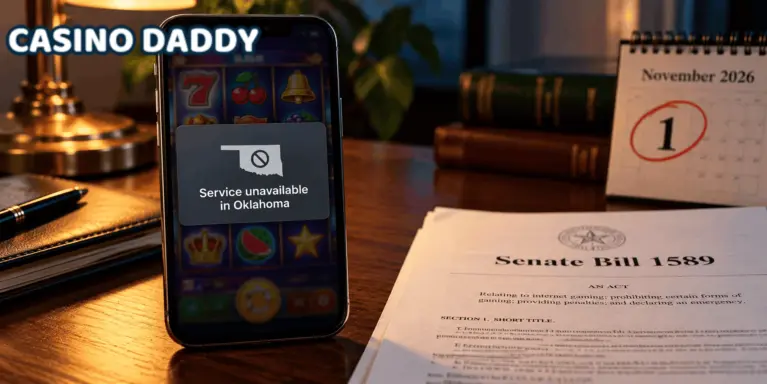
Oklahoma sweepstakes casinos have roughly a week and a half left before the state closes the door on them. Senate Bill 1589 takes effect on November 1, 2026, and it turns the dual-currency model that platforms like Stake.us and Modo built their US business on into a criminal offense. Several operators have decided not to wait for the deadline. Stake.us cuts off access on October 30, ACE Casino has already gone, and Baba Casino ended its coin play in the state earlier this month.
What SB 1589 Actually Changes
The law works by widening a definition rather than by naming the industry. Oklahoma now treats virtual currency inside a dual-currency system as a representative of value, which pulls Gold Coin and Sweeps Coin casino games directly into the state’s gambling statutes. That single change makes the standard Oklahoma sweepstakes setup illegal to operate. Violations carry a Class C2 felony, with fines running from $500 to $2,000 and the possibility of jail time.
Liability does not stop at the operator either. Suppliers, payment processors, geolocation providers and affiliates all sit inside the scope of the bill, which gives the law considerably more reach than a straightforward operator ban. Games run under the Oklahoma Charity Games Act stay legal, and so does tribal gaming conducted under the Indian Gaming Regulatory Act. Tribes pushed hard for the legislation, so that carve-out was never in question.
Oklahoma Sweepstakes Operators Are Leaving Early
Stake.us moved first among the larger brands. It stops serving players in the state on October 30, two days before the statutory deadline, though account holders can still log in afterwards to redeem what is left in their balance. ACE Casino went further and pulled out entirely before the announcement cycle even got going.
Modo picked a different route. The platform stopped selling coin packages that include Sweeps Coins to Oklahoma customers, told players to use or redeem the rest by November 1, and plans to stay in the state on Gold Coin play and its Boxes product. Baba Casino has taken the same approach, ending Sweeps Coin play in October while leaving its free-to-play side running. McLuck has also started trimming its Oklahoma sweepstakes offering.
Two Strategies, One Deadline
The split tells you something about how operators read the law. One group treats Oklahoma sweepstakes play as unsalvageable and walks away rather than risk a felony charge over a market of this size. The other strips out the redeemable currency and stays on as a pure social casino, betting that Gold Coin games fall outside the definition because nothing converts to cash.
Both approaches carry risk. A full exit hands the market to whoever stays, and re-entry gets difficult if a court later reads the statute narrowly. Staying on a Gold Coin basis keeps the brand visible but removes the prize mechanic that drives most of the revenue, so the Oklahoma sweepstakes business becomes a free game with a marketing function attached.
What Players Need to Do Before November 1
Anyone holding a balance should treat the end of October as the hard stop. Oklahoma sweepstakes accounts with unredeemed coins will not necessarily vanish, but redemption windows differ by platform and some of them close earlier than the statutory date. Stake.us set October 30 and Modo set November 1, so clearing balances now beats testing which policy applies.
Nothing in the law targets individual players, and the penalties point at businesses rather than the people using them. The state also has no regulated online casino market to absorb the demand, because compact disputes have kept even sports betting off the table. Tribal venues, the lottery and daily fantasy remain, which leaves a real gap for anyone who used these platforms specifically because they worked from a phone.
What Oklahoma Sweepstakes Rules Mean Nationally
Counting banned states depends on who is doing the counting. Nine states have a statute in force that bans or restricts dual-currency platforms, but the figure climbs to around fifteen once you include states squeezing the model through enforcement action or existing gambling law, among them Michigan, Nevada, Idaho and Washington. Neither number is wrong, because they measure different things.
Iowa shows why the lists get messy. Its SF 2289 handed the racing and gaming commission cease-and-desist and injunction powers from July 1 rather than declaring every sweepstakes product illegal, which produces a similar outcome through a different mechanism. Maryland tried twice in 2026 and failed in Senate committee both times, leaving a 2027 attempt wide open. Massachusetts, Pennsylvania, Ohio and Hawaii keep coming up as the next likely battlegrounds.
What Happens After November 1
Any Oklahoma sweepstakes operator that stays past the deadline with a redeemable currency intact will be testing a felony statute, and nobody in the sector looks willing to volunteer. The more interesting question is what happens to the Gold Coin holdouts, since the state has not yet shown how aggressively it reads its own definition. Enforcement will answer that faster than any further legislation.
For the wider industry, the Oklahoma sweepstakes ban matters because it survived a governor’s veto. Governor Kevin Stitt called the language vague and overbroad, and lawmakers overrode him in May anyway, the Senate by 34-10 and the House by 68-19. That House margin cleared the two-thirds threshold by a single vote, which is as close as the sector has come to a win all year and still counts as a loss.

The Author
The Author
Slots and News Reviewer