











New Jersey Prediction Markets Bill Sets Taxes, Bans


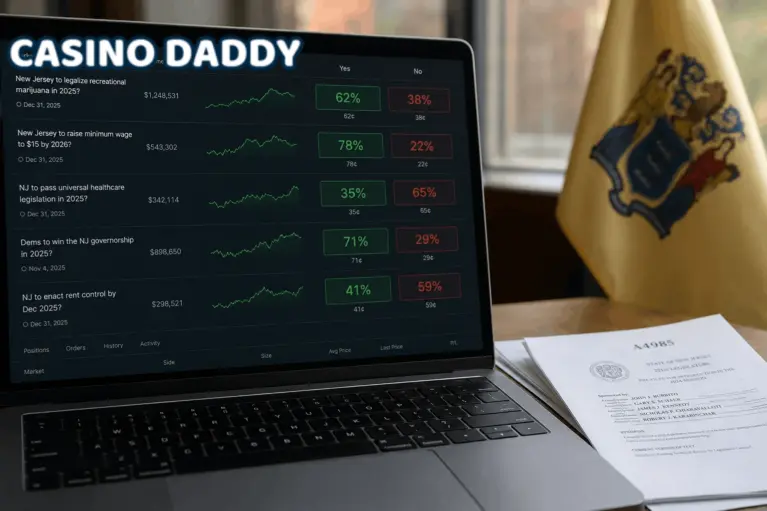
New Jersey lawmakers have introduced a bill that would create a complete regulatory and tax system for prediction markets. Senate President Nicholas Scutari and Sen. Paul Sarlo filed Senate Bill 4447 this week. It goes further than any previous attempt to bring New Jersey prediction markets under state control. The bill would license sports-related contracts, tax operators directly, and ban entire categories of products outright.
The companies behind these products insist they are simply letting people speculate on real-world events. New Jersey lawmakers see something closer to sports betting operating without a license. That disagreement sits at the heart of the debate over New Jersey prediction markets, and it explains why the proposal reaches so far beyond a simple tax increase.
How New Jersey Prediction Markets Would Be Licensed
Companies that want to offer sports-related contracts within New Jersey prediction markets would need state approval first. They could apply for a standard sports wagering license, or pursue a newly created athletic event market operator license. That second path requires a partnership with an existing licensed sportsbook. Oversight would then fall to the Division of Gaming Enforcement, which already regulates casinos and sports betting in New Jersey.
The bill also sets baseline standards for how these markets should operate. Operators would have to disclose the source of information used to settle a contract, and take real steps to prevent manipulation, insider trading, or fraud. Participants must be at least 21 years old. Operators would also need responsible gaming tools in place, including self-exclusion programs, age verification, and stronger controls on advertising and deposits. None of that exists today for most operators serving New Jersey residents, and the bill treats that gap as the central problem it wants to solve.
A New Jersey Prediction Markets Tax Plan Takes Shape
The financial side of the bill is just as detailed. Revenue from positions opened within New Jersey prediction markets would carry a 10% surcharge, paid quarterly into the state’s General Fund. Sports-related contracts face an even heavier tax burden. They carry the existing online sports wagering rate of 19.75%, stacked on top of that same surcharge.
Licensing alone is not cheap. Athletic event market operators face an initial fee of $5 million, with renewal costs to be determined later by regulators. Supporters describe this whole structure as a way to put prediction market operators on equal footing with the sportsbooks that already pay these same rates and fees.
Political Bets and Death Markets Would Be Banned
Not every prediction market would survive under this bill. The bill bans political event contracts, death markets, and contracts tied to catastrophic events entirely, regardless of licensing status. Operators that keep offering those products anyway could face serious consequences. The attorney general could seek injunctions, and violators risk civil penalties of up to $1 million per day. Unlicensed sports-related operators face penalties of their own. Running an athletic event market without state approval would be classified as a fourth-degree crime, carrying fines of up to $25,000 for individuals and $100,000 for companies.
Insider Trading Rules Target Public Officials
The bill also takes direct aim at public officials. It bars state and local employees, legislators, and certain family members from using inside information to trade on prediction markets. An official who breaks that rule would be guilty of a fourth-degree crime, punishable by up to 18 months in prison and a $10,000 fine. A family member or associate acting on an official’s behalf would instead face a lesser charge. That charge is a disorderly persons offense, carrying up to six months in jail and a $1,000 fine.
Part of a Wider Fight Over Who Regulates the Sector
This is the second prediction market bill introduced in New Jersey this year. An earlier, narrower proposal from Sen. Shirley Turner mainly sought to apply existing sports betting laws to event contracts. Scutari and Sarlo’s version goes much further, building a complete licensing and tax framework instead of just adjusting the rules already on the books.
Timing plays a role here too. A federal appeals court ruled in April that New Jersey could not block Kalshi from operating in the state, a decision that pushed lawmakers toward regulation rather than prohibition. Other states are running their own experiments with this same balancing act. Illinois has adopted a tax and regulatory structure of its own. Kentucky’s 14.25% tax has already triggered litigation from prediction market groups. Minnesota banned certain markets outright instead, a move now challenged by both Kalshi and federal regulators.
Senate Bill 4447 still has a long way to go before it becomes law. It currently sits with the Senate Budget and Appropriations Committee, and no hearing has been scheduled yet. Given how aggressively prediction market operators have fought similar rules in other states, New Jersey could be heading toward its own legal battle if this bill ever reaches the governor’s desk.

The Author
The Author
Slots and News Reviewer