
USD Coin casinos accept USDC, a stablecoin pegged to the dollar. Deposit a hundred dollars worth and it is still worth a hundred next week, whatever the market does. If you play across several sessions rather than in one sitting, that removes the most irritating thing about gambling with volatile coins.
The comparison everyone makes is with Tether, and rightly so. Both do the same job at a cashier, but USDC is issued by a regulated US company that publishes monthly reserve attestations and complies with Europe’s MiCA framework. Tether reaches more casinos; USDC has the clearer paperwork.
Below you will find the operators we currently rate highest for USDC play, followed by a full guide to deposits and withdrawals, and why the network you choose matters far more than the coin itself.
76 of the casinos we track accept USD Coin. Every one has been checked for its licence, its payout record and the small print on its bonuses.
 Reviewed byFred Anderson

Exclusive Bonus
 Rated 88 of 100%
welcome bonus
400% up to €4,000 + 400 FS


New Casino
Rated 83 of 100%
welcome bonus
250% up to €4,000 + 250 FS


Crypto Casino
Rated 76 of 100%
welcome bonus
200% up to €500

Crypto Casino
Rated 85 of 100%
welcome bonus
500% up to $10,000

Crypto Casino
Rated 89 of 100%
welcome bonus
100% up to €100,000

Crypto Casino
Rated 90 of 100%
welcome bonus
200% up to €100 + 150 FS

Crypto Casino
Rated 82 of 100%
welcome bonus
200% up to €2,000 + 500 FS
Rated 91 of 100%
welcome bonus
200% First Deposit Bonus

Rated 90 of 100%
welcome bonus
NO KYC REQUIRED

Rated 93 of 100%
welcome bonus
300% up to €3,000 + 300 FS

Rated 94 of 100%
welcome bonus
300% up to €3,000 + 300 FS

Rated 94 of 100%
welcome bonus
350% up to €15,000 + 350 FS
USD Coin casinos accept USDC, a stablecoin pegged to the dollar. Deposit a hundred dollars worth and it is still worth a hundred dollars next week, regardless of what the crypto market does. For anyone who plays across several sessions rather than in one sitting, that removes the single most annoying thing about gambling with volatile coins.
The obvious comparison is Tether, which does the same job and is accepted at more casinos. The difference is in how the two are backed and supervised. USDC is issued by a regulated US company that publishes monthly attestations of its reserves and operates under Europe’s MiCA framework. Tether has faced far more questions about its reserves over the years.
What is a USD Coin casino?
A USD Coin casino is an online casino that accepts USDC for deposits and withdrawals. Your balance tracks the dollar, so the only thing that changes it is how you play.
The 10 highest rated casinos accepting USD Coin, side by side.
| Casino | Rating | Licence | Min deposit | Min withdrawal | Withdrawal limit |
|---|---|---|---|---|---|
| Dragonia Casino | 95/100 | Anjouan | €10 | €10 | €15,000 Monthly |
| Wazbee Casino | 94/100 | Curacao | €10 | €20 | €310,000 Monthly |
| CasaBet Casino | 94/100 | Curacao | €20 | €25 | €50000 monthly |
| WinSpirit Casino | 94/100 | Curacao | €10 | €10 | €30,000 Monthly |
| 22Bet | 94/100 | Curacao | €10 | €10 | €15,000 Monthly |
| Avocasino | 94/100 | Anjouan | €20 | €20 | Not stated |
| Hugo Casino | 94/100 | Curacao | €20 | €20 | 15,000€ Monthly |
| Spellwin Casino | 94/100 | Curacao | €25 | €20 | €20,000 per Month |
| RetroBet Casino | 94/100 | Curacao | €20 | €20 | €20,000 |
| Welle Casino | 94/100 | Curacao | €20 | €20 | €20,000 Monthly |
Minimum withdrawal is not always the same as minimum deposit. Where it is higher, a small balance can sit stranded until you top it up.
A USD Coin casino treats USDC as a payment method. The games are identical to those anywhere else. What changes is that your balance sits still while you are away from it.
With Bitcoin or Solana, the amount you can withdraw depends on two things: how you played, and what the market did meanwhile. Win twenty percent and lose it to a price drop overnight and it feels like losing twice. USDC removes that second variable entirely.
It also makes bonus terms readable. A wagering requirement in dollars stays a requirement in dollars, so you can work out what you need to turn over without recalculating every day.
Both are dollar stablecoins and both behave identically at a cashier. The distinction is institutional. USDC is issued by Circle, a regulated US company that publishes monthly reserve attestations from an independent accounting firm and holds reserves in cash and short dated US Treasuries. It is also compliant with Europe’s MiCA regulation.
Tether is larger and more widely accepted, but has attracted more scrutiny over its reserves and paid regulatory settlements in the past. If counterparty transparency is something you weigh, that is the practical difference. If it is not, Tether will get you into more casinos.

Accepting USDC is a payment feature, not a mark of quality. Every site here goes through the same checks we run on any casino, plus several specific to a multi network stablecoin.
Sites that fail on licensing or on paying out do not make the list. The full method is on our how we rank casinos page.
The price is the least interesting thing about a stablecoin. Here is what actually determines how a USDC deposit behaves at a casino cashier.
Live EUR price from the Kraken exchange. Shown for reference only, not financial advice.
USDC
A stablecoin pegged one to one with the US dollar, issued by Circle, a regulated US company
Monthly attestations from an independent accounting firm, with reserves in cash and short dated US Treasuries
Compliant with Europe’s MiCA framework, which is the clearest difference from Tether
Ethereum, Solana, Base, Arbitrum, Polygon and others. The network you choose decides the speed and the cost
A fraction of a cent on Solana or Base, potentially several dollars on Ethereum mainnet. Same coin either way
ETH on Ethereum or Base, SOL on Solana. A wallet holding only USDC cannot send anything
The coin is stable, but your experience of it is not, because it depends entirely on which network you send it over. USDC on Solana or Base costs a fraction of a cent and arrives in seconds. The same USDC on Ethereum mainnet can cost several dollars and takes a minute or two. Same coin, same value, wildly different cost.
So the question is never whether to use USDC, it is which network your casino supports. If it offers Solana, Base or Arbitrum, take it. If Ethereum mainnet is the only option, deposit larger amounts less often, or consider Tether over Tron instead.
Depositing USDC is simple once you have settled the network question. Get that wrong and it is the one mistake that actually loses funds.
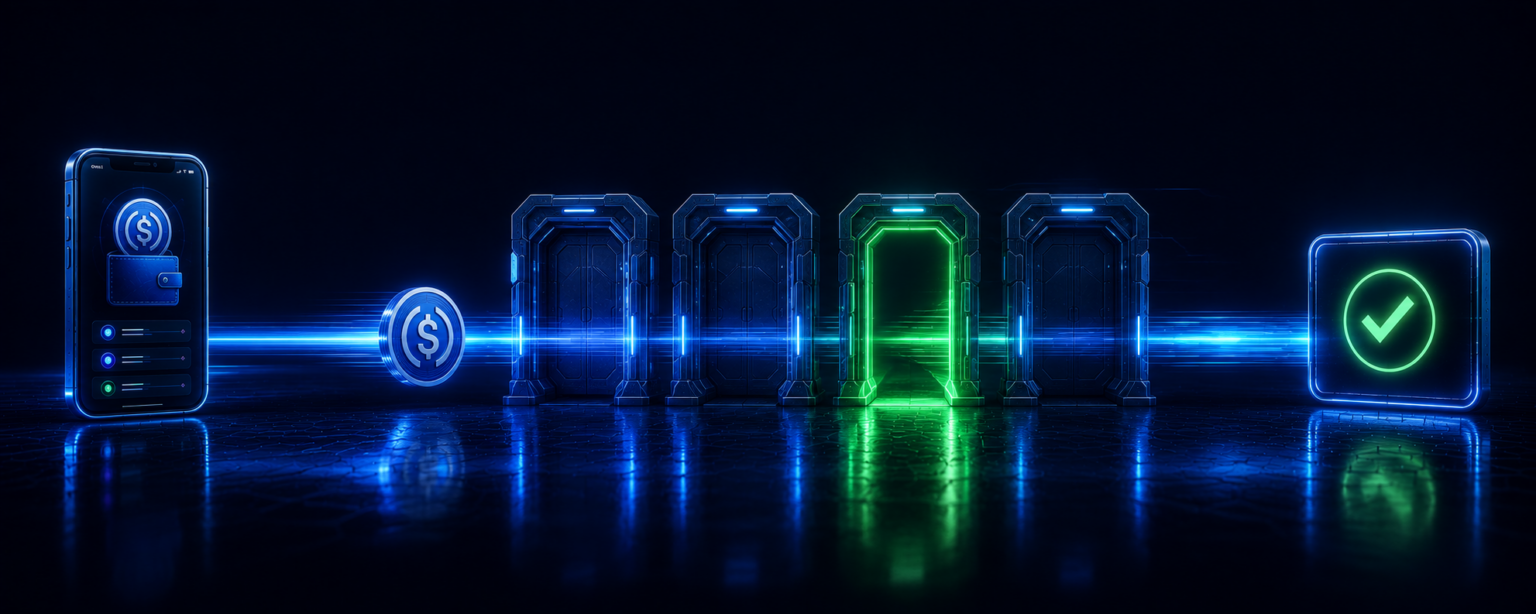
Withdrawals follow the same network logic as deposits, and the cost falls partly on you depending on the casino’s policy.
Approval, not the blockchain, is almost always the bottleneck. Casinos that process automatically can return funds in under ten minutes. Those reviewing manually may take a working day, and some only process during office hours. A first withdrawal is usually slowest because identity documents are requested then.
One advantage worth noting: because USDC does not move in value, a withdrawal sitting in review for a day is worth exactly what it was when you requested it. With a volatile coin that wait carries real risk.
There is no separate USDC lobby. You get the full library at whichever casino accepts it.
Crypto casinos popularised a family of in house titles you will not find at traditional operators: dice, mines, plinko and the rest. The whole category is covered on our casino originals page.
The best known are crash games, where a multiplier climbs until it crashes and you try to cash out first. A stable balance suits these particularly well, since bet sizing in dollars stays consistent from session to session rather than drifting with the market.
Many of these titles are provably fair, meaning the result can be verified afterwards.
This is where a stablecoin quietly earns its keep. Every figure in the terms means what it says, and keeps meaning it.
A 5,000 USDC wagering requirement is 5,000 dollars today and 5,000 dollars in a fortnight. With a volatile coin the same requirement shifts in real terms while you work through it, and a maximum bet cap can quietly tighten or loosen as the price moves. Neither happens with USDC.
Read the wagering multiplier and what it applies to, and the maximum bet allowed while wagering, which is the most common reason a withdrawal gets voided. Offers built around cryptocurrency are collected on our crypto casino bonuses page.
USDC and Tether do the same job, and Tether is accepted at more casinos. USDC’s argument is transparency: monthly reserve attestations, a regulated US issuer and MiCA compliance in Europe. Against the volatile coins the trade is simpler still. You give up any chance of your balance growing on its own, and in exchange it cannot shrink either.
Use USDC if you want a stable balance and care that the issuer publishes its reserves, particularly if your casino supports it on Solana or Base. Use Tether if you want the same stability at more casinos and the network choice matters more to you than the issuer. Use Bitcoin or Ethereum for the widest acceptance overall. Use Litecoin, Dogecoin or Solana if you want a coin of your own and are comfortable with the price moving.
Whichever you pick, the licence and the payout record matter far more than the coin. Our full crypto casinos hub covers every coin we have a page for.
USDC is one of the most predictable ways to fund a casino account, with one thing you have to get right.
Because a dollar balance is so easy to read, it is also easy to treat like a normal account and keep topping up. Set deposit limits, decide the amount before you start, and treat gambling as entertainment rather than income. For free and confidential support, visit BeGambleAware or read our responsible gambling guide.
A licensed USD Coin casino with proper encryption is as safe as any other online casino. The licence and the payout record decide whether a site is trustworthy, not the payment method. Accepting USDC tells you nothing on its own, so check the regulator before you deposit.
Both are dollar stablecoins and both behave identically at a cashier. The difference is the issuer. USDC comes from Circle, a regulated US company that publishes monthly reserve attestations and complies with Europe’s MiCA framework. Tether is larger and accepted at more casinos, but has attracted more scrutiny over its reserves. If transparency matters to you, USDC has the stronger record. If acceptance matters more, Tether reaches further.
Whichever cheap one your casino supports. Solana, Base and Arbitrum cost a fraction of a cent and settle in seconds. Ethereum mainnet can cost several dollars for the identical transfer. The coin is the same on all of them, so the network is the only thing that changes your experience.
The transfer completes on a chain the casino is not watching, so nothing is credited. This is the main risk with USDC, because a 0x address is valid on Ethereum, Base, Arbitrum and Polygon at once. Recovery means a support ticket and not every casino can do it. Always match the network in your wallet to the one the cashier specifies.
Almost certainly because you have no gas in the wallet. USDC cannot pay for its own transfer, so you need a small amount of the network’s own coin: ETH on Ethereum or Base, SOL on Solana. Add some and the transaction will go through.
No. The peg has held reliably and the reserves are attested monthly, but it depends on Circle remaining solvent and on the regulatory environment staying favourable. It is a company’s commitment rather than a guarantee. What it does remove is market risk: your balance will not shrink because Bitcoin had a bad week.
The Author
The Author
Site Admin