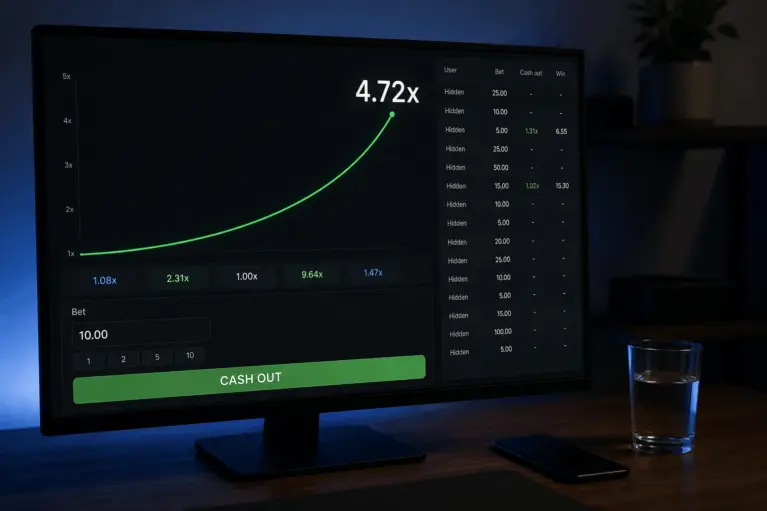
The original Crash game runs on a single rising number and one decision about when to stop watching it. A round opens, the multiplier leaves 1.00x and climbs, and it keeps climbing until it stops without warning. Cash out first and your stake gets multiplied by whatever the counter read. Leave it a second too long and the round takes the lot.
Casinos build Crash themselves rather than buying it in, which is why it lives in the originals section next to Plinko and Dice. BC.Game, Stake, BetFury and Roobet all operate their own version under the same short name. Most run a 1% house edge for a 99% return, though not every build matches that. The one you open depends entirely on the casino you opened it at.
Rounds resolve in seconds and every result stays independent of the last. That speed suits some players and catches others out, so knowing the mechanics before you stake anything counts for more here than in a slower game. Below you’ll find how a round is generated, how the builds differ, how to check a result yourself, and where the 2014 original still runs.
 Reviewed byNadia Winchester

New Casino
 Rated 82 of 100%
welcome bonus
550% up to €3540 + 400 FS


Exclusive Bonus
Rated 88 of 100%
welcome bonus
400% up to €4,000 + 400 FS

New Casino
Rated 83 of 100%
welcome bonus
250% up to €4,000 + 250 FS

New Casino
Rated 81 of 100%
welcome bonus
100% up to €5,000 + 175 FS


Crypto Casino
Rated 85 of 100%
welcome bonus
500% up to $10,000

Crypto Casino
Rated 89 of 100%
welcome bonus
100% up to €100,000

Crypto Casino
Rated 90 of 100%
welcome bonus
200% up to €100 + 150 FS

Crypto Casino
Rated 55 of 100%
welcome bonus
150% up to €1,300 + 100 FS

Crypto Casino
Rated 87 of 100%
welcome bonus
100% up to $1,500 + 150 FS

Crypto Casino
Rated 94 of 100%
welcome bonus
150% up to €4,000 + 400 FS

Rated 91 of 100%
welcome bonus
305% up to €1,200

Rated 89 of 100%
welcome bonus
305% up to €1,200

Crypto Casino
Rated 91 of 100%
welcome bonus
100% Deposit Bonus

Rated 91 of 100%
welcome bonus
200% Bonus up to €350

Rated 90 of 100%
welcome bonus
NO KYC REQUIRED

Rated 74 of 100%
welcome bonus
100% up to €500


Hot Casino
Rated 95 of 100%
welcome bonus
243% up to €5,555 + 243 FS

Rated 93 of 100%
welcome bonus
300% up to €3,000 + 300 FS
Crash belongs to the casino that built it. Each operator codes its own version, runs it in-house, and never licenses it out, which is why no aggregator carries the game and no studio sells it. Search a fiat casino’s list and you will often come up empty.
That changes what the name tells you. Two players can both say they play Crash and mean different math, different bet limits, and a different ceiling on the multiplier. The interface stays familiar across builds, with a curve, a bet panel, a cash-out button, and a live feed of other players heading for the exit. The numbers underneath are where the versions split.
Crash sits in the originals section rather than the slots grid. You will find it beside Plinko, Mines, Dice and Limbo in the casino originals lineup.
Crypto-first platforms carry it, and most fiat-only casinos skip it entirely. A house game needs a development team rather than a content deal, so plenty of operators never bother. If a lobby has an Originals tab, that is where Crash lives, running the same rising-multiplier loop as every other crash game in the room.
Crash asks for two inputs and hands you one decision. You set a stake, then you pick the moment to take the money back. Everything else on screen is information rather than control.
Casinos file Crash under Originals or House Games rather than the slot library, so the search bar is often quicker than browsing. Loading the game gives you the curve, a bet panel, and a running feed of live bets from other players. The round history strip above the curve shows recent crash points.
Bet limits sit lower on house builds than on licensed crash titles. Some casinos accept stakes of a few cents. Look at the maximum too, since each operator sets its own ceiling and its own cap on total win per round.
Deciding your cash-out target while the betting window is open beats reacting to a climbing number. Type the multiplier into the auto cash-out field and the game exits your bet the instant the curve touches it. Leave the field empty and you are cashing out by hand.
Once betting closes, the multiplier leaves 1.00x and accelerates as the round runs. Hitting cash out pays your stake times the figure on screen at that instant. Miss it and the round ends with the stake gone, no partial return.
Auto-bet places the same stake round after round until you stop it or hit a condition you set. Most house builds let you cap the number of rounds and set stop-on-loss and stop-on-profit values. Configure those before starting rather than watching the balance and deciding later.
The loop never changes, which is why the discipline sits in the settings rather than the reflexes. A target chosen calmly before the betting window closes tends to hold up better than one picked while the number climbs.
Most house-built Crash games run a 1% house edge, which puts the return at 99%. That single percentage governs everything else on the page: how often the curve busts early, what any cash-out target is worth, and how much a session costs you on average.
The edge sits inside the formula that turns a hashed result into a crash point rather than getting deducted from wins afterwards. In the standard implementation, roughly one round in a hundred busts instantly at 1.00x, and that slice of rounds is the entire margin. Nobody cashes out of those rounds, so the house collects without touching the payout on any other result.
That design has a useful consequence. Your cash-out target does not change the edge, because a player who exits at 1.5x every round and a player who holds for 50x face the same 1% over a long enough sample. What changes is variance, meaning how violently the balance swings on the way there.
Expected loss works out as your stake multiplied by the number of rounds, multiplied by the edge. Crash rounds resolve in seconds, so round counts climb faster here than in almost any other game, and that volume matters more than the percentage does.
| Stake per round | 100 rounds | 500 rounds | 1,000 rounds |
|---|---|---|---|
| €0.10 | €0.10 | €0.50 | €1.00 |
| €1 | €1 | €5 | €10 |
| €5 | €5 | €25 | €50 |
| €20 | €20 | €100 | €200 |
These are averages across a long run, not predictions for any particular session. Real results scatter widely around them, and the scatter gets wider the higher you set your cash-out target.
A 99% return stretches a bankroll further per round than most games in the lobby. It also removes the friction that slows a session down, and a game this cheap per round encourages more rounds. Two thousand rounds at a 1% edge costs more than two hundred rounds at 3%.
Check the figure at your casino rather than assuming it. Operators publish the house edge in the game info panel, and builds do vary, with some running closer to 97%. A number that appears nowhere in the interface is worth treating as a reason to look at a different site.
Two casinos can both list Crash and run entirely different games underneath. The house codes it, so the house sets the maths, the limits and the extras. That makes the version worth checking before the stake.
The core loop survives every build. A multiplier climbs from 1.00x, you cash out or lose the stake, and the result comes from a seed pair you can verify afterwards. Most versions also carry a live bet feed, a round history strip, and auto-bet controls.
Presentation barely varies either. Crash builds keep the stripped-back chart look rather than dressing the game up, which is part of the appeal for players who find Aviator’s plane and chat window noisy.
Return is the big one. BC.Game runs its Crash at 99%, and BetFury publishes a figure just above that, while Roobet sits lower at 97%. Two percentage points sounds trivial until you put it through a thousand rounds.
Ceilings differ too. Each operator caps the maximum multiplier and the maximum win per round at its own level, and those caps rarely get equal billing with the RTP. Minimum stakes vary by an order of magnitude between sites, and the currency list depends on what the casino supports rather than what the game does.
Some builds bolt features onto the base game. BC.Game’s Crash adds Trenball, a side bet on colour outcomes that resolves without a cash-out decision, plus a script editor for players who want to automate a betting pattern. Stake and Roobet keep closer to the plain format.
None of that changes the underlying odds, so treat extra modes as different ways to spend the same edge rather than an advantage. The game info panel is where the numbers live, and a build that hides them tells you something on its own.
Provably fair means you can prove a round was fixed before you bet on it. Crash builds all promise that, but they do not all reach it the same way, and a verifier from one casino will not validate a result from another.
The casino generates the crash point before betting opens, then shows you a hash of the seed instead of the seed itself. A hash cannot be worked backwards, so it proves the result existed without revealing it. When the round ends, the casino publishes the seed, you hash it yourself, and the two values match or they do not.
That is the whole guarantee. The result was locked before your bet, the casino could not adjust it mid-round, and you can check the claim rather than trust it.
Two approaches dominate. The chained model generates millions of seeds in advance, where each one hashes to the previous, and publishes the final hash at the start. Every round then unwinds the chain backwards, so a single published value verifies every result that follows it. Bustabit works this way.
The per-round model splits the work between you and the casino. A server seed pairs with a client seed you control, plus a nonce that counts up each round. You can change your client seed whenever you like, which stops the casino from knowing the outcome of a bet you have not placed yet.
Casinos publish a verifier for their own build, and the fairness or provably fair section of your account holds the seeds and the nonce. Paste the values in, compare the output against the crash point you saw, and the round either checks out or it does not.
Do the check after rotating your client seed, since a rotation forces the casino to commit to a fresh server seed. Our provably fair guide covers the hashing and the verification steps in detail. Any Crash build without a published verifier and visible seed history has not earned the label, whatever the game page claims.
The game that started the format never went away. Bustabit has run continuously since 2015, when Ryan Havar bought Eric Springer’s MoneyPot and rebranded it, and Daniel Evans has operated it since 2018. Green Train S.R.L., a Costa Rica company, holds it today.
Opening it is a shock if you arrived through Aviator. There is no lobby, no bonus, and no casino wrapped around the game. You get a chart, a chat window, a bet field and a list of players in the round.
Bitcoin is the only currency, and stakes get counted in bits rather than euros. The house edge sits at 1%, matching the better casino builds, and the hash chain that produces every result was published years in advance. Nobody can change it now, including the operator.
The site also lets players fund the bankroll instead of only betting against it. Investors take a share of what the house wins and a share of what it loses, which is the closest thing in gambling to sitting on the other side of the table. It is a niche well outside what a casino original offers.
For most players, no. Bustabit has no licence from a regulator you could complain to, no bonuses, no fiat, and no support desk in the sense a casino has one. Its case rests entirely on the maths being checkable and the code being open.
The reason to know it exists is context. Bustabit is why Crash looks the way it does at every casino running its own version, and it is the reference point those builds copied. Playing one of those builds gets you the same game with a licence, a wallet and a cash-out button that works in your currency.
No cash-out target beats the house edge, and no pattern in the round history predicts the next result. What Crash hands you is control over variance and over how fast you cycle through a bankroll. That is where the real decisions sit, and four of them matter more than the rest.
Progression systems fare worst under automation. Doubling after each loss recovers small amounts again and again, then meets the run that empties the balance or hits the table maximum. Set stop-on-loss and stop-on-profit values before starting, and never leave a script running without both.
Session length deserves the same attention as the target. A 99% return costs little per round, which quietly encourages more rounds than a slower game would, and volume is what actually drains a bankroll here. Deciding in advance how long you play matters as much as deciding where you cash out.
Crash sits in the same genre as the titles with mascots, but the differences are worth knowing before you pick where to spend a session.
Aviator brings the social layer that made the genre mainstream, with live chat, free-bet rain and a player count in the thousands. JetX runs the same loop with a heavier arcade feel, and Spaceman adds Pragmatic Play’s presentation and a half-cash-out option. All three follow you between casinos, because the studios license them out. Find a lobby with Spribe and Aviator behaves identically to the last one you played.
Return, mostly. Aviator and JetX run at 97%, Spaceman lands lower than either, and a well-built Crash gives you 99%. Crash also strips the round back to the chart and the button, which suits players who find the animations and chat feeds a distraction.
The trade is portability. Your Crash history, seed pairs and familiar limits belong to one casino, and switching sites means learning a different build with different caps. Branded titles travel; house games do not.

Crash only exists at casinos that build their own games, which narrows the field before you compare anything else. A lobby without an Originals or House Games section will not have it, and no amount of searching the slots grid changes that.
The house edge comes first, since the gap between a 99% build and a 97% one costs real money across a session. Find it in the game info panel rather than the casino’s marketing copy. A build that will not state the figure anywhere is worth walking away from.
Then check the fairness tooling. A working verifier, visible seed history and the ability to rotate your client seed are the difference between a provably fair claim and provably fair mechanics. Bet limits and the maximum win per round matter too, particularly if you plan to hold for high multipliers.
The casinos running Crash are overwhelmingly crypto-first platforms, which is a legacy of where the format came from rather than a rule about payments. Many of them accept cards and bank transfers alongside coins now, so crypto is not a requirement, just the common thread among operators with in-house development teams.
Our best crypto casinos list covers the sites with the deepest originals sections, along with what each one runs its house games at.
Crash gives you the best return in the crash genre and the least to look at. A 99% build costs a third of what Aviator does per round, and nothing on the screen competes for your attention. For players who want the mechanic without the mascot, that is the whole argument.
What you give up is portability and polish. Your build belongs to one casino, the limits and ceilings vary between sites, and there is no chat feed or free-bet rain to make a losing session feel social. Some players count that as a feature.
The honest caveat is pace. Rounds resolve in seconds, the low edge makes each one feel cheap, and volume is what actually empties a bankroll here. Decide your cash-out target and your session length before the first bet, use the stop conditions on auto-bet, and check the house edge in the info panel rather than assuming it. If a session stops feeling like entertainment, our responsible gambling guide covers the deposit limits, timers and self-exclusion tools worth knowing about.
Crash is a house-built casino game where a multiplier climbs from 1.00x and stops at a random point. You cash out before it stops or lose the stake. The format started with Bustabit in 2014 and casinos now code their own versions for the Originals section.
Most house builds run 1%, giving a 99% return, though some sit closer to 97%. The edge comes from the roughly one round in a hundred that busts instantly at 1.00x. Check the game info panel at your casino rather than assuming the figure.
Good builds are. The casino commits to a hashed seed before betting opens and publishes the seed afterwards, so you can verify the result was fixed in advance. Verification methods differ between casinos, so a verifier from one site will not validate a round from another.
No. Each crash point is generated independently, and the round history tells you nothing about what comes next. Any tool or service claiming to predict results is selling something that cannot work.
No. Exiting at 1.3x and holding for 50x both face the same edge across a long sample. What changes is variance, meaning how much the balance swings between results.
Only at casinos that build their own games, since the format is never licensed out to other operators. Look for an Originals or House Games section in the lobby, which is where these titles live. Crypto-first platforms carry it most often.
The Author
The Author
Slots and News Reviewer