




















New Game

Every slot lobby advertises a number of ways to win, and slot paylines are where that figure comes from. By the time it reaches 117,649, the word “line” has long since stopped applying to anything. A payline is a route through the grid, and counting routes remains the cheapest method ever invented for making a game sound generous. Nobody has to lie, because the arithmetic flatters without help.
The reels underneath decide what those routes can be. Five columns three symbols tall gives you fifteen positions, and every payline traces a path through them. The grid sets the ceiling before anyone starts counting. Widen it to six columns, let the height change between spins, and the count goes somewhere the human brain politely declines to follow.
Reels and paylines get filed as separate topics, which no game released this decade agrees with. You cannot explain 4096 ways without counting six reels, and a cluster grid pays without drawing a line anywhere. A 25-line slot can also hand you more across a session than something quoting a five-figure total. Read both numbers together and they tell you how often a game pays and what each spin really costs.
 Reviewed byNadia Winchester
Megaways sits behind a licence, cluster grids come from a short list of studios, and three-reel classics arrive from specialists nobody else competes with. A site running fifteen providers gives you one opinion about what a grid should be. The ones below carry enough to make the choice yours.


New Casino
 Rated 84 of 100%
welcome bonus
100% up to €100

New Casino
Rated 82 of 100%
welcome bonus
550% up to €3540 + 400 FS


Exclusive Bonus
Rated 88 of 100%
welcome bonus
400% up to €4,000 + 400 FS

New Casino
Rated 83 of 100%
welcome bonus
250% up to €4,000 + 250 FS

New Casino
Rated 81 of 100%
welcome bonus
100% up to €5,000 + 175 FS


Crypto Casino
Rated 85 of 100%
welcome bonus
500% up to $10,000

Crypto Casino
Rated 89 of 100%
welcome bonus
100% up to €100,000

Crypto Casino
Rated 90 of 100%
welcome bonus
200% up to €100 + 150 FS

Crypto Casino
Rated 55 of 100%
welcome bonus
150% up to €1,300 + 100 FS

Crypto Casino
Rated 87 of 100%
welcome bonus
100% up to $1,500 + 150 FS

Crypto Casino
Rated 94 of 100%
welcome bonus
150% up to €4,000 + 400 FS

Rated 91 of 100%
welcome bonus
305% up to €1,200

Rated 89 of 100%
welcome bonus
305% up to €1,200
Crypto Casino
Rated 91 of 100%
welcome bonus
100% Deposit Bonus

Rated 91 of 100%
welcome bonus
200% Bonus up to €350

Rated 90 of 100%
welcome bonus
NO KYC REQUIRED

Rated 74 of 100%
welcome bonus
100% up to €500


Hot Casino
Rated 95 of 100%
welcome bonus
243% up to €5,555 + 243 FS
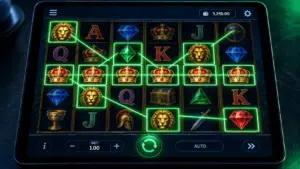 A payline is a route through the grid, drawn by the developer before the game ships and fixed for its entire lifetime. Line 1 runs flat across the middle row on almost every slot ever made. Line 7 zigzags down and back up because somebody at the studio decided it should, and that decision is now permanent.
Picture the standard layout: five reels across, three symbols tall, fifteen positions on screen. A payline touches exactly one position on each reel, so a five-reel line uses five of those fifteen squares and ignores the other ten. Symbols landing outside the route may as well have stayed on the strip.
That coloured line flashing across the screen after a win is a receipt. It explains a payout the game has already calculated and paid.
Combinations read from left to right, and they have to start on reel one. Four matching symbols sitting on reels two, three, four and five pay nothing, because the run never began. Every player learns this rule at the precise moment it costs them money.
Reel one carries far more weight than its position suggests, and studios build their reel strips knowing exactly that. The symbols you need most appear there least often, which is not an accident anybody is hiding.
Adjacency applies just as strictly in the middle. A run of three that skips reel three and picks up again on reel four is two separate non-events.
Older slots let you choose how many lines to play, and a winning run on a line you deactivated pays absolutely nothing. The game still draws it for you. Watching a five-symbol run land on line 18 while your bet covered fifteen lines is a specific kind of misery, and it is the reason most modern games removed the choice entirely.
Fixed-payline games activate every line on every spin. You pay for all of them and you cannot leave any behind, which sounds restrictive and mostly protects you from yourself.
Four things have to be true before a line pays:
Miss any of the four and the game owes you nothing, no matter how good the screen looks.
Every card below lists reels and paylines next to the RTP, so the two numbers this page is about are sitting in plain view before anything explains them.
Rated 71 of 100%
Rated 81.9522 of 100%
Rated 75.6442 of 100%
Rated 84 of 100%
Rated 88 of 100%
Rated 92 of 100%
Rated 82 of 100%
Rated 79.4 of 100%
Rated 92.4 of 100%
Rated 78 of 100%
Rated 81 of 100%
Rated 81 of 100%
Rated 91 of 100%
Rated 87 of 100%
A reel is a vertical column of symbols, and the column on your screen is a peephole onto something considerably larger, because the strip behind it carries far more symbols than the three or four visible at any moment. A spin picks where that strip stops, and the window shows whatever happens to be parked in front of it.
The vocabulary trips people up, so it is worth pinning down: reels run vertically and get counted left to right, while rows run horizontally and describe how tall the window is. So a 5×3 game has fifteen visible positions and five hidden strips.
Studios build each strip separately and stock them differently, so reel one is nothing like reel five, and a symbol that appears constantly on one column can be genuinely scarce on the next. It explains why runs keep dying on reel three, and why a game seems to hold opinions about which column should disappoint you today.
Wilds get this treatment hardest of all, and a wild that lands freely on reels two, three and four while never once touching reel one is doing precisely what it was built to do. The paytable admits it in small print nobody reads.
Free spins frequently run on a different set of strips from the base game, with low-value symbols thinned out and extra wilds dropped in, so the grid in front of you looks identical while the game underneath has been quietly swapped. That is why a bonus round can feel far more generous than the base game and genuinely be so, and it also explains what a bonus buy is really selling you.
Strip positions do not have to map evenly to results, and once they stop mapping evenly, counting the symbols on screen tells you nothing whatsoever about how often each one lands.
 Mechanical machines ran 18 to 22 stop positions per reel, which capped jackpots hard, since three reels of 22 stops only produces so many combinations. Inge Telnaes patented the fix in 1984 by letting a random number generator pick from a far larger range and mapping many of those numbers onto the same physical stop, and IGT bought the patent four years later. The industry has never looked back.
A symbol occupying one position in twenty on the strip can therefore land far less often than one spin in twenty, and online slots inherited the whole idea with no physical reel holding them back at all. What you are watching is a picture of a result rather than a mechanism producing one.
None of this is hidden, and licensed games get tested to confirm they behave as declared. It does mean the visible grid cannot tell you what your odds are, which is why the published RTP figure ends up being the closest thing to an answer available.
Reel count is the first constraint on everything else, because the number of columns and the height of each one decides which win mechanics are even available to the designer. A three-reel grid cannot host 243 ways no matter how the maths is arranged, and a 7×7 grid cannot host a payline that means anything, so the layout gets chosen before a single symbol is drawn.
The original layout survives because it works, running one to five lines across a 3×1 or 3×3 grid with almost nothing in the way of features. Wins land or they do not, resolved in under a second, and there is no cascade to watch or meter to fill while you wait to find out.
Studios still build them, and 1spin4win has made a whole catalogue out of the format. The appeal is that the return sits almost entirely in ordinary symbol payouts rather than being held back to fund a bonus round you might never trigger, which makes a session feel steadier even when the ceiling is low. Mega Joker and the Double Diamond line are the reference points here.
Five reels across three rows became the default because it is the smallest grid that comfortably supports a bonus round, a scatter, a wild that means something and a payline count large enough to advertise. Everything from 9 lines to 100 fits here, and the same grid drops its lines entirely to run 243 ways when each of the five columns shows three symbols.
Stretch the height to four rows and the ways count reaches 1024, with no extra reel required. Book of Dead and Starburst sit at opposite ends of what this layout can do, one packing a retrigger-heavy bonus into ten lines, the other paying in both directions across a grid with no bonus round at all.
Adding a sixth column changes the arithmetic sharply rather than gently, since a 6×4 grid produces 4096 ways where 5×4 produced 1024. Coconut Island runs exactly that configuration, and the jump from four columns to six is the single cheapest way for a studio to quadruple a number on the thumbnail.
Six reels is also the Megaways baseline, which is why so many games in this bracket carry variable symbol counts and a cascade. Base hits arrive more often across the wider grid, though each individual one covers a smaller share of your stake.
Past six columns the concept of a line stops being useful, and games at this size mostly abandon paylines rather than trying to draw thousands of them. Reactoonz runs 7×7 and Jammin’ Jars runs 8×8, both paying for clusters of touching symbols with no direction or starting reel involved at all.
These grids hold enough positions that a single spin can produce several separate wins, and the tumbling mechanic that usually accompanies them turns one spin into a sequence. That is a different rhythm from a five-reel game, and it suits people who would rather watch something unfold than get a verdict immediately.
| Layout | Visible positions | Win mechanic it supports | How a session feels |
|---|---|---|---|
| 3×3 | 9 | 1 to 5 paylines | Fast, flat, no waiting |
| 5×3 | 15 | 9 to 100 lines, or 243 ways | Bonus-led, familiar |
| 5×4 | 20 | 40 lines, or 1024 ways | More frequent, smaller hits |
| 6×4 | 24 | 4096 ways | Busy grid, diluted line value |
| 6 reels, variable height | 12 to 42 | Megaways, up to 117,649 ways | Swingy, cascade-driven |
| 7×7 and larger | 49+ | Cluster pays, no lines | Chain reactions, slower resolution |
A wider grid buys more chances per spin and shrinks what each one returns, so the total stays roughly where the maths model put it. Reel count tells you how a game will feel across an hour, and it tells you nothing at all about how much it intends to give back.

The bet you place is not a bet on the spin, it is a bet on each line separately, which is the single most misunderstood thing about slot pricing. A game with 20 paylines and a 5c line stake costs €1 per spin, and the €1 figure on the button is doing the arithmetic on your behalf without ever showing you the sum.
That matters because every payout is calculated against the line stake rather than the total. Land a combination paying 10x on that same game and you collect 50c, which is a win by the game’s definition and a 50c loss by yours, complete with celebratory noises.
Older slots let you switch lines off to reduce the cost per spin, and the appeal was obvious to anyone watching a bankroll drain. Playing 5 lines out of 25 dropped the spin cost to a fifth of the maximum, which felt like control and was really just a smaller ticket to a game that had stopped checking most of its own grid.
The problem arrived every time a five-symbol run landed on line 18. The game drew it for you, lit it up, and paid nothing, because you had declined to buy that particular line before the reels moved. Studios eventually decided the feature generated more resentment than flexibility, and fixed-line games now dominate almost everything released.
A fixed-payline game activates every line on every spin, so your only decision is the stake per line. Nothing on the grid goes unchecked, no win gets drawn and then withheld, and the trade is that you cannot make the spin cheaper by making the game smaller.
Ways-to-win games work the same way by necessity, since there are no lines to switch off in the first place. A 243-ways slot evaluates all 243 routes every single time, and the number sitting in the game info is a description of the grid rather than a menu you can shop from.
Two games advertising a €1 minimum spin can price identically and behave completely differently, because a 10-line game at 10c per line pays 10x the line stake on a decent hit while a 50-line game at 2c per line pays 10x of almost nothing. The spin costs the same, the win sizes do not, and the paytable multipliers you are reading apply to the smaller number in both cases.
The useful habit is finding the line stake before the total, since that figure is what every multiplier in the paytable refers to. On ways-to-win and cluster games the same logic applies to the total bet directly, and the volatility of the game decides how far apart the wins arrive once you know what each one is worth.
Ways-to-win games drop paylines entirely and pay for matching symbols on adjacent reels regardless of which row they land in, starting from reel one as always. The advertised number is not a design choice or a generosity setting, it is just the count of every possible route through the grid, and you can work it out yourself in about four seconds.
Multiply the symbols per reel together, once per reel. Five reels showing three symbols each gives 3 x 3 x 3 x 3 x 3, which is 243, and the same grid with a fourth row gives 4 to the power of five, or 1024. Add a sixth column to that four-row grid and you land on 4096, which is the configuration Coconut Island runs.
| Grid | Calculation | Ways to win |
|---|---|---|
| 5 reels, 3 rows | 3⁵ | 243 |
| 5 reels, 4 rows | 4⁵ | 1,024 |
| 6 reels, 4 rows | 4⁶ | 4,096 |
| 6 reels, 5 rows | 5⁶ | 15,625 |
| 6 reels, 7 rows | 7⁶ | 117,649 |
That last row is the Megaways ceiling, reached only on spins where all six reels happen to extend to their full seven symbols, which is a good deal rarer than the marketing implies.
Here is the part the number hides. A win on a 243-ways game pays for the matching symbols and nothing else, so three matching symbols on the first three reels counts as one hit no matter how many of the 243 routes technically pass through those positions.
The routes are not separate prizes waiting to be collected, they are the accounting method the game uses to check itself. Landing two identical symbols on reel one, one on reel two and one on reel three produces two wins rather than one, because either symbol on the opening reel can start a run, and that is where the ways count earns its keep in practice.
Ways games charge a flat stake covering the entire grid, which removes the per-line arithmetic and replaces it with a total that means what it says. A €1 spin on a 243-ways slot is €1 against all 243 routes, and the paytable multipliers refer to that whole figure rather than a slice of it.
The maths model still has to balance, so a game evaluating hundreds of routes pays proportionally less for each hit than a 20-line game paying against a line stake. More frequent wins, smaller wins, same return over time, which is the trade this entire format runs on.
Megaways takes the ways-to-win formula and removes the one thing holding the number steady, since the reels no longer keep a fixed height between spins. Each of the six columns lands anywhere from two to seven symbols, the ways count gets recalculated on the spot, and every spin arrives with a different grid and a different total printed above it.
Big Time Gaming built the engine, launching it in Dragon Born and turning it into an industry standard with Bonanza. The mechanic now appears in over 200 games from multiple studios under licence, and Evolution bought the company in 2021 in a deal worth up to €450 million, which gives you a fair sense of what a well-designed reel modifier is worth.
Seven symbols on all six reels gives 7⁶, which is 117,649, and that figure appears on the marketing because it is the largest number the grid can produce. Reaching it requires every single reel to extend to full height on the same spin, and most spins land nowhere near it.
A more typical spin might show four symbols on three reels and three on the others, which works out somewhere in the low thousands. The counter above the reels updates honestly every time, so the game tells you exactly how far from the headline you actually are, and nobody looks.
Many implementations add a horizontal carriage above the main grid, feeding extra symbols into the middle columns and pushing the count higher without adding a seventh reel. It is a neat piece of design, and it exists because six columns of seven was already the ceiling.
Winning symbols disappear and new ones drop in, so a single spin can resolve into a chain of separate wins, and free spin rounds on these games frequently carry a multiplier that climbs with every step of the chain. That combination produces the numbers people post screenshots of, and it also produces the long dry stretches that fund them.
Megaways games skew high volatility as a rule, because the maths has to pay for a mechanic capable of paying thousands of times the stake. The base game feels tighter than the ways count implies, and most of the return sits inside a bonus round you might spin two hundred times without seeing. The volatility page covers what that distribution does to a bankroll in practice.
The useful checks take seconds. Look at the ways counter on a few idle spins to see the range the game actually operates in, check the paytable for whether the multiplier resets between cascades or carries through the round, and find out how many scatters the bonus needs.
That last one varies more than people expect across games sharing the same engine, and a four-scatter trigger on a six-reel grid is a materially different proposition from a three-scatter one.
Some games dispense with routes entirely, paying instead for where symbols sit relative to each other or for how many turned up at all. These formats arrived once grids grew past the point where drawing lines meant anything, and they now cover a large share of what studios release.
A cluster win needs a group of matching symbols touching each other horizontally or vertically, usually five or more, anywhere on the grid. Direction stops mattering, reel one stops mattering, and a shape sprawling diagonally across the middle of a 7×7 board pays exactly as well as a neat vertical block.
 Reactoonz and Jammin’ Jars built their reputations on this, both pairing clusters with tumbling symbols so one landing can clear space for the next. The pacing is completely different from a payline game, since a spin becomes a sequence that resolves over several seconds and you spend most of it watching rather than deciding.
Cluster games also tend to hide their real potential inside charge meters and progressive multipliers that build across a single spin chain. A dead-looking board can turn into the best result of your session three tumbles later, which is precisely the hook.
Scatter pay games count matching symbols wherever they land, with no adjacency requirement at all, so eight matching symbols scattered randomly across a 6×5 grid pays the same as eight sitting together. Pragmatic Play’s Sweet Bonanza and Gates of Olympus are the format’s most copied examples, and the mechanic has spread far enough that it now feels like a genre rather than a feature.
The threshold does the work here. Wins usually start at eight or more of a kind, which sounds demanding and is entirely reasonable across thirty positions, and the number required is what keeps the game honest rather than the placement.
Both-ways games keep conventional paylines and evaluate them from the right as well as the left, which roughly doubles the qualifying combinations without changing the grid or the stake. Starburst is the format everyone knows, and the doubled hit rate is a large part of why it feels so gentle to play.
The trade sits in the paytable, since a game paying in two directions has to pay less per hit to balance. More wins, smaller ones, and a session that lasts longer while going nowhere in particular.
| Format | What triggers a win | Does position matter? |
|---|---|---|
| Paylines | Symbols on a set route from reel one | Yes, exactly |
| Ways to win | Adjacent reels from reel one, any row | Reel order only |
| Cluster pays | Touching group of matching symbols | Adjacency only |
| Scatter pays | Enough matching symbols anywhere | Not at all |
| Win both ways | Payline runs from either end | Yes, in two directions |
The looser a format is about position, the more often it pays and the less each hit returns, which holds across every row above without exception.

Every format above fixes the grid before the spin resolves. A separate group of mechanics rebuilds it while the round is still running, which makes the reel and payline counts in the game info a starting position rather than a description of what you will actually be playing.
3 Orbs of Zeus and Lucky And Brave Win Spins both run collection rounds of that last kind, and the format spread across the industry because a visible partial fill is considerably harder to walk away from than a losing spin. Bonus mechanics of this sort get fuller treatment on the slot features page.

Industry News
The payline figure on a game tile is the most prominent number in most lobbies and one of the least useful. It describes how thoroughly the game inspects its own grid, and a game checking 117,649 routes is not paying more than one checking 20, it is dividing the same return into smaller and more frequent pieces.
A 20-line slot might pay something on one spin in four, while a 4096-ways game pays on one in two, and the second game is not being generous with anything. Both are working toward the same return over time, so a format landing wins twice as often has to make each one roughly half the size.
The pattern holds all the way up. Cluster and scatter formats pay constantly and pay small, three-reel classics pay rarely and pay properly, and the number in between tells you which experience you are buying rather than how much is coming back.
Here is the practical consequence. On a 25-line game at 4c per line, your spin costs €1, and a three-symbol combination paying 5x the line stake returns 20c. The screen celebrates, the counter ticks up, and you are 80c down on a spin the game just told you that you won.
These sub-stake wins are the most common outcome on any high line count game, and they are the reason a session can feel like it is going fine while the balance drops steadily. Ways and cluster formats do the same thing with different arithmetic, paying multiple small amounts that add up to less than the spin.
None of this touches the return figure. A game’s RTP is set by its maths model, and the payline count is one input into that model rather than a lever that raises or lowers what comes back. Two games from the same studio at 96% will return the same over the long run at 10 lines or at 10,000 ways.
What the line count changes is the shape of the journey, which is a different thing from the destination and matters more to most sessions. Anyone comparing games on the headline number would be better served comparing the RTP figures instead, since that is the only number on the page describing what the game gives back.
The paytable sits two taps from the reels on every licensed slot ever built, and nobody opens it. Thirty seconds in there answers most of what this page has covered, for the specific game in front of you rather than in general.
Six things worth finding before the first spin:
Cluster and scatter games move the important detail elsewhere, since the threshold for a paying group matters more there than any of the above. Eight symbols required instead of five is a substantially harder game wearing the same clothes.

Nothing on this page makes one format better than another, since they all resolve through the same random number generator and most sit within a percentage point of each other on return. What separates them is pacing, and pacing decides how a deposit feels on its way out.
| If you want | Look for | What you give up |
|---|---|---|
| Fast, simple spins | 3 reels, 1 to 5 lines | Bonus rounds and big ceilings |
| Frequent small wins | 243 or 1024 ways, both-ways games | Wins that clear the spin cost |
| A long shot at a huge multiplier | Megaways, high max win | A base game that pays anything |
| Something to watch unfold | Cluster grids with tumbles | Quick resolution per spin |
| Predictable spend | Fixed lines, flat stake | The option to play cheaper |
The mismatch that catches people most often involves picking a Megaways title for the headline number and then finding the base game hostile, because the return on those games lives almost entirely inside a bonus round that arrives on its own schedule. A 243-ways game at the same stake will keep you spinning considerably longer and hand you nothing memorable, which is the trade in the opposite direction.
Bankroll size decides more than preference does. Formats with a high ceiling need enough spins for the ceiling to become relevant, and playing one on a deposit that covers eighty spins is buying the shape without buying the distance.
Reels set the boundaries and paylines describe how the game reads what lands inside them, and once you can see both numbers doing their separate jobs, the figure on the lobby tile loses most of its power to impress. A 25-line game and a 117,649-way game are the same proposition arranged differently, dividing a similar return into pieces of very different sizes.
The number worth reading is the one describing what comes back rather than how thoroughly the grid gets checked. Everything else on this page tells you what an hour will feel like, which is worth knowing before you buy the hour rather than after.
Pick the format that suits the session you actually want. Fast and flat, frequent and small, or long and swingy are all available at roughly the same cost, and the only genuinely poor choice is arriving at one by accident because a big number was printed on the tile.
Only on games built for it. Standard paylines evaluate from reel one moving right, so a matching run that starts on reel two pays nothing regardless of length. Both-ways titles like Starburst check from either end and pay whichever direction qualifies, and the game rules state this clearly because it affects the value of every symbol in the paytable.
The visible grid holds more positions than any single payline touches, so high-value symbols land in view without landing where they count constantly. Reel strips also stock symbols unevenly, meaning a symbol you see frequently in the window can still be genuinely rare on the line. Nothing is targeting your particular spin, and the effect is a consequence of showing three rows while paying on one.
They pay more often and pay less per hit, which is a different thing from better odds. Both formats are built to a target return set by the maths model, so a 243-ways game at 96% and a 20-line game at 96% give back the same amount over time. The difference lands entirely in how that amount is distributed across your session.
It drops, and the counter above the reels updates to show the real figure for that spin. Six reels showing three symbols each produces 729 ways rather than 117,649, and spins in that range are far more common than the headline suggests. The number only reaches its maximum when every reel extends to seven symbols simultaneously.
Regularly, and it is the most common outcome on high line count games. A payout of 5x the line stake on a 25-line game returns a fifth of what the spin cost, complete with the animation and the rising counter. Ways and cluster formats produce the same result through multiple small wins that add up to less than the total bet.
Reel count changes the number of combinations available rather than the amount returned. A six-reel game spreads its return across more frequent, smaller wins than a three-reel game working with the same percentage. Maximum win potential comes from the multipliers and features inside a game rather than from the width of its grid.
The Author
The Author
Slots and News Reviewer