











Italy Seizes 145 Cosenza Slot Machines in Alleged Fraud Case


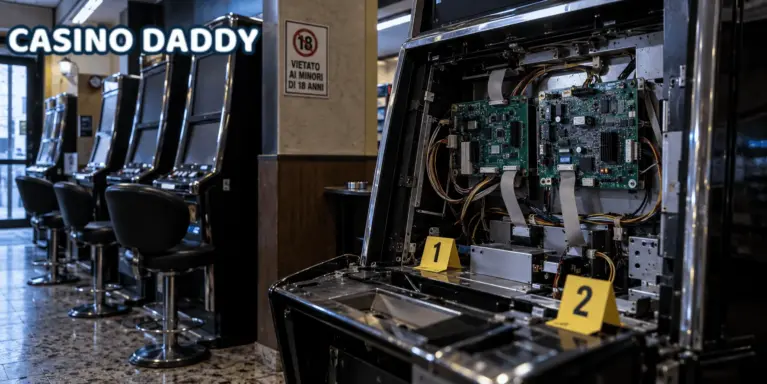
A routine check of wager data inside Italy’s gambling regulator ended with 145 slot machines loaded onto police trucks. Officers from the Carabinieri’s Cosenza Provincial Command worked with the Gaming Directorate of the Agenzia delle Dogane e dei Monopoli, known as ADM, to impose precautionary measures on 15 people across the Calabrian province. In Cosenza, the alleged slot machine fraud ran on hidden circuit boards, wireless switches and, prosecutors suspect, a paid contact sitting inside the regulator itself. The case remains at the preliminary investigation stage, and no court has convicted anyone.
145 Machines and €80,000 Pulled From Provincial Venues
Inspections across the province produced 145 gaming machines and roughly €80,000 in cash. The measures split three ways. Two suspects went into house arrest, six received non-custodial restrictions, and seven now face a one year ban on operating or taking part in gambling activity of any kind. Italian precautionary measures arrive long before a verdict does, so all 15 keep the presumption of innocence.
Officers across Cosenza pulled slot cabinets out of local venues, and every one of them now sits in storage as evidence in a fraud inquiry that remains open. The operation did not begin with a tip or a complaint. ADM’s telematic monitoring, which collects turnover data from every legal machine in the country, picked up striking anomalies in the figures arriving from several terminals in the province. Those readings looked wrong enough to justify a far wider look.
Hidden Boards Allegedly Kept Wagers Off the State Register
Investigators believe the cabinets carried a second set of electronics. Unauthorised boards allegedly sat alongside the approved ADM-connected hardware, wired in so that play could shift away from the official system on command. The suspected rig used modified cabling, remote wireless controls, timers and monitor switches, a combination that would let someone flip a machine between its legal mode and an unrecorded one without ever opening the cabinet in front of customers.
The financial logic behind it is blunt. Every licensed machine in Italy reports its turnover to the state register, and the Prelievo Erariale Unico levy follows from those reported figures. A wager that never reaches the register produces income the tax authority cannot see, so investigators in Cosenza now treat the slot cabinets as the central exhibit in a fraud case built around unpaid tax.
Forensic work on phones, tablets, computers and storage devices allegedly mapped out how the group pushed play onto the cloned boards. That digital trail matters. Hardware on its own proves little about who installed it, who switched it on, or who collected the money afterwards. Investigators in Cosenza still need to tie each slot cabinet to a named operator before the fraud file holds together.
An ADM Employee Allegedly Sold the Inspection Schedule
Prosecutors are also examining the conduct of a local ADM employee, and this is where the case moves past tampered hardware. The official allegedly accepted payments in return for confidential information about planned inspections, including dates and the venues on the list. Operators could then strip out the illegal components before anyone arrived, leaving inspectors to look at machines that appeared entirely compliant. A warning of that kind would make the Cosenza venues close to invisible to the slot inspections designed to catch fraud of this type.
The allegations go further. The same employee faces accusations of using access to an ADM warehouse to retrieve sealed boxes of electronic boards confiscated in earlier cases. He allegedly handed those components to members of the group, who modified them and put them back into service. If prosecutors prove it, operators in Cosenza knew which venues inspectors planned to visit and recycled seized slot hardware straight back into the fraud scheme that produced it.
The offences under investigation cover participation in a criminal organisation, corruption, and the disclosure and use of official secrets. Prosecutors are also looking at fraud against the state, tax evasion and aiding and abetting. No court has tested any of those claims, and the suspects have had no chance to answer them in front of a judge.
Why the Cosenza Slot Machine Fraud Case Matters for Italy
This action connects to a larger investigation that has already produced results. In November 2025, authorities seized more than €12 million in cash and assets tied to the same case, which gives some sense of the money prosecutors believe moved through the network. The file now holds slot machines, cash and a fraud allegation that reaches inside the regulator.
The timing is awkward for Italy. A new framework for online betting and casino operations went live in November 2025, while the rules covering retail gaming remain unsettled, and the Cosenza allegations about slot machine fraud land in the middle of that argument. Lawmakers pushing for tighter control of land-based machines now have a case study involving the regulator’s own warehouse.
Enforcement elsewhere has followed a similar shape. Investigators recently seized more than €25 million in assets while examining former employees accused of exploiting privileged access connected to Gratta e Vinci scratchcards. Two cases do not make a pattern, but both involve insiders rather than outsiders, and both put the same question to Italy’s gambling authorities about their internal controls.
What Happens Next in Calabria
Prosecutors in Cosenza now have to connect the slot cabinets, the hidden boards and the alleged leak of inspection dates into a single fraud case that survives a courtroom. Preliminary investigations in Italy can run for years, and defence lawyers often challenge precautionary measures long before a trial date appears. The 15 people involved may yet see those restrictions reduced or lifted entirely.
For the wider market, the detail worth watching is the warehouse. If confiscated boards really did return to circulation, then Italy’s seizure process needs attention as much as its machines do. The Cosenza case has handed ADM a problem that no volume of slot monitoring data can solve on its own, because fraud of this kind needed a person on the inside.

The Author
The Author
Slots and News Reviewer