










Kalshi Sees $185K in Block Trades Backing Cincinnati


Kalshi has recorded two block trades worth $92,500 apiece, both of them backing the Cincinnati Bearcats to qualify for the 2027 NCAA men’s basketball tournament. The orders landed within 19 minutes of each other on Wednesday afternoon, 4 November, and together they committed $185,000 to a market that had barely moved in six weeks. If Cincinnati reaches the expanded field, the positions return $250,000. If the Bearcats miss, the entire stake disappears.
Nineteen Minutes and 250,000 Contracts
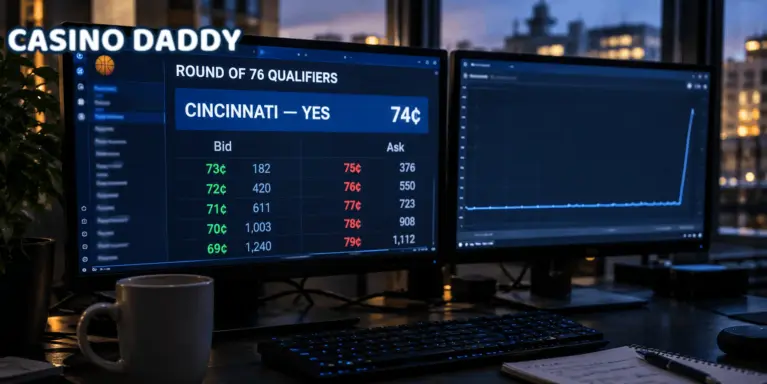
Each order bought 125,000 YES contracts at 74 cents. The first cleared at 2:44pm ET and the second followed at 3:03pm, pushing open interest in Cincinnati’s contract to 250,065. Market surveillance firm BETINT picked up the matching pattern and flagged both orders as unusual for a college basketball market this early in the season. Kalshi treats block trades as off-exchange business, so the two positions reached the public record only once they had closed.
Price deserves as much attention as size here. Cincinnati’s last ordinary trade before Wednesday went through at 82 cents, and the smaller trades that followed the two blocks sat between 79 and 82. Both large orders filled at 74, which is below anything a buyer working the public order book could have reached that afternoon.
A Market Nobody Was Trading
Kalshi opened its Round of 76 Qualifiers market on 22 September, shortly after the NCAA voted to expand both the men’s and women’s tournaments from 68 teams to 76. Cincinnati drew almost no attention in the weeks that followed. Only 39 contracts on the Bearcats changed hands across the entire six-week stretch, which is the kind of volume you would expect from a handful of curious retail traders.
Two orders then swallowed the whole book. The pair of Kalshi positions, both executed as block trades, now account for roughly 95% of all volume across the exchange’s 126-team market. One mid-tier program with modest expectations now carries almost the entire market on its own. No other school in the Kalshi field has drawn block trades at anything close to that scale.
Cincinnati finished last season 18-15 and missed the tournament. The Bearcats opened this campaign with a comfortable 79-53 win over American University, though a single November result tells you very little about March. By Thursday morning, Kalshi’s pricing implied an 82% chance that the team qualifies.
Why Kalshi Keeps Block Trades Out of Public View
Kalshi runs block trades on a completely separate track from ordinary exchange activity. Counterparties negotiate a price privately, away from the public order book, then report the finished transaction to the platform afterwards. The exchange never discloses who sits on either side of those deals.
Kalshi also restricts block trades to a narrow group of participants. Financial institutions, investment funds, regulated insurers and entities holding more than $10 million in assets qualify, and the facility exists so that very large positions fill without dragging public prices around. That threshold says something about the buyer’s profile, though it reveals nothing at all about identity.
BETINT offered two readings of the identical size, price and timing. One buyer may have split a single order in half, or a broker may have executed on behalf of two separate clients. Nobody has confirmed either reading. No evidence so far links the two orders to any specific person, firm or financial arrangement.
The LSU Precedent That Does Not Fit Here
Big sports positions on the exchange are no longer rare. Kalshi has handled nine sports block trades since 27 July, worth roughly $1.38 million on the purchased side. The Cincinnati orders join an established pattern rather than starting one.
The clearest precedent involves LSU football. Five sizeable positions backed the team to win the national championship, with a combined payout of $3 million riding on the outcome. A third party reportedly placed them while managing exposure to a coaching bonus, which is a legitimate hedge against a contractual payment and explains the money cleanly.
Cincinnati does not line up the same way. Head coach Jerrod Calhoun’s reported bonus for reaching the NCAA tournament sits at $100,000, well short of the $250,000 these contracts would pay. Nobody has identified a comparable arrangement behind the Kalshi orders, and no regulator or exchange has alleged wrongdoing.
What the Orders Leave Unanswered
The purpose of the two positions remains unknown, and the structure of the market means it may stay that way. Someone with institutional-grade access took a $185,000 view on a team that finished five games above .500 last season and watched its contract sit untouched for a month and a half. Recruiting information, a scheduling read, a private hedge or plain conviction about an easier 76-team field could all sit behind it.
Kalshi now runs block trades alongside a retail product that regulators across several US states are already fighting over. The two systems answer to different disclosure standards, and this episode puts that difference on display. A retail trader buying at 79 cents could see the price move without ever learning why it moved, or who moved it.
Cincinnati plays its season out over the next four months, and the answer arrives in March. Either the Bearcats make the field and someone collects $250,000, or they do not and $185,000 evaporates. The identity of the buyer will almost certainly remain private in both cases.

The Author
The Author
Slots and News Reviewer