






Finland Targets Gambling Advertising With Fines up to €1.2M


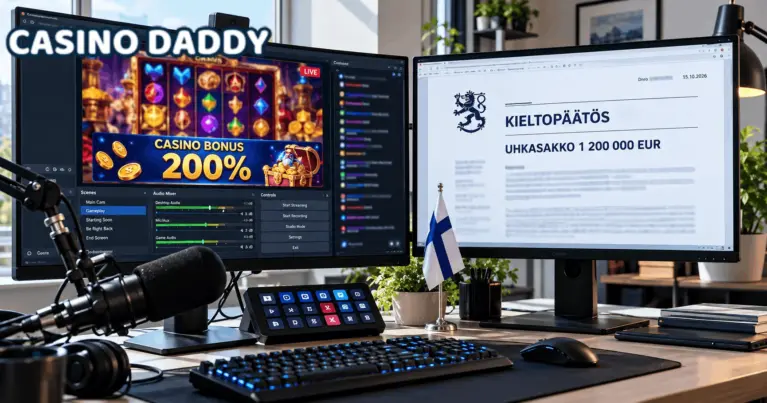
Finland has tightened its grip on gambling advertising once again. The National Police Board confirmed that its Gambling Administration keeps issuing prohibition orders against anyone promoting unlicensed operators to players in the country, and conditional fines follow when the authority wants the marketing stopped at once. Four prohibition decisions and six conditional fines have already landed during 2026.
The sums behind those decisions explain why operators pay attention. Conditional fines imposed this year have run from 30,000 to 200,000 euros for individuals and from 100,000 euros to 1.2 million euros for companies. Finland applies its rules on gambling advertising to a limited company and a solo streamer in exactly the same way, which puts real personal exposure on the table for affiliates and content creators who take offshore sponsorship money.
Prohibition Orders Do the Heavy Lifting
Finland backs its ban on gambling advertising with a mechanism built for speed. A prohibition order tells the recipient to stop, and the conditional fine attached to it works as leverage rather than punishment. Juhani Wallinvirta, head of group at the National Police Board, framed the fine as a way to reinforce the decision and make illegal marketing actually cease. The authority only orders payment once a company or individual misses the deadline it received.
That distinction matters in practice. Someone who pulls the content inside the time limit walks away owing nothing, while someone who ignores the order watches the figure turn into a bill. Individuals who reached that point during 2026 have been ordered to pay between 20,000 and 100,000 euros.
Severity sets the scale. A single post and a long-running affiliate operation built around Finnish-language content sit at opposite ends of the range, so the authority has room to calibrate each decision against what it finds. Companies with deeper pockets face the top end, and that is how the ceiling reached 1.2 million euros this year.
Why Finland Polices Gambling Advertising on Social Media
Finland catches most gambling advertising breaches on social platforms and inside livestreams, which is where the Gambling Administration now concentrates its monitoring. Promotional posts, affiliate links and stream overlays reach Finnish audiences cheaply, then disappear before anyone files a complaint. Some of it addresses Finns in their own language, which breaches local rules outright.
Streaming has become the sharpest edge of the problem. A broadcast can run for hours with casino branding visible the whole time, and the audience watching tends to skew young. Finland has treated gambling advertising of that kind as a priority for several years, and a Finnish court convicted a content creator in June for pushing offshore casino bonuses through Instagram, Kick and a website carrying his name.
The 2026 Record Points to Precision Over Volume
Four prohibition decisions and six conditional fines across ten months hardly counts as a flood of enforcement. Finland weighs gambling advertising cases by what each one costs the recipient rather than by how many files it opens, so a single order running to seven figures does more work than a dozen warnings. Each decision also sets a reference point that the next one builds on.
The heaviest cases climb well past the headline figures. Helsinki Administrative Court upheld a prohibition order issued against BML Group, a Betsson subsidiary, carrying a conditional fine of 2.4 million euros after the authority found sustained Finnish-language promotion across podcasts, blogs and video content. The company also ended up on a payment blocking list.
Player Protection Drives the Policy
The reasoning behind the enforcement push centres on harm rather than market share. Unlicensed operators owe Finnish players nothing in the way of deposit limits, self-exclusion tools or affordability checks, and a player who runs into trouble on one of those sites has no regulator to turn to. Online gambling moves fast enough on its own, and problems can develop quickly once access becomes effortless.
Advertising is the entry point, so that is where the authority applies pressure. A player who never sees the offer never opens the account, which is why Finland keeps gambling advertising rules at the centre of its harm reduction work instead of chasing domains that change hourly. Blocking one address achieves very little when the replacement goes live the same afternoon.
A Monopoly in Its Final Stretch
All of this plays out under a system with a closing date. Veikkaus still holds the exclusive right to offer and market gambling on mainland Finland, so every other brand reaching Finnish consumers breaks the law by definition. That changes on 1 July 2027, when the licensed market opens and supervision moves to the new National Supervisory Authority.
Around 75 licence applications were sitting with the regulator in September, with no approvals granted yet. Operators in that queue have an obvious reason to keep their names off prohibition orders, because a documented history of illegal marketing makes a poor opening argument to a licensing authority. Finland will loosen its gambling advertising rules next summer by allowing television, radio and newspaper campaigns from licensed brands, while influencer marketing stays restricted.
Until then the current rules apply in full, and this year has shown that the Gambling Administration intends to use them. Finland now prices gambling advertising breaches anywhere from a modest five-figure sum to seven figures for a company that drags its feet past the deadline. For anyone selling access to a Finnish audience, that arithmetic has stopped being theoretical.

The Author
The Author
Slots and News Reviewer