









Polymarket Parlay Contracts Go Live in US Beta Testing


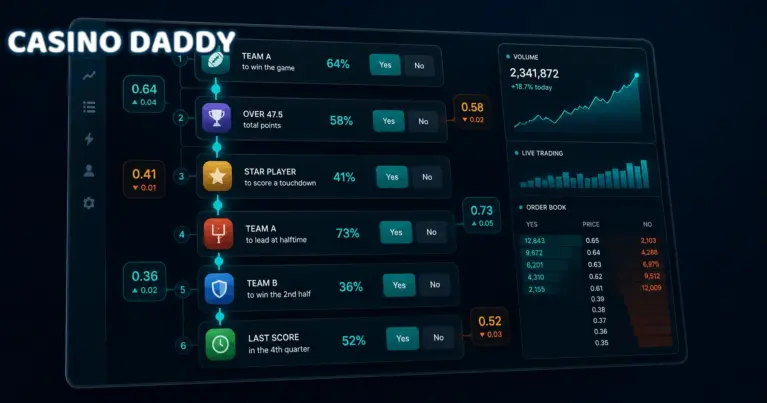
Polymarket has started testing parlay contracts on its regulated US exchange, giving American traders a route into multi-outcome positions for the first time. The first trade cleared on August 5. Since then the test environment has handled roughly $7.4 million in volume across 16,173 trades, with most of that activity arriving in the past few days. For now, Polymarket parlay contracts live inside a restricted beta rather than a full public rollout.
A Quiet Launch for Polymarket Parlay Contracts
The product carries a formal name that hides how familiar it feels. Polymarket US filed the contracts with the Commodity Futures Trading Commission back in May, self-certifying them as Combinatorial Athletic Outcome Contracts, or CAOCs. That filing cleared the paperwork, but nothing appeared for ordinary users afterwards.
Three months later, the exchange finally switched the Polymarket parlay contracts on for testers. The rollout remains narrow. Traders cannot reach the parlay option through the Polymarket US app, and the company has not opened its desktop platform to a wide audience either. Every trade recorded so far has come through the beta process.
That caution makes sense given the pressure around the sector. Prediction markets are fighting lawsuits, state cease-and-desist orders and regulatory challenges across several jurisdictions. Launching a parlay product loudly would invite exactly the comparison that critics keep making.
Ten Legs and a Deliberate Ceiling
Polymarket US API documentation shows the current limit for testers. Users can combine as many as 10 legs in a single parlay, which caps how far a combination can stretch. Some competing prediction market products allow considerably more.
That ceiling matters for two reasons. Longer parlays produce longer odds, and longer odds produce the eye-catching payouts that drive social clips and new signups. A 10-leg cap keeps the product closer to a conventional multi-outcome bet than to a lottery ticket.
It also reduces pricing risk. Every extra leg makes a combination harder to price accurately, so a tighter limit gives market makers a more manageable job during a test phase.
How the Request System Prices a Combination
Polymarket prices these positions through a request-for-quote model rather than an automatic calculation. A trader submits a request for a specific combination. Market makers then have a set window to respond with a price.
Once the responses come in, the trader picks the best available offer or walks away. The structure lets an exchange put a number on combinations of multiple outcomes without holding the risk itself. Casual users generally see a simpler version of this, reaching only the “yes” side of a parlay through the standard interface.
That mechanism separates Polymarket parlay contracts from sportsbook parlays in a technical sense. A sportsbook sets its own price and takes the other side. Here, competing market makers set the price and absorb the exposure.
Kalshi Sets the Revenue Benchmark
The numbers coming out of Kalshi explain the urgency behind Polymarket parlay contracts. Kalshi reportedly generated $25 million in parlay taker fees during the first 16 days of August alone. That figure dwarfs the volume Polymarket has recorded in its entire beta so far.
Kalshi is also preparing to introduce maker fees on its parlay products. Those rates are expected to follow the existing fee structure, sitting below taker fees rather than matching them. Charging both sides would push parlay revenue higher still.
Parlays have quietly become the most commercially valuable product in the prediction market space. They generate more fee income per dollar traded than straight positions, and they keep users active across multiple events at once.
The Offshore Platform Got There First
Polymarket already runs a parlay product outside the United States. Its blockchain-based offshore platform introduced the format in June, timed to land during the FIFA World Cup. That version reached players months before anything appeared on the regulated US side.
The gap between the two arms of the business tells its own story. Building a compliant product under CFTC oversight takes longer than shipping one on a decentralised exchange. Polymarket has effectively spent the summer catching up with itself.
What the Beta Signals
A $7.4 million test volume is small next to the sums moving through prediction markets each week. The direction still matters. Polymarket parlay contracts represent the company’s clearest attempt yet to compete with Kalshi on the product that actually pays the bills.
The next questions are practical ones. Polymarket needs to open the feature inside its app, widen desktop access and decide how it will charge for the privilege. Regulators will watch each of those steps closely. A multi-leg contract on athletic outcomes looks a great deal like the thing states have spent the past year arguing about.
For now, the beta runs quietly in the background. But the numbers coming out of Kalshi suggest it will not stay quiet for long.

The Author
The Author
Slots and News Reviewer