Dai casinos accept DAI, a stablecoin worth about a dollar. That much it shares with Tether and USD Coin. What it does not share is an issuer: there is no company holding reserves behind it. DAI is created when users lock up crypto worth more than they borrow, and smart contracts keep the whole thing balanced.
At a cashier the effect is the same as any dollar stablecoin, since your balance does not move while you are away from it. The difference is who you are trusting. With the others it is a company and its auditors. With Dai it is collateral and code.
Below you will find the operators we currently rate highest for DAI play, followed by a full guide to deposits and withdrawals, how a stablecoin holds its peg without a company behind it, and why acceptance is narrower than for the major stablecoins.
12 of the casinos we track accept Dai. Every one has been checked for its licence, its payout record and the small print on its bonuses.
 Reviewed byFred Anderson

New Casino
 Rated 74 of 100%
welcome bonus
550% up to €3400 + 400 FS


Crypto Casino
Rated 92 of 100%
welcome bonus
275% up to €2000


Exclusive Bonus
Rated 88 of 100%
welcome bonus
400% up to €4,000 + 400 FS


Rising Star
Rated 74 of 100%
welcome bonus
325% up to €1,500 + 175 FS


Fan Favourite
Rated 94 of 100%
welcome bonus
250% up to €2,000 + 200 FS

Crypto Casino
Rated 84 of 100%
welcome bonus
70% Rakeback + 10% Cashback

Crypto Casino
Rated 82 of 100%
welcome bonus
200% up to €2,000 + 500 FS

Rated 92 of 100%
welcome bonus
100% up to €1,500 + 150 FS

Rated 91 of 100%
welcome bonus
100% up to $420,000 + 200 FS

Rated 94 of 100%
welcome bonus
225% up to €1000 + 200 FS

Rated 93 of 100%
welcome bonus
100% up to €700 + 75 FS
Dai casinos accept DAI, a stablecoin worth about a dollar. So far that sounds like Tether or USD Coin, but Dai gets there a completely different way. There is no company holding dollars in a bank account. Instead DAI is created when users lock up more crypto than they borrow, and smart contracts enforce the rest automatically.
For a casino player the practical effect is the same as any dollar stablecoin: your balance does not move while you are away from it. What differs is who you are trusting. With Tether and USDC that is a company and its auditors. With Dai it is code and collateral.
What is a Dai casino?
A Dai casino is an online casino that accepts DAI for deposits and withdrawals. It is a stablecoin that tracks the dollar without any company issuing it.
The 10 highest rated casinos accepting Dai, side by side.
| Casino | Rating | Licence | Min deposit | Min withdrawal | Withdrawal limit |
|---|---|---|---|---|---|
| Wazbee Casino | 94/100 | Curacao | €10 | €20 | €310,000 Monthly |
| Welle Casino | 94/100 | Curacao | €20 | €20 | €20,000 Monthly |
| Wintopia Casino | 93/100 | Curacao | €10 | €20 | €1000 monthly |
| Reels Casino | 92/100 | Anjouan | 1 USDT | 1 USDT | 5,000 USD per month, more on request |
| SpinBetter Casino | 92/100 | Curacao | €20 | €20 | €15,000 Monthly |
| Win.Casino | 91/100 | Anjouan | €10 | €10 | $150,000 Monthly |
| BC.Game Casino | 88/100 | Anjouan | 0.01$ | €10 | Unlimited |
| Thrill Casino | 84/100 | Anjouan | €2.5 | €1 | Unlimted Monthly |
| Bitsler Casino | 82/100 | Curacao | €1 | €8 | €30,000 Monthly |
| Lussurio Casino | 74/100 | Curacao | 10 EUR (crypto has no minimum) | 25 USD (about €21) | €425 per transaction, €850 per day, €4,250 per week, €17,000 per month (set in USD: 500 / 1,000 / 5,000 / 20,000) |
Minimum withdrawal is not always the same as minimum deposit. Where it is higher, a small balance can sit stranded until you top it up.
A Dai casino treats DAI as a payment method. The games are identical to those anywhere else. What changes is that your balance holds its value, and that no single company can freeze it.
Tether and USD Coin work the obvious way: a company takes dollars, holds them, and issues tokens against them. Dai does not. It is created when someone deposits crypto worth considerably more than the DAI they take out, and if that collateral falls too far in value the system sells it automatically to keep everything backed.
The system is governed by MakerDAO, a collection of token holders who vote on parameters rather than a board that decides them. Nobody has the authority to reverse a transaction or freeze an address the way a centralised issuer can.
Day to day, nothing. DAI moves like any other Ethereum token and holds its dollar value like any other stablecoin. The difference shows up in the risks rather than the experience. There is no company that could be pressured into blocking your funds, and equally no company to answer to if something goes wrong. The peg is maintained by mechanism, not by promise.

Accepting DAI is a payment feature, not a mark of quality. Every site here goes through the same checks we run on any casino, plus a few specific to a smaller stablecoin.
Sites that fail on licensing or on paying out do not make the list. The full method is on our how we rank casinos page.
The price should sit close to a dollar. Here is what actually determines how a DAI deposit behaves at a casino cashier.
Live EUR price from the Kraken exchange. Shown for reference only, not financial advice.
DAI
A stablecoin tracking the US dollar, created by locking up crypto collateral rather than issued by a company
MakerDAO, governed by token holder votes. No board and no central issuer that can freeze an address
Every DAI is backed by more collateral than it is worth. If that collateral falls too far, the system sells it automatically
Mainly Ethereum, also Polygon, Arbitrum, Base and others. The network decides the cost
ETH on Ethereum and most layer 2s, MATIC on Polygon. A wallet holding only DAI cannot send
Around a dozen sites, far fewer than Tether or USD Coin. Check the cashier before registering
Dai does the job of a stablecoin without asking you to trust a company, which is a genuine difference if that matters to you. The peg has held through several severe market drops, which is the real test of a collateral backed design.
The cost is reach. Around a dozen casinos accept DAI against hundreds for Tether. If you already hold it and can find a good licensed site that takes it, it works well. If you are choosing a stablecoin from scratch and want options, Tether or USD Coin will get you into far more casinos.
Depositing DAI works like any Ethereum token transfer, with the usual network question to settle first.
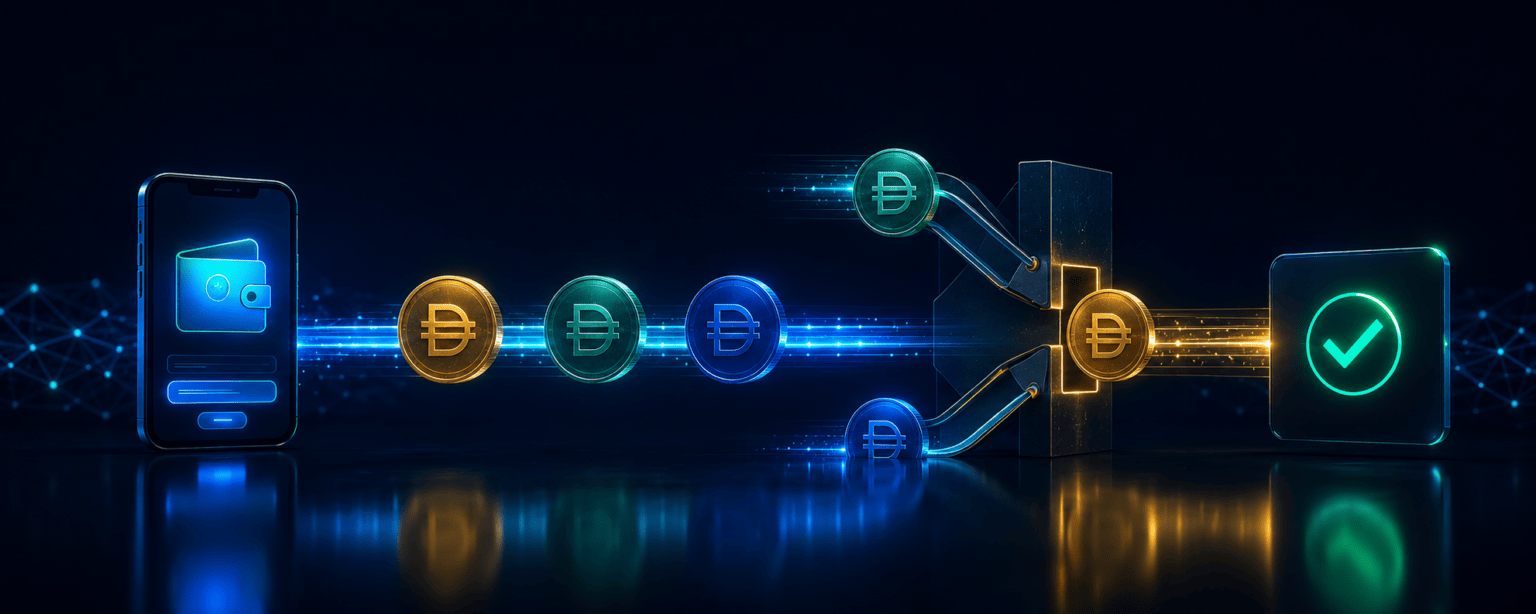
Withdrawals follow the same network logic as deposits, and the gas cost is the main variable.
Approval, not the blockchain, is almost always the bottleneck. Casinos that process automatically can return funds in under ten minutes. Those reviewing manually may take a working day, and some only process during office hours. A first withdrawal is usually slowest because identity documents are requested then.
With a smaller stablecoin there is a second consideration: not every casino holds deep DAI reserves, so a large cashout may be processed manually or converted. Ask support before you commit a big balance if that matters to you.
There is no separate DAI lobby. You get the full library at whichever casino accepts it, and since acceptance is narrow, the choice of site matters more than the choice of games.
Crypto casinos popularised a family of in house titles you will not find at traditional operators: dice, mines, plinko and the rest. The whole category is covered on our casino originals page.
The best known are crash games, where a multiplier climbs until it crashes and you try to cash out first. A dollar denominated balance suits them well, since your stake sizing stays consistent between sessions instead of drifting with the market.
Many of these titles are provably fair, meaning the result can be verified afterwards. That pairs neatly with DAI: both let you check the mechanism rather than take someone’s word for it.
Bonus offers work the same way as at any crypto casino, and a stable balance makes the terms easier to judge.
This is the one to watch. Many casinos write bonus terms around their main currencies and treat smaller stablecoins as an afterthought, so an offer advertised for crypto deposits may exclude DAI or convert it to another currency first. Read the qualifying deposit methods rather than assuming.
Beyond that, the wagering multiplier and what it applies to, and the maximum bet allowed while wagering, which is the most common reason a withdrawal gets voided. Offers built around cryptocurrency are on our crypto casino bonuses page.
All three dollar stablecoins on this site answer the same question differently. Tether has a company and the widest acceptance. USD Coin has a regulated company with monthly attestations. Dai has no company at all, just collateral and code. Against the volatile coins the trade is the familiar one: no upside from the market, and no downside either.
Use Dai if you want a stable balance and prefer that no company sits between you and your funds, and you have found a licensed casino that takes it. Use USD Coin if you want the same stability with published reserves and far wider acceptance. Use Tether if reaching the most casinos matters most. Use Bitcoin, Litecoin or Solana if you would rather hold a coin whose price can move in your favour.
Whichever you pick, the licence and the payout record matter far more than the coin. Our full crypto casinos hub covers every coin we have a page for.
Dai behaves predictably at a cashier once you have the basics right.
A dollar balance reads like an ordinary account, which makes it easy to keep topping up without noticing the total. Set deposit limits, decide the amount before you start, and treat gambling as entertainment rather than income. For free and confidential support, visit BeGambleAware or read our responsible gambling guide.
A licensed Dai casino with proper encryption is as safe as any other online casino. The licence and the payout record decide whether a site is trustworthy, not the payment method. Accepting DAI tells you nothing on its own, so check the regulator before you deposit.
All three track the dollar and behave identically at a cashier. The difference is what backs them. Tether and USD Coin are issued by companies holding reserves. Dai has no company at all: it is created when users lock up crypto worth more than the DAI they take out, and smart contracts enforce the rules. You are trusting collateral and code rather than a business.
There is no central issuer with the authority to freeze an address, which is not true of Tether or USD Coin. That cuts both ways: nobody can block your funds under pressure, and equally there is no company to appeal to if something goes wrong. Note that the casino itself can still restrict your account, since that is a matter of its own terms.
It has wobbled during severe market stress and briefly during the 2023 banking turbulence that affected some of its collateral, but it has always returned to roughly a dollar. The design holds more collateral than DAI in circulation and sells it automatically if values fall too far. It is a mechanism with a solid record rather than a guarantee.
Almost certainly because you have no gas in the wallet. DAI is a token and cannot pay for its own transfer, so you need ETH on Ethereum and most layer 2s, or MATIC on Polygon. Add a small amount and the transaction will go through.
No. Around a dozen casinos accept it, against hundreds for Tether. If you already hold DAI and find a good licensed site that takes it, it works well. If you are choosing a stablecoin from scratch and want the most options, USD Coin or Tether will serve you better.
The Author
The Author
Site Admin