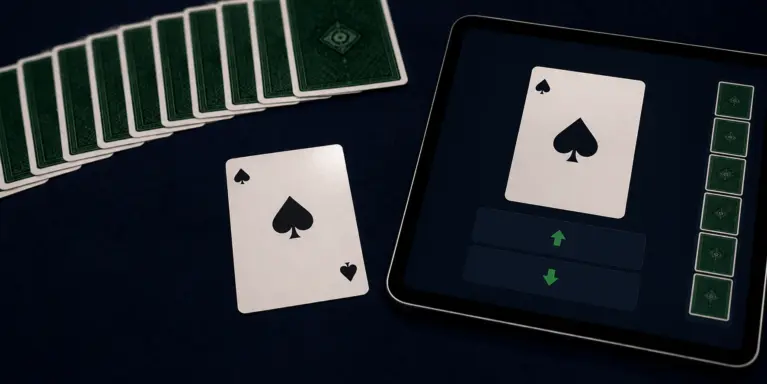
Every round of Hi-Lo opens with one card face-up and two buttons beneath it, each carrying its own win chance and its own multiplier. Turn up a nine and the game offers roughly 2.57x for higher, 1.43x for lower. The reason sits in plain sight: eight ranks live below a nine and only four above it. No help file, no certification document, no menu buried three clicks deep. The game prints the odds on the thing you are about to press, then refreshes them the moment a new card lands.
The deck itself refuses to behave the way a deck should. Most house-built versions draw every card from a fresh 52, so nothing thins out and no rank ever runs short. Watch six kings go by across forty rounds and the seventh remains exactly as likely as the first. Anyone arriving from blackjack finds this genuinely offensive, and the name does not help, since the most widely used card counting system in the game is also called Hi-Lo. Different Hi-Lo, and counting cards here achieves nothing beyond a sore neck.
What the buttons will not tell you is when to stop. Correct calls multiply together, so a five-card streak can turn a modest 1.43x into something resembling a slot bonus round, and one wrong guess wipes the chain. The cash-out decision arrives fresh after every card. Version choice carries the same weight as any of it, because house-built Hi-Lo returns 99% while Hacksaw ships builds running as low as 88% to operators who ask for them.
 Reviewed byNadia Winchester

New Casino
 Rated 82 of 100%
welcome bonus
550% up to €3540 + 400 FS


Exclusive Bonus
Rated 88 of 100%
welcome bonus
400% up to €4,000 + 400 FS

New Casino
Rated 83 of 100%
welcome bonus
250% up to €4,000 + 250 FS

New Casino
Rated 81 of 100%
welcome bonus
100% up to €5,000 + 175 FS


Crypto Casino
Rated 85 of 100%
welcome bonus
500% up to $10,000

Crypto Casino
Rated 89 of 100%
welcome bonus
100% up to €100,000

Crypto Casino
Rated 90 of 100%
welcome bonus
200% up to €100 + 150 FS

Crypto Casino
Rated 55 of 100%
welcome bonus
150% up to €1,300 + 100 FS

Crypto Casino
Rated 87 of 100%
welcome bonus
100% up to $1,500 + 150 FS

Crypto Casino
Rated 82 of 100%
welcome bonus
200% up to €2,000 + 500 FS

Crypto Casino
Rated 94 of 100%
welcome bonus
150% up to €4,000 + 400 FS

Rated 91 of 100%
welcome bonus
305% up to €1,200

Rated 89 of 100%
welcome bonus
305% up to €1,200

Crypto Casino
Rated 91 of 100%
welcome bonus
100% Deposit Bonus

Rated 91 of 100%
welcome bonus
200% Bonus up to €350

Rated 90 of 100%
welcome bonus
NO KYC REQUIRED

Rated 93 of 100%
welcome bonus
100% up to €100 + 100 FS


Hot Casino
Rated 95 of 100%
welcome bonus
243% up to €5,555 + 243 FS
Hi-Lo sits in the instant-win corner of the Casino Originals library, though it plays nothing like the games sitting either side of it. A round opens with one card face-up and then waits, as long as you keep calling correctly. Every correct guess grows a running multiplier and hands the next decision straight back to you.
The loop takes one breath to describe. Look at the card, decide if the next one lands higher or lower, and press the button carrying that prediction. Guess right and the multiplier climbs while a fresh card takes the base position. Guess wrong and the round closes with your stake gone. Cash out anywhere between those two outcomes and the accumulated multiplier pays.
The closest relative in the lobby is Mines, which also builds a multiplier tile by tile and also leaves the stopping point to you. The difference is information. Mines keeps its bombs hidden, so one tile carries exactly the same risk as the last one you clicked. Hi-Lo shows you the odds for the next card and rewrites them constantly, which turns every decision into a fresh problem rather than a repeat of the previous one.
The screen carries less furniture than almost anything else in a casino lobby. A base card sits in the middle, two buttons wait underneath, and a row of face-down cards runs off to one side to show the round has somewhere to go. Each button prints its own win chance and its own multiplier, calculated for the card currently showing and nothing else.
Those two figures move in strict opposition. A deuce makes higher almost certain and pays about 1.07x for the privilege, while backing lower on that same deuce returns 6.44x when it lands. Face cards reverse the arrangement completely. Only the 7 treats both buttons identically, offering 53.85% and 1.84x in either direction, which makes it the closest thing Hi-Lo has to a coin flip.
Two further controls matter more than most players allow. Skip passes on a card you dislike, and it costs nothing. Platforms disagree on how often you may use it, with some permitting a handful and others letting you skip your way through an entire deck. Cash out collects the accumulated multiplier and ends the round on your terms, which is the only exit the game provides.
House-built Hi-Lo counts an identical rank as a win on both buttons, which is stranger than it first sounds. Back higher on an eight and the game pays you for any eight, nine, ten, jack, queen or king. Back lower on the same eight and it pays for that eight and everything beneath it. The card sits on both sides of the argument.
Add the two win chances together and they pass 100%, because the tie appears in both. Across a full 52-card deck the pair covers 107.7% of possible outcomes, which reads like a gift until you remember who wrote the paytable. That generosity already lives inside the multiplier, and the house edge survives at 1% regardless.
Ace and King break the pattern, since neither has anywhere to go in one direction. Each gets a strict call in the only direction available at roughly 1.07x, plus a separate same bet paying around 12.87x for anyone who likes a 1-in-13 shot. Provider and live dealer versions handle ties on their own terms, with some paying a fixed snap bet and others returning your stake, so the rules panel deserves thirty seconds before your first click.
Hi-Lo asks almost nothing of a new player at the start of a round. There is no grid to memorise, no paytable to study and no slider to position. What takes practice is the middle of a round, because the game keeps handing decisions back and every one of them arrives with a number attached that most players stop reading somewhere around the third correct guess.

Open the game info panel before your first bet and find the stated return alongside the provider name. House-built Hi-Lo runs 99% and carries no studio logo, since the operator wrote it. Provider titles sit lower and sometimes ship in several configurations, which means two casinos can offer the identical game at different returns. The interfaces give you almost no clue which one you have.
Pick a base stake you would place a few hundred times without thinking about it. While you are in the rules panel, check two things: how the game treats an identical rank, and how many skips you get. Both vary between platforms, and both change the arithmetic on every button you press for the rest of the session.
The card in the middle decides everything about the round in front of you. Low ranks make higher close to certain and pay accordingly, high ranks flip the arrangement, and the middle of the deck splits the difference. Get in the habit of reading the card first and the multiplier second, because doing it the other way round is how players talk themselves into 6.44x calls.
Skipping costs nothing and it is the only free thing in the game. A jack showing gives you 1.17x for lower and 4.29x for higher, and neither number appeals if you wanted something balanced. Pass on it and wait for a card that offers a trade you actually like. Skip limits do run out on some platforms, so treat them as a budget rather than an infinite supply.
Press higher or lower and the next card lands immediately. A correct guess folds the multiplier into your running total and promotes the new card to base position, which resets every number on screen. A wrong guess ends the round and takes the stake along with everything the streak had built. There is no partial credit anywhere in this game.
The cash-out button is live after your first correct call and stays live for the rest of the round. Multipliers compound, so four decent calls in a row produce a figure that looks worth protecting and simultaneously worth risking on one more card. Decide your exit before the round starts rather than during it. That decision gets measurably harder with every card you survive.
The multiplier on each button comes from one calculation, and it takes about a minute to learn. Count the ranks that satisfy your call, divide by 13, and you have your win chance. Divide 99 by that percentage and you have the multiplier the game will offer. Because house-built versions draw from a full 52 every time, these figures hold on the first card of a round and the fortieth, with nothing that came before altering them by a fraction.
| Card Showing | Higher or Same | Multiplier | Lower or Same | Multiplier |
|---|---|---|---|---|
| Ace | 92.31% (higher only) | 1.07x | 7.69% (same bet) | 12.87x |
| 2 | 92.31% | 1.07x | 15.38% | 6.44x |
| 3 | 84.62% | 1.17x | 23.08% | 4.29x |
| 4 | 76.92% | 1.29x | 30.77% | 3.22x |
| 5 | 69.23% | 1.43x | 38.46% | 2.57x |
| 6 | 61.54% | 1.61x | 46.15% | 2.15x |
| 7 | 53.85% | 1.84x | 53.85% | 1.84x |
| 8 | 46.15% | 2.15x | 61.54% | 1.61x |
| 9 | 38.46% | 2.57x | 69.23% | 1.43x |
| 10 | 30.77% | 3.22x | 76.92% | 1.29x |
| Jack | 23.08% | 4.29x | 84.62% | 1.17x |
| Queen | 15.38% | 6.44x | 92.31% | 1.07x |
| King | 7.69% (same bet) | 12.87x | 92.31% (lower only) | 1.07x |
Read the table down one column and the mirror becomes obvious. A 3 pays exactly what a jack pays, with the directions swapped, and the same holds for every pair either side of the middle. The 7 sits alone at the centre, offering 1.84x on both buttons at 53.85%, which is the only genuinely balanced choice the game ever presents you with.
The interesting part is what happens when you chain these calls together. Ten consecutive 1.07x calls compound to roughly 2.01x, and you will complete that run about 45% of the time. A single call on an 8 pays 2.15x and lands 46.15% of the time. Both routes reach the same destination with almost identical odds, so the safe path looks like a clever way of getting there.
It costs about ten times as much. The house edge applies to every call individually, so a single bet returns 99% while ten bets chained together return 0.99 to the tenth power, which works out near 90%. Cautious play in Hi-Lo means more decisions, and more decisions means paying the edge more often. That relationship runs through the entire game and explains why long streaks of safe calls drain a balance faster than most players expect.
Displayed multipliers vary slightly across platforms, since some round down where others round to the nearest cent. The win chances behind them do not move, because the deck they describe is the same 52 cards on every single card of every single round.
Skip is the only free thing in Hi-Lo, and most players treat it as decoration. Press it and the current card disappears, a new one takes its place, and nothing happens to your stake or your accumulated multiplier. The round waits. In a game where every other button costs money, one that costs nothing deserves more attention than it gets.
The reason it goes unused is pace. Hi-Lo rounds move quickly, the buttons sit right under the card, and pressing one of them feels like progress in a way that pressing skip does not. Players who fire through a session on instinct rarely stop to consider that the card in front of them is a bad offer they were never obliged to accept.
The extremes of the deck give you the best trades available. A deuce pays 6.44x for a correct lower call, and a queen pays the same for higher, both at a 15.38% hit rate. Neither is a good bet in isolation, since the edge sits at 1% on those exactly as it does everywhere else. What they offer is a meaningful multiplier from a single decision rather than a chain of them.
That distinction carries real weight. Reaching 6.44x through cautious 1.07x calls takes roughly twenty-eight consecutive correct guesses, and each one pays the house its cut. Taking a queen at 6.44x pays the edge once. Same destination, one twenty-eighth of the toll.
The mirror argument works for anyone who prefers frequent wins. A deuce backed higher lands 92.31% of the time, which is the closest thing to a sure call the game offers. Skip your way to the low cards, take the near-certain 1.07x, and cash out inside two or three calls. The returns are small and the sessions run long, which suits some players considerably better than the alternative.
Middle cards are where skip earns its keep. A 7 hands you 1.84x at 53.85% in both directions, which sounds fair and functions as a coin flip with a 1% tax attached. Players who hate coin flips should skip it. Players who want maximum variance per decision should not.
Platforms disagree sharply on how generous to be. Some let you skip a handful of times per round, others allow ten, and a few permit you to work through an entire deck’s worth without placing a bet. That range changes strategy more than any other rule difference between versions.
A ten-skip limit turns skipping into a resource you have to budget. Burning six of them hunting a queen leaves four for the rest of the round, and the round could still have a dozen cards left in it. Generous limits remove that pressure entirely and let you hold out for whatever card you decided you wanted.
Provider-built versions handle this differently again. Some offer unlimited free skips as a headline feature, while others fold the mechanic away or drop it completely. Check the rules panel before building any approach around it, because a strategy that depends on skipping falls apart immediately in a version that does not offer the button.
One warning worth taking seriously. Skipping does not improve your odds on the card you eventually accept, and it never has. What it does is let you choose which bet you make instead of taking the one the game dealt you, and that choice is worth something even though the house edge stays exactly where it was.
Hi-Lo builds its multiplier through multiplication rather than addition, and that distinction does all the damage. Two correct calls at 1.84x land you on 3.39x. Four gets you past 11x. The figure on screen starts behaving like a slot bonus round somewhere around the fifth card, which is roughly the point where the decision stops being mathematical and starts being about nerve.
Nothing about the game forces an exit. The cash-out button sits there through the entire round, available after every correct call, and it never once suggests that now might be the moment. That silence is the design.
Each correct call multiplies your running total by whatever the button offered. Take a 9 backed lower at 1.43x, then an 8 backed higher at 2.15x, then a 5 backed higher at 1.43x, and you sit on 4.40x after three cards. The odds of getting there were about 22%, which is the part the screen never shows you.
Cumulative probability is the number that matters, and it shrinks faster than the multiplier grows.
The pattern holds across every combination you can build. Your multiplier climbs geometrically while your chance of holding onto it falls at the same rate, and the two cancel out almost perfectly because the house edge is the only gap between them.
Long safe streaks carry a hidden cost worth restating. Every call pays the 1% edge separately, so a fifteen-card run of 1.07x calls returns about 86% rather than 99%. Grinding is expensive in this game, and it feels like the careful option right up until you check the arithmetic.
One wrong call takes the whole chain. Not a portion, not the last card’s contribution, all of it. A player sitting on 21.4x after four correct guesses who backs a jack for higher at 4.29x is risking every unit of that 21.4x on a 23.08% shot, and the interface presents that decision exactly as casually as the first one.
Two forces push players into it. The multiplier looks too small to bother cashing early in a round, then too large to walk away from later, and the window where it feels right is narrow enough to miss entirely. Meanwhile the next card might be a deuce, and a deuce would grow the total for almost nothing.
Setting an exit before the round starts is the only defence that works. Pick a target multiplier or a number of correct calls, then take it when it arrives regardless of what the base card is offering. Players who decide mid-round decide badly, because the decision arrives loaded with a number they already feel they own.
Watching a streak die also does something specific to the next round. The urge to rebuild is strong, the stake often goes up, and the calls get bolder. That sequence has ended more Hi-Lo sessions than bad luck ever has.
The Hi-Lo name travels further than almost any other Original, and the versions carrying it disagree about nearly everything. Returns run from 99% down to 88%. Some deal from an inexhaustible supply of cards while others work through a physical shoe. Ties pay differently, skip rules differ, and two of these versions have a human being in a studio dealing the cards to you.
Getting the version right matters more than any decision you make once the round starts. An 11-point spread in return means one build costs eleven times what another does across the same volume, and the interfaces rarely announce which one you loaded.
Crypto casinos writing their own Originals set the edge themselves, and 1% is where most of them land. These builds carry no studio badge, since the operator produced them, and they come with full provably fair verification attached to every card.
The distinguishing feature is the deck that never runs down. Each card arrives from a full 52 regardless of the round’s history, which keeps the win chances in the table above accurate from the first card to the fortieth. Ties count as a win on both buttons here, an arrangement provider versions rarely copy.
Regulated markets generally require games from certified third-party suppliers, so operators cannot run their own RNG titles there. That licensing split explains why the 99% version thrives at crypto casinos and barely appears anywhere else.
Licensed studios sell to hundreds of operators, and their pricing reflects a broader market than any single platform. What you gain is independent testing and availability in regulated lobbies. What you give up sits in the return column.
| Version | Provider | RTP | Worth Knowing |
|---|---|---|---|
| House-built Hi-Lo | Operator’s own studio | 99% | Ties win on both buttons, player-side verification, deck never depletes |
| Hi-Lo | Hacksaw Gaming | 88% to 98% across six models | Free skips, and the operator chooses which return model to run |
| Hi-Lo | Coin Machine Gaming | 98% | High volatility with a ceiling of 20,000x |
| Hi-Lo Premium (RNG, not live) | Playtech | 97.17% to 97.50% | Separate snap bet on an identical rank, common in regulated lobbies |
| Hi-Lo | Turbo Games | Not published consistently | Maximum win capped at €10,000 |
The Hacksaw row deserves a second look. Six configurations from one studio means the game on your screen could be returning 98% or 88%, and the artwork looks identical either way. Open the rules panel and read the stated figure rather than trusting the game’s description on the casino’s page.
Playtech complicates the picture by shipping both formats. The Hi-Lo Premium listed above deals its cards through software, while Hi-Lo Club Live and the western-themed Hi-Lo Western Live put real hosts in a studio and stream them to you. Players regularly arrive at one expecting the other, which the shared name does nothing to prevent. All three keep the core question intact, since you still predict higher or lower against a base card and the payouts still adjust to whatever that base card happens to be.
Everything underneath works differently on the dealer-led tables. Cards come from a physical shoe rather than a bottomless supply, three get burned each round before the result card appears, and the winning card becomes the base card for the round that follows. Ties get their own fixed bet rather than paying out on both buttons, with the snap position returning 12.06 to 1 on the standard table. Rounds run on the dealer’s timing, so a session lasts as long as it lasts.
Neither approach beats the other outright. The house-built Original gives you speed, verification and the highest return in the category, while the live tables offer a host, a shared table and side bets the RNG versions do not carry. Anyone drawn to the studio format will find the full range of dealer-led tables in our live casino section, including the card games this one grew out of.
Card games carry a specific trust problem that Plinko and Dice avoid entirely. A ball bouncing down pegs looks random because it looks physical. A shuffled deck looks like something a casino could arrange, since arranging decks is the oldest cheat in the business, and a digital shuffle happens somewhere you cannot see.
Provably fair systems answer that objection with cryptography rather than reassurance. Three inputs generate every card, and the design makes it impossible for the operator to change any of them once the round is underway.
Your casino produces a server seed and shows you its hashed version before you bet, which commits the operator to a value it cannot alter afterwards. You supply a client seed, editable whenever you want. A nonce counts upward through your rounds, guaranteeing that the same seed pair produces fresh cards every time.
Verification works retroactively, since server seeds only reveal once you rotate them. The process takes a couple of minutes and you only need to do it once to know the panel works.
Matching results confirm every card was determined before you pressed a button. A mismatch is worth raising publicly, though correctly implemented systems will not produce one.
Checking a round proves the cards were honest. It says nothing about what those cards were worth to you, and the two are entirely separate questions.
An operator can run flawless provably fair mechanics while paying 1.80x on a card that should return 1.84x. Both deals are legitimately random, and one quietly costs you more per call than the other. Auditing that means running the arithmetic from the table above yourself, because the fairness panel will never do it on your behalf.
Deck rules deserve the same scepticism. A version that deals from a depleting deck produces different odds as cards leave, and the multipliers should move to match. Verification confirms the cards were random within whatever rules the game uses, not that those rules were the ones you assumed.
Provider titles work differently again, leaning on certified random number generators and independent lab audits rather than player-side checks. Both models hold up. Anyone who wants the cryptographic detail, including how hashing stops a seed being swapped after the fact, can work through how provably fair systems generate and verify results before their next session.

The question comes up constantly, and the name is entirely to blame. Hi-Lo is also the most widely used card counting system in blackjack, assigning plus one to low cards, minus one to high cards and zero to the middle. Players who know that system arrive at this game assuming their skill transfers. It does not, and the reason is worth understanding rather than simply accepting.
Counting works in blackjack because the shoe depletes. Every card dealt is a card that cannot appear again until the reshuffle, so tracking what has gone tells you something real about what remains. Remove twenty low cards from a six-deck shoe and the composition genuinely shifts in your favour.
House-built Hi-Lo removes that mechanism completely. Each card comes from a full 52 every single time, which means the deck has no memory and no composition to track. Sit through a round where six kings appear and the seventh king remains exactly as likely as the first. Your count, however carefully maintained, describes a deck that stopped existing the moment the previous card resolved.
The information a counter would work to extract is printed on the buttons before you press them. Win chance and multiplier both appear on screen, recalculated for the card showing, with no arithmetic required from you at all.
That transparency removes any edge counting could theoretically provide. A blackjack counter earns money by knowing something the casino has not adjusted for. Hi-Lo adjusts for everything, immediately, on every card, and shows you the adjustment while it does it.
There is one genuine skill available, and it has nothing to do with memory. Knowing which trades you want and using skip to wait for them is a real decision that changes your session. It does not beat the house edge. It does let you choose your bets rather than accepting whatever the game deals.
Live dealer Hi-Lo runs on a physical shoe, so cards genuinely leave play and the composition genuinely changes. In principle that opens the door counting needs.
Practice closes it again fairly quickly. Three cards get burned every round without ever being shown, which corrupts any count before it can build. Shoes get reshuffled at intervals the operator chooses, payouts adjust to the base card rather than staying fixed, and the edge on each bet is priced independently of what the shoe holds. A counter would need to track burned cards they never see, which is not a solvable problem.
Depleting-deck RNG versions from third-party studios sit in the same position. The software reshuffles when it likes, the odds display updates to reflect remaining cards, and any information advantage disappears into the multiplier before you can act on it.
The short answer holds across every version. Counting cards in Hi-Lo produces nothing except a false sense of control, and false confidence has a habit of arriving right before somebody raises their stake.
Nothing below beats the house edge, because nothing does. What these habits address is the specific way Hi-Lo sessions unravel, which has less to do with bad cards than with the number of decisions the game asks you to make and how quickly it asks for them.
Pick a target multiplier or a number of correct calls before the round opens, then take it when it arrives. The base card in front of you will always make a case for one more, and that case gets more persuasive the more you have riding on it.
A useful rule is to set the exit somewhere you would be pleased to reach rather than somewhere that would feel impressive. Three correct calls at 1.84x lands you near 6.2x, which most players reach reasonably often. Chasing 20x turns a frequent modest win into an infrequent large one, and the arithmetic behind that trade is not in your favour.
Small choices separate a long session from a short one, and none of them require willpower in the moment.
Free versions run identical math, which makes them useful for one specific purpose. Build a streak in demo mode, get to 15x or 20x, then keep calling until it dies. Do it three or four times.
That exercise teaches something no table on this page can. You will watch large multipliers evaporate on a single card, repeatedly, and the memory of that tends to survive into real sessions better than any rule you write down. Watch for one distortion though, since demo mode removes the financial weight entirely and your patience holds up considerably better when nothing is at stake.
Hi-Lo asks for a decision every few seconds and never once suggests you stop making them. A single round can run twenty cards deep, and each card presents the same choice dressed in slightly different numbers. Sessions extend without anyone deciding to extend them, because the round never technically ended and the multiplier was still climbing.
The decision frequency does most of the work here. Slots resolve on their own and crash rounds run on a shared timer, so both build in natural pauses. Hi-Lo waits for you indefinitely, which sounds like control and functions as an absence of friction.
Streak loss creates the second pressure point. Watching 20x disappear on one card produces a strong urge to rebuild it immediately, and the next round usually starts with a larger stake and bolder calls. That sequence ends more sessions than any run of bad cards.
The 99% return figure carries its own risk. A 1% edge sounds harmless, and it stays harmless right up until it applies to several hundred calls in an evening. Volume is what costs money in this game, and Hi-Lo generates volume more quietly than anything else in the Originals lobby.
Certain patterns mean a session has stopped being entertainment.
One of these warrants a pause, but several together warrant support.
Licensed casinos provide controls that hold up precisely because you set them in advance, while thinking clearly.
Setting a round limit belongs alongside those. Decide how many rounds you will play before you open the game, because the game itself will never raise the subject.
Help is free, confidential and available regardless of how serious things feel.
Reaching out early makes a real difference. Gambling should stay entertainment funded by money you can afford to lose, and our responsible gambling guide covers the available tools and regional resources in more detail.
Hi-Lo hands over more information than any other game in the Originals lobby and then trusts you to do something sensible with it. The odds sit on the buttons. The multiplier updates in front of you. Every card can be verified against a seed pair the casino committed to before you pressed anything. Very few casino games are this open about the trade they are offering.
What the interface withholds is any sense of when enough is enough. A round runs as long as you keep calling correctly, the cash-out button never nudges you, and the multiplier grows into a figure that feels simultaneously too small to take and too large to risk. That gap is where sessions go wrong, and it opens one reasonable-looking call at a time.
Three decisions carry more weight than anything else on this page. Play the highest return version you can reach, since the spread between 99% and 88% is the largest in the category and version selection outranks every in-round choice you will make. Treat skip as free, because it is, and taking a card you did not want is the only mistake here that costs nothing to avoid. Set your exit before the round starts, because deciding mid-streak means deciding with a number in front of you that you already feel you own.
Get those right and Hi-Lo delivers something unusual: a fast, verifiable game with the odds printed on the button and a 1% edge that never hides. Take a look at the casinos listed at the top of this page for the versions running the best returns, then pick your exit before the first card lands.
Not on house-built versions. Every card comes from a full 52-card supply, so the round can run indefinitely and the odds for any given rank never shift. Live dealer tables work differently, since they deal from a physical shoe that genuinely depletes and gets reshuffled at intervals the operator sets.
Most house-built versions treat an identical rank as a win on both buttons, so backing higher or lower on an eight both pay when another eight arrives. Ace and King are the exceptions, since each has only one direction available and gets a separate same bet paying around 12.87x. Provider and live dealer versions handle ties on their own terms, with some offering a fixed snap bet instead.
Fewer calls cost less. The house edge applies to each call individually, so ten chained 1.07x calls return roughly 90% while a single 2.15x call returns 99%. Both routes reach a similar multiplier with similar odds, and the safe path pays the edge ten times to get there.
The 7 is the only balanced card in the deck, offering 53.85% and 1.84x in both directions. Everything either side of it favours one button over the other, and the pairs mirror each other exactly, so a 3 pays what a jack pays with the directions swapped.
Yes. Several house-built versions run zero-stake rounds using the real game and the real fairness system, and provider titles offer standard demos on studio sites and review pages. The useful exercise is building a large streak and then playing it out until it dies, which teaches more about cash-out timing than any guide can.
Rounding is the usual explanation. Some platforms round down and others round to the nearest cent, so a 2.145x call might display as 2.14x or 2.15x. A larger gap points at the version rather than the rounding, since a build running below 99% prices every card lower across the board.
The Author
The Author
Slots and News Reviewer