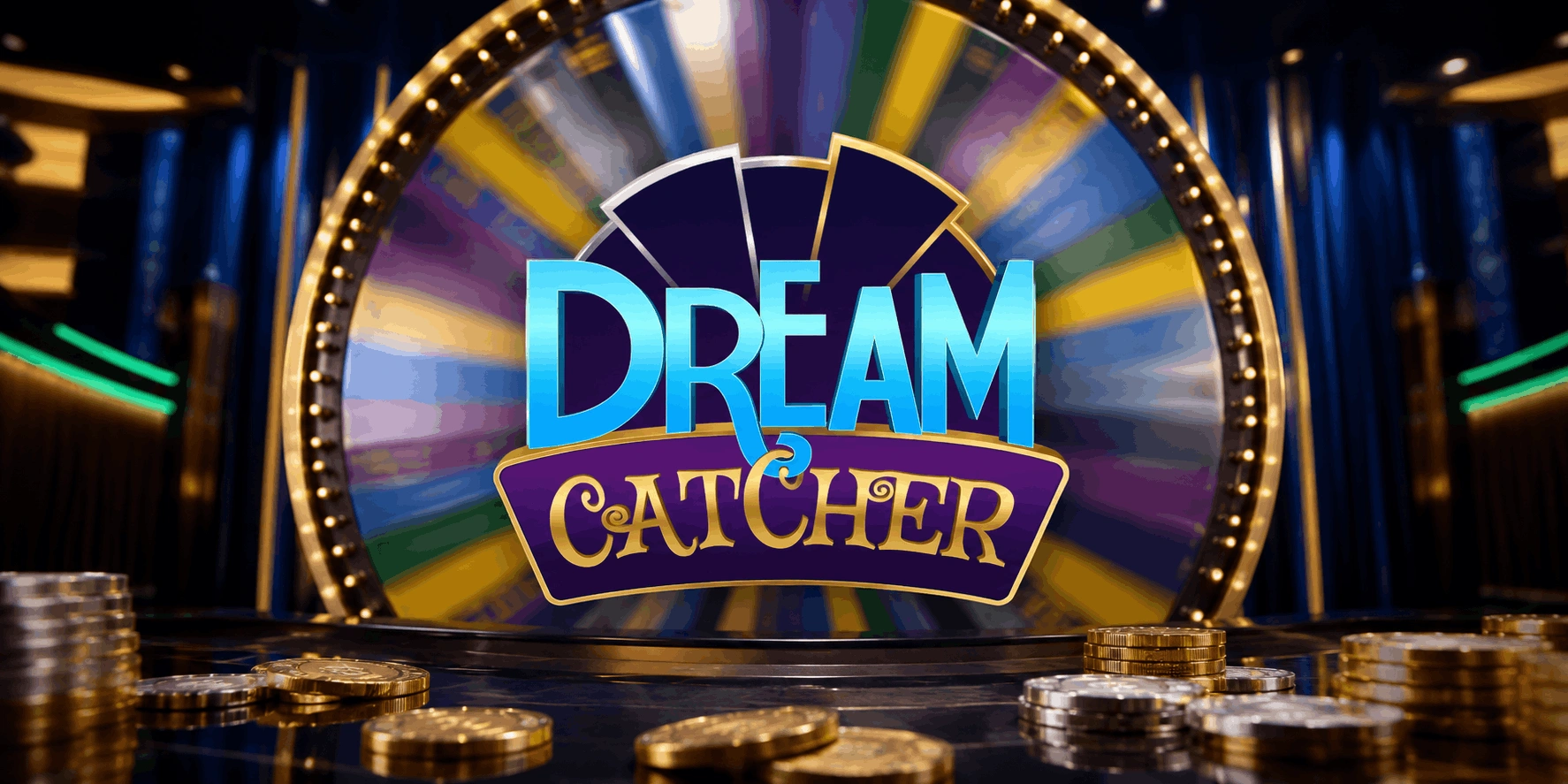
Before Crazy Time, before Monopoly Live, there was just a giant wheel and two colored segments that could turn a modest bet into a small fortune. Dream Catcher is Evolution’s original live game show, one of the earliest hits to define modern live casino, and it works exactly like it sounds. Pick a number, watch the wheel spin, collect if it lands where you bet. No bonus board, no dice, no mini-games. Just a 54-segment wheel with a pair of multiplier slots that can stack your winnings sky-high.
That simplicity was deliberate. Evolution built Dream Catcher for slot and bingo players who wanted nothing to do with card counts or betting strategy, and the format caught on fast enough to spawn an entire category of live game shows. Nearly a decade later, it’s still one of the most played live casino games around, precisely because it never got more complicated than it needed to be.
Here’s the full breakdown: how the wheel works, what the 2x and 7x multipliers actually do to your bet, where the game got its start, and everything else worth knowing before you place a single chip.


Crypto Casino
 Rated 80 of 100%
welcome bonus
200% up to €500


New Casino
Rated 85 of 100%
welcome bonus
100% up to €5000 + 175 FS

Crypto Casino
Rated 95 of 100%
welcome bonus
500% up to $10,000

Crypto Casino
Rated 93 of 100%
welcome bonus
100% up to €100,000


Fan Favourite
Rated 94 of 100%
welcome bonus
325% up to €1000 + 175 FS


Exclusive Bonus
Rated 97 of 100%
welcome bonus
Unique NDB - 3 USDT

Crypto Casino
Rated 94 of 100%
welcome bonus
200% up to €100 + 150 FS

Crypto Casino
Rated 59 of 100%
welcome bonus
150% up to $1500 + 100 FS

Crypto Casino
Rated 91 of 100%
welcome bonus
100% Up To $1500 + 150FS

Crypto Casino
Rated 94 of 100%
welcome bonus
200% up to €2000 + 500 FS

Crypto Casino
Rated 98 of 100%
welcome bonus
150% up to €4000 + 400 FS

Rated 95 of 100%
welcome bonus
305% up to €1,200

Rated 93 of 100%
welcome bonus
305% up to €1,200

Rated 95 of 100%
welcome bonus
100% up to €2000 + 225 FS

Crypto Casino
Rated 95 of 100%
welcome bonus
100% up to €500 + 50 FS


Closed Casino
Rated 1 of 100%
welcome bonus
280% up to €1200 + 150 FS
Rated 95 of 100%
welcome bonus
200% First Deposit Bonus

Rated 94 of 100%
welcome bonus
NO KYC REQUIRED
Dream Catcher is a live money wheel game built by Evolution Gaming, running on a super-sized vertical wheel manufactured by TCS John Huxley, the same company behind casino equipment used on land-based floors worldwide. There’s no RNG deciding where the wheel lands. A live host spins it by hand, and physics does the rest.
The format strips live casino down to its simplest form. You bet on a number, the wheel spins, you either win or you don’t. The only twist sits in two special segments that can multiply whatever comes next.
Here’s the quick-reference rundown before we get into how it plays:
| Detail | Specification |
|---|---|
| Provider | Evolution Gaming |
| Wheel type | 54-segment vertical wheel, built by TCS John Huxley |
| RTP | Up to 96.58% (varies by number bet) |
| Betting options | 6 numbers: 1, 2, 5, 10, 20, 40 |
| Multiplier segments | 2x and 7x, stack on consecutive hits |
| Max multiplier | Up to 20,000x |
| Max payout | $500,000 per round |
| Launched | February 2017, ICE London |
Unlike Crazy Time or Funky Time, there’s no bonus round waiting behind a rare segment. Every spin resolves in one of two ways: you land on a number, or you land on a multiplier that carries into the next spin. That’s the entire rulebook, and it’s exactly why the game still pulls in players who’d never sit down for blackjack.
Dream Catcher went live on February 7, 2017, at ICE, the International Casino Exhibition, at ExCeL London. It was the first title in what Evolution called its “Live Lucky Wheel” category, a format the company hadn’t tried before and one nobody else in live casino had built at scale.
The idea came from a simple problem. Evolution’s Chief Product Officer Todd Haushalter has explained that operators kept asking for ways to cross-sell live casino to slot, bingo, and pull-tab players, but that audience wanted nothing to do with cards, dice, or a table. A basic money wheel seemed promising, except the house edge on traditional wheel games ran too high and the top payouts stayed too small to excite anyone. Evolution’s fix was bolting on the 2x and 7x multiplier segments, which pulled the house edge in line with online slots while opening the door to genuinely big multipliers.
It worked. Dream Catcher won Digital Product of the Year at the 2017 Global Gaming Awards, presented at G2E Las Vegas inside the Sands Expo Centre, just months after its launch. The wheel itself, a custom build from TCS John Huxley, became the template for every big-wheel game show that followed. Crazy Time, Monopoly Live, Funky Time, and the rest of the live game show lineup all trace their DNA back to this one wheel and its two multiplier segments.
Dream Catcher hasn’t needed a redesign to stay relevant. While newer game shows piled on bonus boards, dice rolls, and multi-round mini-games, Dream Catcher kept its original format untouched. That’s partly nostalgia and partly strategy. A slot player who found live casino intimidating in 2017 still recognizes exactly what they’re looking at today: a wheel, a number, and a shot at a big multiplier.
Evolution later built a First Person version of the game, an RNG-powered single-player variant that runs the same wheel and odds without a live host, giving players a free-play option to learn the format before betting real money on the live tables.
Dream Catcher's rules take about thirty seconds to learn, which is exactly the point. There's no card strategy to study and no bonus round mechanic to memorize before your first spin. Here's the round-by-round breakdown, from joining a table to collecting a payout.

Dream Catcher streams 24/7 from Evolution’s studio, so there’s no lobby wait and no scheduled start time. A new round begins moments after the previous one resolves, and you can drop into the betting window as soon as it opens. There’s no demo mode for the live version, though a First Person variant exists for practice.
You get a short betting window, usually around 13 to 15 seconds, before the host spins the wheel. Six betting spots sit along the bottom of the screen, one for each number: 1, 2, 5, 10, 20, and 40. Choose your chip value and click on any number you want to back, and you can spread bets across multiple numbers in the same round if you’d rather cover more ground.
Once betting closes, the host spins the large vertical wheel by hand. There’s no RNG deciding the outcome here. The wheel slows naturally, and a leather flapper mounted at the top settles on the winning segment as momentum runs out.
If the flapper lands on the silver 2x or gold 7x segment, nothing pays out yet. All existing bets stay exactly where they are, no new bets get placed, and the host spins again immediately. Land on another multiplier and the process repeats, with each multiplier stacking onto the last until a number finally comes up.
Once the wheel lands on a number, every matching bet gets paid at that number’s odds, multiplied by whatever multiplier chain preceded it. A bet on 10 with no multiplier pays 10 to 1. The same bet following a 7x hit pays 70 to 1. Winnings land in your balance automatically once the round closes.
Every number on the Dream Catcher wheel pays odds that match its face value, but the segments backing each one aren’t distributed evenly. Lower numbers dominate the wheel and pay less. Higher numbers show up rarely and pay a lot more when they land.
| Segment | Count on Wheel | Payout | Chance per Spin |
|---|---|---|---|
| Number 1 | 23 of 54 | 1:1 | 42.6% |
| Number 2 | 15 of 54 | 2:1 | 27.8% |
| Number 5 | 7 of 54 | 5:1 | 13.0% |
| Number 10 | 4 of 54 | 10:1 | 7.4% |
| Number 20 | 2 of 54 | 20:1 | 3.7% |
| Number 40 | 1 of 54 | 40:1 | 1.9% |
| 2x Multiplier | 1 of 54 | Doubles next win | 1.9% |
| 7x Multiplier | 1 of 54 | 7x next win | 1.9% |
Add the two multiplier segments together and you’re looking at roughly a 1 in 27 chance of hitting one on any given spin. That’s rarer than it sounds over a short session, but frequent enough that most players see a multiplier chain within their first hour at the table.
Number 1 covers nearly 43% of the wheel on its own, which explains why Dream Catcher feels approachable even to players who’ve never bet on a wheel before. Land somewhere in that yellow zone often enough, and the multiplier hits become the only real surprise in the game.
The two multiplier segments are the only thing separating Dream Catcher from a plain money wheel, and they’re doing more work than their small footprint on the wheel suggests.
Land on 2x or 7x and nothing pays out immediately. Every bet already placed stays exactly where it is, no new bets get accepted, and the host spins again right away at no extra cost to anyone at the table. Whatever number comes up on that next spin pays out at its usual odds, multiplied by the value that just hit.
Bet $10 on the number 5, and the wheel lands on 7x first. On the respin, the wheel stops on 5. Instead of the standard 5:1 payout, you collect 5 x 7, or 35:1. That $10 bet returns $350.
Multipliers don’t reset after one hit. If the wheel lands on a multiplier segment again before landing on a number, the two values multiply together instead of replacing each other. A 2x followed by another 2x becomes 4x. A 2x followed by a 7x becomes 14x. The host keeps spinning until a number finally shows up, however many multiplier hits it takes to get there.
There’s no built-in limit to how many multipliers can chain together in theory, though the odds drop fast with each additional hit since only 2 of the wheel’s 54 segments trigger a stack. In practice, the payout has a hard ceiling regardless: no single round pays out more than $500,000, no matter how the multiplier math adds up.
The most talked-about Dream Catcher round happened on November 10, 2018, when the wheel landed on the 7x multiplier three times in a row before finally stopping on 40. That chain worked out to 7 x 7 x 7 x 40, a 13,720x multiplier on every bet placed on 40 that round. It’s the kind of outcome the game is built around, technically possible on any spin and vanishingly rare in practice.
Dream Catcher’s headline RTP is 96.58%, but that figure only applies to one specific bet. Every number on the wheel carries its own RTP, since the frequency of hitting it and the multiplier chain feeding into it both shift the math.
We ran the numbers ourselves using the wheel’s confirmed segment counts and the stacking mechanic above, rather than relying on the conflicting figures floating around other review sites. Here’s how each number actually performs over the long run:
| Number | Theoretical RTP |
|---|---|
| 1 | 95.36% |
| 2 | 95.51% |
| 5 | 91.25% |
| 10 | 96.58% |
| 20 | 92.74% |
| 40 | 90.81% |
Number 10 comes out on top, and it’s not close. Its segment count is rare enough to keep the odds interesting, but not so rare that the multiplier math can’t make up the difference. Numbers 5, 20, and 40 sit at the bottom of the table for the opposite reason: 40 pays the most on paper, but it shows up so infrequently that the big number alone can’t offset how rarely you’ll actually collect it.
None of this changes how the game plays. The wheel doesn’t know or care what you bet on, and every spin is independent of the last. But if you’re choosing a number purely on long-run value, 10 is the mathematically sound pick.

Short answer: no. Dream Catcher runs on a physical wheel spun by hand, and nothing about how you bet changes where the flapper lands. Any site promising a system for beating it isn’t being straight with you.
That doesn’t mean every approach to the game feels the same, though. How you spread your bets still shapes what a session looks like, even without shifting the underlying odds.
Betting on 1 and 2 covers close to 71% of the wheel between them. You’ll win often, the payouts stay modest, and a multiplier hit on one of these numbers still delivers a solid return without needing a rare number to land. This approach suits players who want a long session over a big spike.
Spreading chips across 2, 5, and 10 balances win frequency against payout size. You’ll lose more spins than the low-risk approach, but the wins land bigger, and 10 carries the best theoretical RTP on the whole wheel.
Concentrating everything on 20 or 40 means accepting long dry stretches between wins, in exchange for a shot at a genuinely large payout if a multiplier hits right before your number comes up. This works best for players who’ve set a loss limit they’re comfortable hitting and are playing purely for the chance at a big number.
Bankroll management does more for your session than number selection ever will. Betting a small, consistent percentage of your bankroll per spin keeps you in the game long enough to see a multiplier chain play out, which is the entire draw of Dream Catcher in the first place.
Dream Catcher streams from Evolution’s studio complex in Riga, Latvia, the same production hub behind Crazy Time, Monopoly Live, Funky Time, and most of Evolution’s other flagship game shows. Riga has functioned as one of Evolution’s primary studios for years, where new titles get built, tested, and launched before reaching players worldwide.
Dream Catcher’s presentation borrows from Evolution’s Immersive Roulette playbook: multiple HD camera angles, synchronized lighting, and close-up shots that track the wheel as it slows down. The studio format was a deliberate choice at launch, built to give slot and bingo players something closer to a TV broadcast than a stripped-down webcam feed of a casino floor.
Unlike newer game shows that lean on 3D animation or LED wheel displays, Dream Catcher’s presentation hasn’t needed a major overhaul since 2017. The wheel is a physical object, the host is a real person, and the camera work does the rest. That consistency is part of why the game still feels familiar to players who tried it in its first year and never left.
Dream Catcher runs on HTML5, so it resizes automatically for whatever screen you’re using. There’s no separate mobile app to download and no stripped-down version of the game waiting on smaller devices.
You get the same live broadcast, the same wheel, and the same odds as the desktop version. The main adjustment is layout. Betting spots sit closer together on a phone screen, and desktop’s dual viewing modes (a wide-angle Theatre Mode and a bandwidth-friendly Classic Mode) condense into a single interface built for portrait or landscape play. Rotating your phone switches between the two automatically.
A stable connection matters more here than it does on a slot game, since you’re streaming continuous live video rather than loading static assets. A dropped connection mid-round can be frustrating, though most platforms hold your bet and resolve the outcome once you reconnect. Battery drain is also worth planning around. Extended live streaming pulls more power than a typical mobile session, so keep that in mind if you’re settling in for a while without a charger nearby.
Play Dream Catcher through your licensed casino’s own app or mobile site. There’s no standalone “Dream Catcher app” from Evolution, and any third-party site offering one as a download isn’t a legitimate source.
Dream Catcher’s simplicity can work against you as easily as it works for you. Fast rounds and a low barrier to entry make it easy to play more spins than you meant to, especially once a multiplier chain gets the table excited. It helps to set boundaries before that excitement kicks in, not during it.
A few practical habits make a real difference:
If gambling stops feeling like entertainment and starts feeling like something you can’t control, support is available. Organizations like GamCare and the National Council on Problem Gambling offer confidential help, and most licensed casinos provide self-exclusion tools directly through your account settings. For a deeper look at staying in control, see our full responsible gambling guide.
Dream Catcher earns its spot as the elder statesman of live game shows by refusing to overcomplicate itself. Nearly a decade after its ICE London debut, it’s still just a wheel, six numbers, and two multiplier segments that can turn a modest bet into something worth remembering.
That simplicity is exactly what makes it a smart starting point. There’s no bonus board to learn, no mini-game mechanics to track, and no rulebook longer than a single paragraph. What you see on your first spin is what you’ll be playing on your hundredth.
If you want steady, frequent wins, lean on 1 and 2. If you’re chasing the number with the best long-run value, 10 has the math on its side. And if you’re playing purely for the thrill of watching 2x and 7x stack back to back, set your limit, place your bet, and let the wheel do what it’s always done.
The headline figure is 96.58%, though that applies specifically to betting on the number 10. Every other number carries a slightly different RTP based on how often it hits and how the multiplier math works out, ranging down to around 90.8% on the number 40.
Fifty-four. Fifty-two are numbered segments (1, 2, 5, 10, 20, and 40, each in its own color), and the remaining two are the 2x and 7x multiplier segments.
Yes. If the wheel lands on a multiplier segment, the host respins immediately with all bets still in place. Land on another multiplier, and the two values multiply together rather than replacing each other. This can continue indefinitely in theory, though the odds of a long chain drop fast with each additional spin.
No. Dream Catcher uses a physical wheel spun by hand, with the outcome decided by the wheel’s momentum and a leather flapper, not a random number generator. Evolution’s licensing and independent auditing cover the fairness of the physical wheel itself.
It depends what “best odds” means to you. Number 1 hits most often, covering close to 43% of the wheel. Number 10 carries the highest theoretical RTP of any bet on the table, based on how its frequency and payout size balance out.
Yes. Evolution released a First Person Dream Catcher as an RNG-based single-player alternative, running on the same odds and wheel layout without a live host. It’s typically available in demo mode, unlike the live version.
No. Dream Catcher runs through your licensed casino’s own app or mobile browser via HTML5. Be cautious of any third-party site offering a standalone “Dream Catcher app,” since Evolution doesn’t distribute one.

The Author
The Author
Content Expert