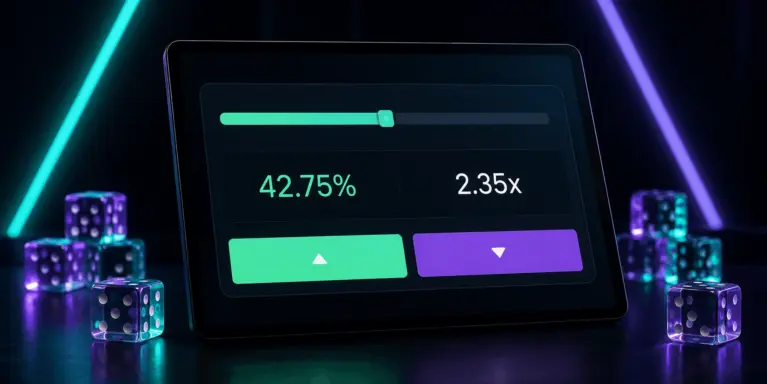
Most casino games dress up their odds in reels, ribbons and a bonus round nobody asked for. Dice skips the wardrobe entirely. You get a slider running from 0.00 to 99.99, a choice between over and under, and a payout figure that updates in real time as you drag. Nudge the slider toward the long shots and the multiplier balloons while your win chance withers. Pull it back and you win far more often for pocket change. No mystery, no small print, just a number staring back at you before you commit.
That stubborn simplicity is exactly why the game refuses to die. Dice landed in April 2012 as SatoshiDice, the first Bitcoin gambling product to pull serious volume, and by 2013 Primedice had built the seed-and-nonce system that every provably fair casino still runs on today. Fourteen years and countless flashier rivals later, the mechanic has barely changed a pixel. It turns out you cannot really improve on “guess the number, get paid.”
There is a catch worth knowing before you start dragging that slider around. Modern dice comes in two flavours that look like cousins and pay like strangers. Crypto casinos build the slider version in-house, while providers such as BGaming ship titles that roll two genuine dice with a fixed multiplier table. Both settle on the same over/under logic, but their RTP figures sit a couple of percentage points apart. That gap is small on paper and brutal over a few thousand rolls.
 Reviewed byNadia Winchester

New Casino
 Rated 82 of 100%
welcome bonus
550% up to €3540 + 400 FS


Exclusive Bonus
Rated 88 of 100%
welcome bonus
400% up to €4,000 + 400 FS

New Casino
Rated 83 of 100%
welcome bonus
250% up to €4,000 + 250 FS

New Casino
Rated 81 of 100%
welcome bonus
100% up to €5,000 + 175 FS


Crypto Casino
Rated 85 of 100%
welcome bonus
500% up to $10,000

Crypto Casino
Rated 89 of 100%
welcome bonus
100% up to €100,000

Crypto Casino
Rated 90 of 100%
welcome bonus
200% up to €100 + 150 FS

Crypto Casino
Rated 55 of 100%
welcome bonus
150% up to €1,300 + 100 FS

Crypto Casino
Rated 87 of 100%
welcome bonus
100% up to $1,500 + 150 FS

Crypto Casino
Rated 82 of 100%
welcome bonus
200% up to €2,000 + 500 FS

Crypto Casino
Rated 94 of 100%
welcome bonus
150% up to €4,000 + 400 FS

Rated 91 of 100%
welcome bonus
305% up to €1,200

Rated 89 of 100%
welcome bonus
305% up to €1,200

Crypto Casino
Rated 91 of 100%
welcome bonus
100% Deposit Bonus

Rated 91 of 100%
welcome bonus
200% Bonus up to €350

Rated 90 of 100%
welcome bonus
NO KYC REQUIRED

Rated 93 of 100%
welcome bonus
100% up to €100 + 100 FS


Hot Casino
Rated 95 of 100%
welcome bonus
243% up to €5,555 + 243 FS
Dice belongs to the instant-win corner of the Originals library, where a bet resolves the moment you place it. There is no spin animation to sit through and no bonus round hiding behind a scatter symbol. You set your odds, you pick a side, and the result lands in under a second. Everything that matters happens on a single control, which is why players either fall for this game immediately or bounce off it in thirty seconds.
The slider is the whole game. It sets your win chance as a percentage, and the payout multiplier moves inversely to whatever you choose. Sit at a 50% win chance and you are looking at roughly 2x. Drag down to a 5% win chance and the multiplier jumps close to 20x, but you now lose nineteen rolls out of twenty on average.
Most versions let you push that slider to genuine extremes. The floor sits at a fraction of a percent, which unlocks four-figure multipliers, and the ceiling sits in the high nineties, where you win almost every roll for a payout barely above your stake. Here is what the interface actually gives you control over:
The over/under toggle sounds like a strategic decision and functions as a cosmetic one. Choosing under 25.00 gives you a 25% win chance. Choosing over 75.00 gives you the same 25% win chance and the identical multiplier. The winning range simply sits at the other end of the number line.
Players still develop fierce preferences here, and the game happily indulges them. Some swear by rolling under after a losing streak, others flip sides every ten rolls to “reset” something. The math shrugs at all of it.
Open a crypto casino’s dice game and you will notice a distinct lack of dice. The slider version generates a random number between 0.00 and 99.99, then compares it against your target. Spribe’s Dice runs the same idea with an extra decimal place, producing results from 0.000 to 99.999.
That naming quirk is a hand-me-down from SatoshiDice, which used the word before the interface settled into its current shape. The two-dice titles from studios like BGaming do put physical-looking dice on screen, which we cover further down. Both families share the over/under skeleton, so the name stuck across the whole category.
Search for dice games and you will trip over three completely different products. They share cubes and almost nothing else. Craps and sic bo are table games with dealers, betting layouts and a menu of side wagers. Dice as an Original is one player, one number, one decision.
| Game | What Gets Rolled | Bet Options | House Edge on the Best Bet |
|---|---|---|---|
| Dice (Original) | A random number from 0.00 to 99.99 | Roll over or roll under, at any win chance you set | 1% at most house-built versions |
| Craps | Two physical dice thrown by a shooter | Pass, don’t pass, come, odds, plus dozens of prop bets | 1.41% on the pass line |
| Sic Bo | Three dice shaken in a sealed container | Small, big, totals, specific triples and combinations | 2.78% on small or big |
The gap in that final column is the reason dice players stay put. A 1% edge is among the friendliest numbers in any casino lobby, and you reach it without memorising a single betting system or waiting for a dealer to finish paying out the table.
Dice holds a claim no other Original can make. It was the first casino game built for cryptocurrency rather than adapted to it, and the trust mechanics invented to support it now underpin every provably fair title in the category. The story runs from a site that nearly choked the Bitcoin network to a game sitting in almost every crypto casino lobby today.
Erik Voorhees launched SatoshiDice in April 2012, and it worked in a way that seems almost reckless now. There were no accounts, no balances and no deposits. Players sent bitcoin directly to one of several published wallet addresses, each carrying its own fixed odds and payout, and the transaction itself was the bet.
The result was settled against the transaction hash, with winnings returned automatically to the sending address. Losers received one satoshi back so the outcome appeared on-chain as a confirmed reply. That design made every single wager a permanent public record, which is exactly where the trouble started.
Voorhees blocked US-based IP addresses in May 2013 over legal concerns, then sold the site that July for 126,315 BTC. At the time that came to roughly $11.5 million, making it the first major acquisition in the crypto industry. The purchase was settled entirely in bitcoin, which felt appropriate for a business built on it.
Dooglus launched Just-Dice in June 2013 with a 1% house edge and an idea nobody had tried at scale. Players could bet against the bankroll or invest in it, taking a share of the site’s profits and losses in proportion to their stake. Ordinary users could sit on the other side of the table for the first time.
The model worked well enough to attract serious money, and the site published weekly return data for investors. Canadian regulations forced a shutdown of betting in June 2014, and dooglus refused offers to sell rather than hand over a trusted brand. Just-Dice returned months later running on CLAM instead of bitcoin, and it still operates on that currency today.
Primedice arrived in 2013 and solved the problem SatoshiDice had created. Bets moved off-chain into a normal account balance, which killed the blockchain congestion overnight. Verification stayed intact through a cryptographic system built on three inputs.
| Input | Who Controls It | What It Does |
|---|---|---|
| Server seed | The casino | Hashed and shown to you before play, revealed after, so results cannot be altered mid-session |
| Client seed | The player | Editable at any time, meaning the casino cannot know the full input in advance |
| Nonce | The system | Counts up with each roll, producing a different result from the same seed pair |
That combination gave players instant, independent proof without clogging a public ledger. Every crash game, Mines grid and Plinko drop verified today runs on the same three ingredients. Dice invented the trust layer the whole Originals category now takes for granted.
Licensed studios eventually noticed a game with cult status and no reels to maintain. BGaming released Rocket Dice in October 2018, running over/under bets on the total of two dice at a 99% RTP. Spribe later added Dice to its Turbo Games range, keeping the slider format at a 97% RTP with a ceiling of 970x.
Those releases pushed the game beyond crypto-only sites into regulated lobbies where house-built Originals are not an option. Dice now exists in both worlds at once. The mechanic that started as an on-chain experiment in 2012 has outlasted most of the sites that hosted it.
Dice has one of the shortest learning curves in any casino lobby. What takes practice is reading the numbers properly before you commit, because the interface hands you everything and most players glance straight past it.

Crypto casinos run separate balances per coin, and the minimum bet shifts with each one. Most dice versions accept fractions of a cent, so bankroll size rarely blocks entry. Sort this out first, because switching currencies mid-session resets your bet settings.
Nearly every dice game offers a free version, and a hundred practice rolls teach you more about variance than any guide manages. Watch how long a losing run stretches at a 10% win chance. That single observation reshapes how most players set their slider.
Use the doubling and halving buttons instead of typing a figure. Almost every betting system players attach to this game relies on exactly those adjustments, and the buttons keep your progression clean. Start smaller than feels interesting, since dice rounds resolve in under a second.
This single control sets your odds and your payout at the same time. Push it toward the low end for fat multipliers and long dry spells, or toward the high end to win most rolls for a sliver of profit. The ceiling sits around 95% to 98% depending on the version, and the floor drops to a fraction of a percent.
The toggle flips the winning range to the opposite side of your target number. Rolling under 25.00 and rolling over 75.00 give you the same 25% win chance and the same multiplier. Pick the side that feels right, because the math treats both identically.
Check the multiplier, the profit on win and the max profit cap. The first two update live as you drag the slider, showing your exact return in real currency. Max profit is the one players miss, and it caps the largest single win the site will pay regardless of your settings.
Results land instantly, and your balance updates before the animation finishes. Instant bet mode strips the visuals entirely, which lets a player fire several hundred wagers in ten minutes without registering the volume. Leaving the animation switched on is one of the simplest pacing tools available.
Two extras sit outside the main sequence and deserve a look before you settle in.
The max profit figure moves with the site’s bankroll and quietly limits how far you can push the slider. Chase a 500x multiplier and the casino may restrict your stake without a warning popup, because paying out in full would breach that ceiling. Your roll resolves normally, but the limit was set before you clicked.
The fairness panel hides behind a small icon near the bet controls. It displays your hashed server seed, your editable client seed and your running nonce count. Change the client seed whenever you like, and the site rotates the server seed while revealing the old one for verification.
Dice is the rare casino game that shows you its entire pricing model on screen. The multiplier attached to any slider position comes from one short formula, and once you can run it in your head you can audit any dice game in about four seconds. That is a genuinely useful party trick in a category built on trust.
Take the game’s RTP as a number, then divide it by your win chance. That is the whole calculation.
Multiplier = RTP ÷ win chance
A version running 99% RTP at a 50% win chance pays 99 ÷ 50, landing at 1.98x. Push down to a 5% win chance and you get 99 ÷ 5, or 19.80x. The missing 1% is the house edge, baked directly into the payout rather than skimmed off your winnings later.
That structure explains why a “fair” coin flip pays 1.98x instead of 2x. You win half the time and receive slightly less than double, and the gap between those two figures is the entire business model.
| Win Chance | Multiplier at 99% RTP | Multiplier at 97% RTP | What You Give Up |
|---|---|---|---|
| 98.00% | 1.0102x | 0.9898x | At 97% RTP this pays less than your stake, so the setting is unplayable |
| 50.00% | 1.9800x | 1.9400x | Four cents per unit staked, every single roll |
| 25.00% | 3.9600x | 3.8800x | Eight cents per unit, compounding fast under autobet |
| 10.00% | 9.9000x | 9.7000x | Two full units of payout across ten winning rolls |
| 2.00% | 49.5000x | 48.5000x | A full unit of stake on every hit you land |
| 0.10% | 990.0000x | 970.0000x | Twenty units per hit, on an outcome you see once in a thousand rolls |
Here is where dice separates itself from almost every other casino game. In blackjack a bad decision costs you money. In roulette a five-number bet carries a worse edge than red or black. In dice, every slider position from 0.01% to 98% carries exactly the same house edge.
The expected cost per roll is your stake multiplied by the edge, and nothing else touches it. On a 99% RTP version, wagering $100 across any settings costs you $1 in expectation. Grind at 95% win chance or hunt 990x long shots, and the long-run math produces the identical figure.
That has one practical consequence worth internalising. Since the edge is fixed per wager, your total cost scales with volume rather than risk appetite. A cautious player firing 2,000 tiny rolls an hour is paying the house more than a reckless one placing forty.
The slider trades certainty for spikiness. It changes how your bankroll behaves on the way to that fixed expected loss, and the swings at the low end are far uglier than most players anticipate.
| Win Chance | Average Rolls Between Wins | Odds of Zero Wins in 50 Rolls |
|---|---|---|
| 50.00% | 2 | Effectively zero |
| 25.00% | 4 | About 1 in 1.8 million |
| 10.00% | 10 | 0.52% |
| 5.00% | 20 | 7.7% |
| 2.00% | 50 | 36.4% |
| 1.00% | 100 | 60.5% |
| 0.10% | 1,000 | 95.1% |
Read that bottom row carefully. At a 0.10% win chance, going fifty rolls without a single hit is the normal experience rather than a bad night. Players chasing 990x routinely conclude the game is rigged when the math says they simply had a completely average session.
Extreme settings carry two problems beyond the obvious one. Max profit caps mean the site may quietly restrict your stake at high multipliers, so your theoretical 990x payout gets trimmed to whatever the bankroll allows.
The second is subtler. Long dry spells push players toward larger bets to “catch up,” which is precisely when the fixed edge does its most efficient work. Volume kills bankrolls in dice, and low win chances generate volume faster than any other setting.
The dice label covers two mechanically distinct products, and players regularly open one expecting the other. Both settle bets on an over/under prediction, and that is roughly where the similarity ends. One gives you a slider with thousands of possible odds settings, while the other gives you eleven possible outcomes and a fixed paytable.
This is the version that grew out of SatoshiDice and Primedice, and it dominates crypto casino lobbies. A random number lands between 0.00 and 99.99, you set your target and direction, and the multiplier follows the formula. Casinos build these in-house, which is why the game rarely carries a studio logo.
House-built slider dice runs at a 1% house edge as standard, putting RTP at 99%. Some operators go further with promotional structures, dropping the edge to zero for an opening block of wagers before reverting. Spribe supplies the licensed alternative through its Turbo Games range, running the same slider format with a wider decimal range and a 970x ceiling.
BGaming built the best-known version of this format, and it works nothing like the slider. Two dice roll, their faces get added, and you predict where that total lands relative to your chosen number between 2 and 12. There are eleven possible sums, and their probabilities are wildly uneven.
That distribution is the entire game. A total of 7 appears six times out of thirty-six combinations, while 2 and 12 appear once each. Your payout tracks those odds, so betting over 3 wins constantly for almost nothing, and betting over 11 pays handsomely on a result you rarely see.
| Feature | House-Built Slider Dice | Spribe Dice | BGaming Rocket Dice |
|---|---|---|---|
| Result range | 0.00 to 99.99 | 0.000 to 99.999 | Sum of two dice, 2 to 12 |
| Stated RTP | 99% at most operators | 97% | 99% per the studio, with some operator listings showing lower |
| Odds control | Continuous slider, thousands of settings | Continuous slider, thousands of settings | Eleven target numbers, fixed probabilities |
| Maximum multiplier | Varies by operator, often into four figures | 970x | 35.30x |
| Extra features | Autobet, scripting, seed rotation | Autoplay, provably fair panel | Risk Mode gamble, autoplay, paytable |
| Where you find it | Crypto casinos with in-house Originals | Crypto and licensed lobbies alike | Licensed casinos, listed under specialty games |
Regulated markets rarely permit operators to build and run their own RNG games, since the licence usually requires games from certified third-party suppliers. Crypto casinos operating under lighter frameworks face no such restriction, which is why in-house dice thrives there and barely appears elsewhere.
That divide creates a genuine consequence for players. House-built versions offer the best returns and the deepest customisation, and they sit on sites with fewer regulatory guarantees. Provider versions come with independent testing and licence oversight attached, and they pay a little less for the privilege.
The two-dice format suits players who want a paytable to study and a shorter session. Its 35.30x ceiling keeps swings modest, and the Risk Mode gamble adds a decision point without much complexity.
Slider dice suits anyone who wants control over their own variance. Setting a 90% win chance produces something close to a grind, while dropping to 1% turns the same game into a lottery ticket generator. Nothing else in the Originals category hands you that range from a single control.
No other Original hands automation this much control. Dice autobet panels let you set conditions, adjustments and stop points, then walk away while the game fires off thousands of rolls. Players build elaborate systems inside these panels, and the panels execute them beautifully right up until the bankroll runs out.
Two settings sit at the heart of every autobet panel, and both react to the result of the previous roll. The “on win” field either resets your stake to the base amount or increases it by a percentage you choose. Set it to reset and you are flat betting. Set it to 100% and you are riding winning streaks with doubled stakes, which is the Paroli progression in its purest form.
The “on loss” field works identically in the opposite direction. Leaving it on reset keeps your stake flat through a losing run, while any percentage above zero starts a recovery progression. Enter 100% here and the panel builds you a Martingale, doubling after every defeat without a word of warning. It will run that sequence faithfully for as long as your balance holds, which is precisely the danger.
The remaining three settings decide when the run ends, and they matter far more than the progression logic above them. “Number of bets” caps the volume, with zero meaning the panel keeps rolling indefinitely. “Stop on profit” halts everything once net winnings reach your target, which stops a good session turning into a long one.
“Stop on loss” is the single most useful field on the panel. It ends the run at a loss figure you set in advance, before variance had a chance to influence your judgement. Players who skip this field are relying on themselves to intervene mid-run, and that intervention rarely arrives on schedule.
Automation makes progressions feel painless, because you never manually type the escalating numbers. That distance from the figures is exactly the problem. A doubling sequence from a modest base climbs faster than intuition suggests.
At a 49.5% win chance, losing eighteen in a row happens roughly once every 350,000 sequences. That sounds comfortably rare until you remember autobet fires several thousand rolls per hour. Run that setup across a few sessions and the improbable stops being theoretical.
Autobet earns its place when you use it for discipline rather than escalation. The stop fields are the only tools in the game that enforce a decision you made while thinking clearly.
Set both limits before starting a run, keep the win and loss adjustments at zero, and the panel becomes a flat-betting machine with hard boundaries. Your expected loss still equals your volume multiplied by the house edge. The difference is that the session ends where you decided rather than where your nerve failed.
Some casinos expose a scripting console, letting players write custom logic in JavaScript for conditions the standard panel cannot handle. These scripts can adjust win chance mid-run, switch between over and under, or implement multi-stage recovery systems.
The capability is real, and so is the trap underneath it. Every script obeys the same fixed edge, so no amount of conditional logic changes the expected outcome. What scripts do change is throughput, and that is the one variable that reliably damages bankrolls.
A player placing manual bets might manage 300 rolls in an hour. A script runs 10,000 in the same window. On a 99% RTP game with a 1 unit base stake, the first player expects to lose 3 units and the second expects to lose 100.
Three checks are worth making a habit, since automation removes the natural pauses where players normally reassess.
Dice carries a distinction worth repeating. The verification system running underneath every crash game, Mines grid and Plinko board in the Originals category was built for this game first, back when Primedice needed a way to prove honesty without publishing every wager to a public blockchain. Dice players got trustless verification years before it became a category-wide expectation.
Three inputs combine to produce your result, and you control one of them. The server seed comes from the casino, hashed and displayed before you play, which locks the site into a value it cannot change later. Your client seed sits in the fairness panel and you can edit it at any moment. The nonce ticks upward with each roll, guaranteeing that the same seed pair produces a fresh number every time.
Checking a completed roll takes four steps:
If the numbers match, that roll was generated before you placed it and no interference took place. If they do not, you have found something worth reporting loudly.
Verification confirms the roll was fair. It says nothing whatsoever about the payout attached to it, and those are two entirely separate checks.
A casino can run flawless provably fair mechanics while paying 1.94x on a 50% win chance instead of 1.98x. Both rolls are honest, and one costs you twice as much per wager. Auditing the payout means checking the multiplier against the formula from the previous section, which is a job the fairness panel will never do for you.
Players who want the full cryptographic breakdown, including how hashing prevents seed manipulation and how to run verification independently, can dig into how provably fair systems generate and verify results before their next session.
Dice sits near the top of the RTP charts across the entire casino floor, and players tend to treat that as a licence to relax. The figures are genuinely excellent by industry standards. What matters more is the gap between versions, because a two-point difference produces a very different bankroll curve once volume enters the picture.
Most online slots return somewhere in the mid-nineties, and plenty land below that. Dice starts where slots finish.
Only a handful of games beat 99%, and most of them require perfect strategy to reach the advertised figure. Dice hands you the number automatically, since there is no decision you can make badly enough to lower it.
Comparing 99% to 97% looks academic on paper. Attach it to real volume and the difference stops being subtle.
Wagering 10,000 units at 99% RTP costs 100 units in expectation. The same 10,000 units at 97% costs 300. That is triple the expected loss for a game that looks and plays almost identically on screen.
Dice players reach those volumes quickly, since rounds resolve in under a second and autobet exists. Ten thousand rolls at one unit each is a couple of hours of casual autobet, not a lifetime of play. The version you choose is the single largest decision affecting your long-run results.
This point deserves repeating because it contradicts what most players assume. Every win chance setting carries the identical house edge, from 0.01% up to 98%. The formula bakes the edge into the multiplier at every position equally.
Grinding at 95% win chance for tiny profits costs exactly the same per unit wagered as hunting 990x long shots. What changes is the shape of the journey, and nothing about the destination. Playing safe in dice reduces your swings while leaving your expected loss untouched.
Every other casino game arrives with volatility pre-assigned by the studio. Dice hands you the dial instead, which makes the usual low, medium and high labels meaningless here.
A 90% win chance produces a low-volatility experience with frequent tiny wins and shallow drawdowns. A 2% win chance produces something closer to a high-volatility slot, with long droughts punctuated by 49.5x hits. The same game, the same RTP, and two completely different sessions.
That flexibility explains why dice retains players who would never touch a specialty game otherwise. It also explains why bankroll advice for the game is close to useless without knowing where the player keeps their slider.
Search for dice strategy and you will find thousands of systems, several forums dedicated to refining them, and a genuinely impressive amount of mathematics deployed in service of a doomed cause. The systems are real, the enthusiasm is real, and the results are considerably less impressive than the presentation suggests. Here is what each one actually does to your bankroll.
Martingale doubles your stake after every loss, aiming to recover everything plus one unit on the next win. The logic works perfectly in a world with infinite money and no table limits. In the real one, a modest losing streak escalates your stake past your balance or past the site’s maximum bet, and the sequence collapses with everything still owed.
Every system above rearranges the order of your bets. Not one of them changes what any individual bet is worth.
Your expected loss equals total wagered multiplied by the house edge, and no sequencing rule touches either variable. A system that wins small amounts frequently is simply distributing losses into rarer, larger events. Players mistake that redistribution for an edge because the winning sessions arrive often enough to feel like a pattern.
The uncomfortable part is that progressions actively increase total volume. Martingale wagers dramatically more per sequence than flat betting, which means it costs more in expectation while feeling more controlled.
A specific set of myths attaches itself to provably fair games, and dice attracts more than most.
The last one is worth flagging twice, because players switch sides constantly in the belief that it does something. It does nothing at all.
Nothing beats the house edge in dice, and any guide claiming otherwise is selling something. Three choices still make a real difference to how your money behaves.
None of these are strategies in the sense the forums mean. They are the difference between a session that lasts an evening and one that lasts eleven minutes.

None of these will beat the house edge, since nothing does. What they will do is stop the common mistakes that turn a two-hour session into a ten-minute one. Most dice players lose money faster than they need to, and the reasons are almost always structural rather than unlucky.
The most frequent error in dice has nothing to do with betting systems. Players pick a win chance that their bankroll cannot survive, then blame variance when the inevitable happens.
Work backwards from the drought table instead. A 10% win chance needs enough balance to absorb thirty or forty consecutive losses without flinching. A 2% win chance needs several hundred. Divide your session bankroll by the average gap between wins, and you have your realistic maximum stake.
Balance watching tells you almost nothing, because it bounces constantly. Total wagered tells you exactly what the game has cost you, and most dice interfaces display it if you look.
At 99% RTP, every 1,000 units you wager costs 10 units in expectation. Check that figure mid-session and the arithmetic becomes concrete rather than theoretical. Players who track it tend to slow down without being told to.
A handful of small choices compound across a session.
That figure sitting quietly near the bet controls limits the largest single win the site will pay. Chase a 500x multiplier with a stake that would breach it, and the casino restricts your bet without a popup explaining why.
Check the cap before setting up any low win chance run. There is no point building a session around 900x payouts if the bankroll ceiling trims them to a fraction of what the multiplier promises.
High RTP games attract restrictions, and dice sits at the top of that list. Casinos frequently exclude it from bonus play entirely, or count it at a heavily reduced rate toward wagering requirements.
Read the bonus terms before depositing if dice is your intended game. A 20% contribution rate means a 10,000 unit requirement demands 50,000 units of actual dice wagering. That volume costs 500 units in expectation at 99% RTP, which is frequently more than the bonus is worth.
Dice deserves a more serious note than the rest of this page. The game resolves in under a second, runs unattended through autobet, and offers a house edge low enough to make heavy volume feel harmless. That combination makes it one of the easier games to lose track of time and money inside.
Speed is the core risk. A slot spin takes a few seconds and a live blackjack hand takes closer to a minute, while dice can process several thousand wagers in an hour. The number on screen barely moves between rolls, so the scale of what has been wagered stays hidden until you check the total.
Automation adds a second layer. Autobet removes the natural pauses where players normally stop and reassess, and a script running overnight can wager sums that would never be placed one roll at a time. The 99% RTP figure encourages this, because a small edge sounds negligible until it is applied to enormous volume.
Every reputable casino provides tools that work better than willpower.
Autobet stop-on-loss belongs on that list too. Set it before every run, at a figure you accepted losing while thinking clearly.
Certain patterns indicate the game has stopped being entertainment. Chasing losses with larger stakes after a bad run is the clearest one. Playing longer than intended, hiding the extent of play from people close to you, or gambling with money committed to something else all point the same direction.
Gambling is entertainment with a cost attached, and the cost is not negotiable. Treat that cost the way you would treat any other spending, and stop when it reaches the figure you set.
Support is free, confidential and available regardless of how serious the situation feels.
Reaching out early makes a genuine difference. If gambling has stopped feeling like a choice, speak to one of these services today, and our responsible gambling guide covers the available tools and regional resources in more detail.
Dice earns its place in the Originals category by refusing to complicate anything. One slider, two buttons, a multiplier that follows a formula you can run in your head, and a result that lands before the click finishes registering. Fourteen years after SatoshiDice put the first version online, nobody has found a way to improve the mechanic, and plenty have tried.
The transparency is the appeal, and it comes with a warning attached. You can see your odds, verify your rolls and audit the payout math yourself, which is more than most casino games offer. None of that alters the fixed edge sitting inside every multiplier at every slider position.
Three things matter more than any strategy you will read about. Pick the highest RTP version you can find, because the gap between 99% and 97% triples your expected loss. Set your win chance to something your bankroll can genuinely survive. Control your volume, since speed is what turns a small edge into a large bill.
Get those right and dice delivers exactly what it promises: fast, honest, fully customisable variance with numbers you can check. Take a look at the casinos listed at the top of this page for the versions running the best returns, and set your slider before the autobet panel sets it for you.
Yes, and most versions make it easy. Crypto casinos with in-house dice usually offer a demo balance or a faucet that drips tiny amounts of currency for practice. Provider titles from BGaming and Spribe run free demos on the studio sites and on most review pages. Fifty practice rolls at a low win chance will teach you more about drought length than any explanation manages.
It is, though the version changes. Licensed casinos in regulated markets rarely allow operators to build their own RNG games, so in-house slider dice mostly stays on crypto sites. What you find in regulated lobbies are provider titles listed under specialty or table games, which carry independent testing and licence oversight instead.
The result is already determined by the seed pair and nonce, so a dropped connection changes nothing. Your roll resolves server-side and the outcome appears in your bet history once you reconnect. Autobet runs behave differently across operators, with some continuing and others halting, so check the panel behaviour before starting a long unattended session.
Both, and they vary widely. Crypto casinos often accept stakes below a cent, which makes the game accessible on almost any balance. The maximum works differently from most games, because the max profit cap limits your effective stake at high multipliers rather than imposing one flat ceiling. Chasing a 500x payout means your allowed bet shrinks accordingly.
Not on a properly implemented provably fair system. The hashed server seed is published before you play, which locks the casino into a value it cannot alter afterwards. Rotating your seed reveals the original for verification, and running it through a verifier confirms the roll matched what was committed. Any mismatch is evidence worth escalating publicly.
Two-dice titles suit newcomers slightly better, since eleven possible outcomes and a visible paytable give you something concrete to learn. Slider dice offers more control and better returns at 99% RTP, though the freedom to set a 1% win chance is exactly how new players empty a balance in minutes. Starting near 50% on either version keeps the swings manageable while you get a feel for the pace.
The Author
The Author
Slots and News Reviewer