












New Game

A casino platform is the software an operator runs its site on: the account system, the cashier, the bonus engine and the integrations that pull in games from hundreds of studios. Most casinos do not build any of it themselves, they license it.
That is why so many sites feel alike. Two casinos running on the same platform will often share the same payment flow, the same bonus mechanics and the same game lobby, with only the branding and the offers separating them.
Knowing which platform sits behind a casino tells you a great deal in advance: which payment methods are likely to be supported, how the bonus terms are structured and how withdrawals are handled. This page maps the major platforms and the brands running on each.
 Reviewed byFred Anderson

Hot Casino
 Rated 72 of 100%
welcome bonus
Up to €300 + 170 FS


New Casino
Rated 74 of 100%
welcome bonus
240% up to €1,200 + 600 FS

New Casino
Rated 62 of 100%
welcome bonus
500% up to €5,000 + 500 FS

New Casino
Rated 63 of 100%
welcome bonus
430% up to €4,000 + 200 FS

New Casino
Rated 68 of 100%
welcome bonus
345% up to €2,000 + 225 FS


Rising Star
Rated 80 of 100%
welcome bonus
375% up to €5,250 + 325 FS

New Casino
Rated 79 of 100%
welcome bonus
300% up to €5,500 + 300 FS

New Casino
Rated 84 of 100%
welcome bonus
100% up to €100

New Casino
Rated 81 of 100%
welcome bonus
400% up to €2200 + 350 FS

New Casino
Rated 82 of 100%
welcome bonus
550% up to €3540 + 400 FS

New Casino
Rated 73 of 100%
welcome bonus
200% up to €1500 + 150 FS

New Casino
Rated 90 of 100%
welcome bonus
300% up to €10,000 + 500 FS

New Casino
Rated 74 of 100%
welcome bonus
550% up to €3400 + 400 FS


Crypto Casino
Rated 92 of 100%
welcome bonus
275% up to €2000

Exclusive Bonus
Rated 76 of 100%
welcome bonus
500% up to €1,000 + 50 FS

New Casino
Rated 78 of 100%
welcome bonus
225% up to €3000 + 225 FS

New Casino
Rated 71 of 100%
welcome bonus
150% up to €750 + 150 FS

New Casino
Rated 80 of 100%
welcome bonus
200% up to €1500 + 150 FS
A casino platform is the underlying technology and service package that powers an online casino. Instead of building everything from scratch, an operator can license a ready-made iGaming system that already includes the player account engine, wallet, game integrations, payment processing, back office, and reporting. This lets a brand launch faster and at lower cost while the platform provider handles the heavy technical lifting. Most of the casino brands you play at run on one of a relatively small number of platforms. The provider supplies the framework and ongoing maintenance, and the operator focuses on branding, marketing, bonuses, and player support. The three common models are white label, turnkey, and self-service, and each gives the operator a different balance of speed, control, and responsibility.
Quick answer
A casino platform is the technology and services behind an online casino, including the player account system, wallet, game library, payments, and back office. Operators license a platform (white label, turnkey, or self-service) to launch and run a casino without building the full infrastructure themselves. Well-known platforms include Pragmatic Solutions, SoftSwiss, EveryMatrix, SkillOnNet, Aspire Global, and SBTech.
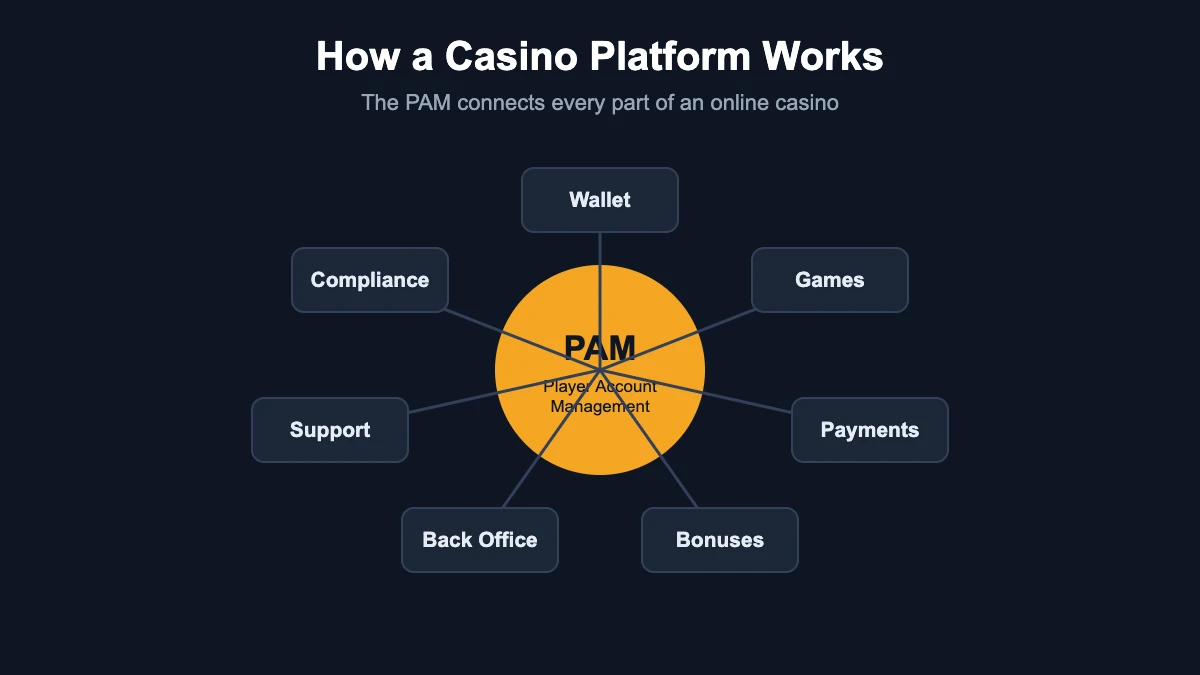
At its core, a casino platform sits between the player and every system a casino depends on. When a player registers, logs in, deposits, opens a game, or withdraws, the platform routes that activity to the right place and keeps a single, consistent record of it. Think of it as the operating system of an online casino: the games, payments, bonuses, and support tools are applications running on top, and the platform makes them work together.
The heart of any platform is the Player Account Management system, usually shortened to PAM. The PAM owns the player profile, the wallet, the transaction history, and the responsible gambling controls. Because all of this flows through one system, the operator gets a unified view of each player and can apply rules, limits, and promotions consistently across the whole site.
Around the PAM sit the other major subsystems. A game aggregation layer connects the casino to dozens or hundreds of studios through a single integration. A payment orchestration layer connects to card processors, e-wallets, bank transfer rails, and often cryptocurrency. A bonus engine manages welcome offers, free spins, reloads, cashback, and loyalty schemes. And a back office ties it all together with dashboards, reporting, and the controls staff use to run the business.
The practical result is that an operator can focus on what differentiates a brand, design, marketing, promotions, and player experience, while the platform provider keeps the underlying machinery running, secure, and up to date.
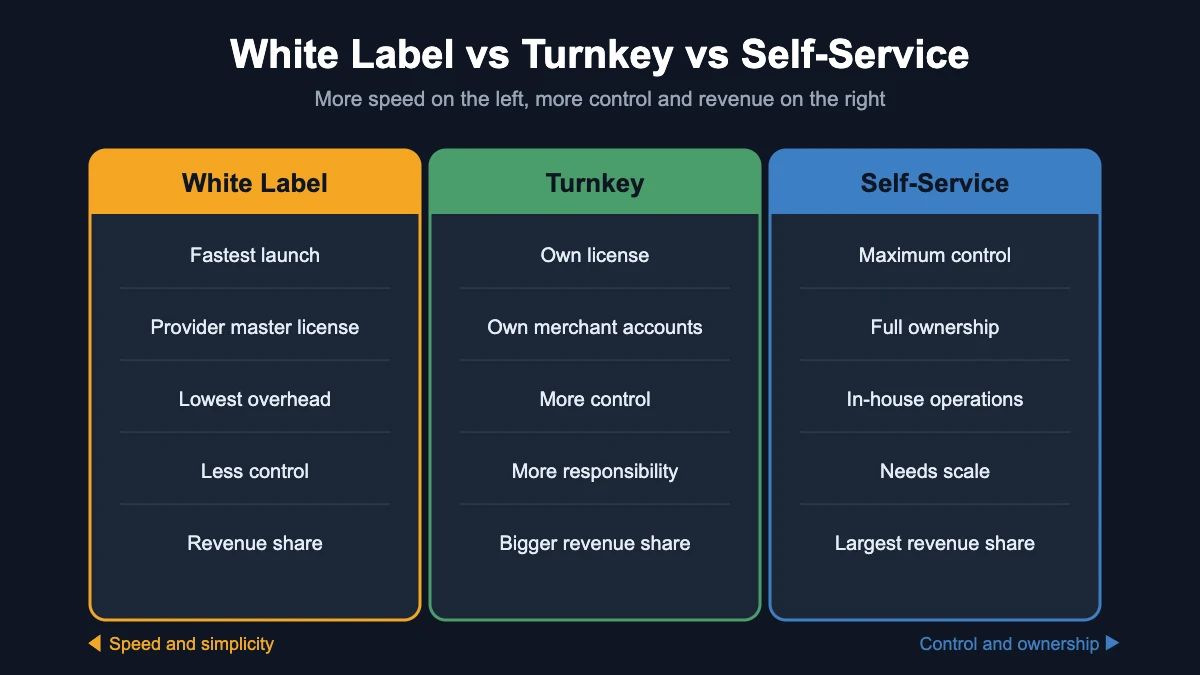
Casino platforms are offered under a few different commercial models. They all deliver similar technology, but they differ in how much of the licensing, payment, and operational burden the operator takes on, and therefore how much control and revenue the operator keeps.
White label is the fastest and lowest-overhead way to launch. The operator runs under the platform provider’s master gaming license and uses the provider’s payment processing, compliance setup, and often its customer support. A brand can be live in weeks rather than months, with very little upfront cost. The trade-off is control: the provider sets many of the rules, takes a share of revenue, and owns parts of the player relationship. White label suits entrepreneurs, affiliates, and media brands that want to monetize an audience quickly.
Turnkey sits in the middle. The operator receives a fully built casino but holds its own gaming license and merchant accounts. The provider supplies and maintains the technology, while the operator takes responsibility for compliance, payments, and the commercial side. This means more work but a larger share of revenue and far more control over the brand. Turnkey suits operators serious about building a long-term business.
Self-service is the most independent model. The operator licenses the platform technology and manages everything else in house: licensing, payment relationships, game contracts, marketing, and operations. This gives maximum control and the largest share of revenue, but it demands real scale and expertise. It is the natural choice for established operators running multiple brands.
There is no single best answer. A first-time operator monetizing an audience will almost always start with white label. A growing operator that wants control and better margins moves to turnkey. A large, multi-brand group standardizes on self-service. Many successful operators progress through these models over time.
Below are some of the most established casino platforms behind online casino brands today, with a summary of what each one does well. Every name links to a detailed breakdown of the provider.
Pragmatic Solutions is the full turnkey and managed-services platform from the team behind Pragmatic Play. It bundles a player account engine, CRM, wallet, and a fast, mobile-first front end, with deep access to a large game portfolio. One of the strongest all-in-one choices for operators wanting a modern stack backed by a major content supplier.
SoftSwiss is one of the best-known platforms for both fiat and crypto casinos. Since 2012 it has supplied operators with game aggregation, a flexible casino platform, jackpot systems, and a robust back office. Its standout strength is cryptocurrency, handled natively with wallets, conversion, and compliance built in.
EveryMatrix is a highly modular platform covering casino, sportsbook, payments, and content aggregation. Operators can take the entire stack or pick individual components, which makes it popular with both new brands and established operators scaling up.
Established in 2005, SkillOnNet provides white label, turnkey, and software solutions to a long list of well-known casino brands, with broad game integration and a stable platform.
Aspire Global is a complete B2B iGaming platform offering managed services, player account management, and a large content library, widely used for white label launches thanks to its end-to-end approach.
RealTime Gaming is a long-running platform focused on casino software, with downloadable and instant-play products, strong mobile compatibility, and solid back-end tools.
SBTech is an award-winning sportsbook and iGaming platform, with a high-quality in-house sportsbook sitting alongside the casino, ideal for brands wanting betting and casino under one roof.
Soft2Bet delivers white label casino and sportsbook solutions with a heavy focus on gamification and player engagement, popular with operators that prioritize retention.
BetConstruct offers a broad platform spanning casino, sportsbook, and many value-added products, suited to operators wanting a single provider for a large, multi-product operation.
Digitain is built around a powerful sportsbook and casino offering with extensive market and payment coverage, often chosen for emerging and newly regulated markets.
Other established providers with full reviews on CasinoDaddy include White Hat Gaming, Gaming Innovation Group, Slotegrator, SoftGamings, ProgressPlay, Delasport, and GamingSoft.
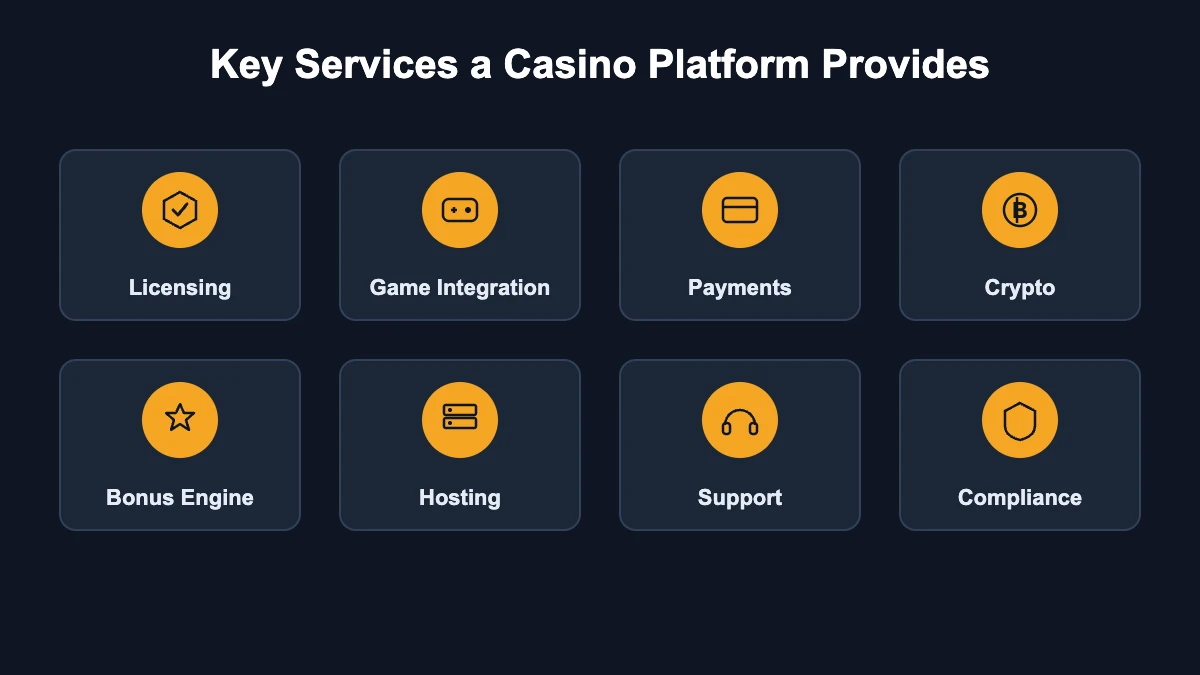
A platform is more than launch software. The provider delivers a set of ongoing services that keep a casino compliant, competitive, and running smoothly. The most important ones are below.
Gambling regulation keeps getting stricter, and licensing is one of the hardest parts of running a casino. White label platforms typically operate under their own master license and can support licensing or certification across many jurisdictions, including Malta, the UK, and a range of other regulated markets. This lets a brand go live legally without securing its own license first.
Visual design shapes a player’s first impression and long-term loyalty. Platforms usually offer customizable templates and branding so each casino looks distinct rather than a clone of the next. Strong design is part of the package, though it works alongside game choice and bonuses to keep players engaged.
Most play now happens on phones, so platforms deliver responsive or app-based experiences optimized for smaller screens. A well-built mobile version keeps navigation, deposits, and gameplay smooth on any device.
Through game aggregation, a platform connects a casino to hundreds or thousands of titles from many studios via a single integration. This saves the operator from negotiating and integrating each provider individually and keeps the library fresh as new games release.
Bonuses are one of the main levers an operator has to acquire and retain players, so a platform’s bonus engine is one of its most important components. A good engine lets the operator build and automate welcome packages, deposit matches, free spins, reload offers, cashback, and tiered loyalty schemes, with full control over wagering requirements, eligible games, and player segments, ideally without developer involvement. Increasingly, platforms also bundle gamification, missions, tournaments, leaderboards, and prize wheels, that keep players engaged beyond a simple deposit bonus.
Slots are the core of almost every online casino. Through game aggregation, a platform gives an operator instant access to large libraries from many studios via a single integration. A new casino can launch with thousands of titles on day one, and new releases appear automatically. Beyond the headline count, what matters is the mix: proven classics, the latest high-volatility releases, jackpot games, and titles tuned for specific markets.
Live dealer games recreate the atmosphere of a land-based casino through HD streaming and real human dealers. Platforms bundle live content, live blackjack, roulette, baccarat, and game shows, from the leading live studios, so operators can offer a full live lobby without negotiating studio deals individually. Because live casino is latency-sensitive, smooth streaming and reliable wallet updates are what keep players at the table.
Many platforms add a sportsbook, either built in-house or integrated from a specialist provider. Offering casino and betting together under a single account and wallet widens a brand’s audience and increases the value of each player. Platforms like SBTech and BetConstruct are particularly known for the strength of their sportsbook.
Cryptocurrency support has gone from a niche feature to a genuine differentiator, especially for casinos targeting players who value speed and privacy. A platform with strong crypto handling lets a casino accept Bitcoin and a range of altcoins, with built-in wallets, automatic conversion, and the compliance tooling regulators expect. SoftSwiss is the best-known platform here. Good integration handles volatile exchange rates, lets players hold balances in crypto or convert to fiat, and keeps deposits and withdrawals fast.
For most casinos, traditional payments are still the backbone. A platform’s payment layer connects the casino to debit and credit cards, e-wallets, instant bank transfer, prepaid options, and local methods, routing each transaction down the best path and keeping approval rates high while blocking fraud. Built in are the essential controls: KYC verification, transaction monitoring, and reconciliation, all mandatory in regulated markets.
Behind every casino is the infrastructure that keeps it fast and available. Platforms typically include managed, scalable hosting that absorbs traffic spikes without slowing down, with security hardening, regular backups, DDoS protection, and uptime monitoring as standard. The appeal is not having to build and staff a reliability operation.
Compliance is woven through everything a platform does. Responsible gambling tools, deposit limits, time-outs, and self-exclusion, are built in, along with geo-blocking and detailed reporting for regulators. Data protection and encryption protect player information, and audit trails record activity. A platform that handles this well lets an operator meet strict regulatory requirements without building a compliance system from scratch.
Getting players to a casino is as important as the casino itself. Many platforms provide marketing, affiliate, and SEO support, including affiliate tracking and attribution, integrations with marketing tools, and the analytics needed to measure which campaigns pay off. For white label operators, strong affiliate tooling is essential, since affiliates are often the main acquisition channel.
The back office is the operator’s control center for players, payments, bonuses, risk, and reporting. Clear dashboards, flexible reporting, and granular controls let a small team manage a large operation. Many platforms also offer managed customer support, so players get help around the clock.
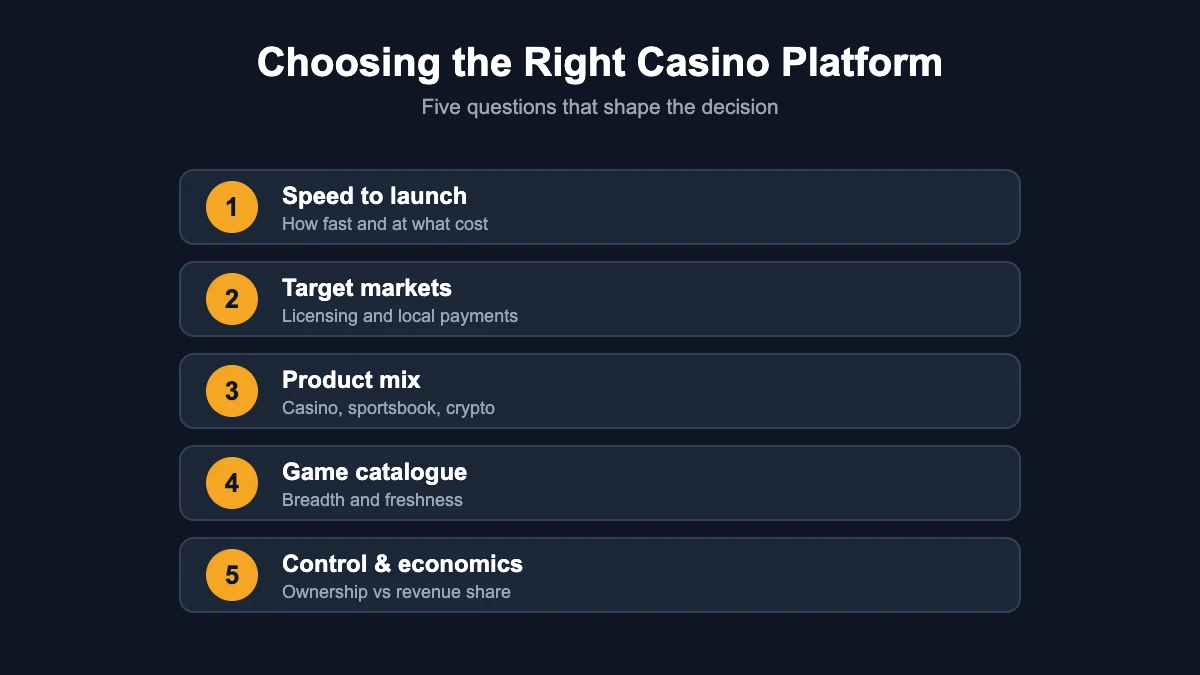
With so many capable platforms available, the right choice comes down to matching a provider’s strengths to the operator’s goals. A few questions cut through most of the decision:
The smartest approach is to shortlist a few platforms that fit the brand’s stage, read detailed reviews of each, and compare them on licensing, content, payments, and commercial terms before committing.
Casino platforms are the invisible engines behind the online gambling industry. They turn a years-long, capital-intensive build into a manageable launch, and keep casinos compliant, secure, and competitive long after they go live. Whether an operator chooses white label for speed, turnkey for balance, or self-service for control, the platform is what makes a modern online casino possible.
A casino platform is the technology and service package that powers an online casino, including the player account system, wallet, game library, payments, and back office. Operators license a platform instead of building all of this themselves.
A white label casino runs on a provider’s platform and master gaming license. The operator handles branding and marketing while the provider manages licensing, payments, and much of the day-to-day operation. It is the fastest and lowest-overhead way to launch a casino.
With white label, the operator uses the provider’s license and payment setup. With turnkey, the operator gets a fully built casino but holds its own gaming license and merchant accounts, giving more control and a larger share of revenue in exchange for more responsibility.
Well-known platforms include Pragmatic Solutions, SoftSwiss, EveryMatrix, SkillOnNet, Aspire Global, SBTech, RealTime Gaming, Soft2Bet, BetConstruct, and Digitain. The best choice depends on the operator’s goals, target markets, and whether a sportsbook is needed.
Many do. SoftSwiss in particular is known for strong crypto support, and a growing number of platforms offer built-in Bitcoin and altcoin handling alongside traditional card and e-wallet payments.
Typical services cover licensing support, player account management, game and slot aggregation, live casino, bonus systems, payments, hosting, marketing and SEO, plus back office tools and customer support.
The Author
The Author
Site Admin